
Recallab › Blog › Hepatitis B serology for NEET PG: reading HBsAg, anti-HBc and anti-HBs
Hepatitis B serology for NEET PG: reading HBsAg, anti-HBc and anti-HBs
Hepatitis B serology is a favourite NEET PG decoder. Three markers do most of the work, and each answers one question: is the virus here now, has this person ever met it, and are they protected?
Register to practise NEET PG microbiology questions →Free account, no card needed.
Three markers, three questions
HBsAg, the surface antigen, means the virus is present now. Anti-HBc, the core antibody, means the person has met the virus at some time; it appears with infection and lasts for life. Anti-HBs, the surface antibody, means immunity, from recovery or from vaccination.
Two refinements finish the decoder. IgM core antibody dates an infection as recent, while IgG core antibody is the long-lasting one. And surface antigen persisting beyond six months defines chronic infection.
The NEET PG hepatitis B decoder
| Pattern | HBsAg | Anti-HBc | Anti-HBs |
|---|---|---|---|
| Acute | + | IgM + | − |
| Window period | − | IgM + | − |
| Chronic | + over 6 months | IgG + | − |
| Recovered | − | IgG + | + |
| Vaccinated | − | − | + |
In the table, + means the marker is present and − means it is absent.
The window period sits between the surface antigen clearing and the surface antibody appearing. Both surface markers are negative then, and IgM core antibody is the key marker that proves the infection.
Try it: say it once before the questions: surface antibody alone means vaccinated; any core antibody means the person has met the virus.
The first marker
Recallab example 1 · the marker blood banks screen for
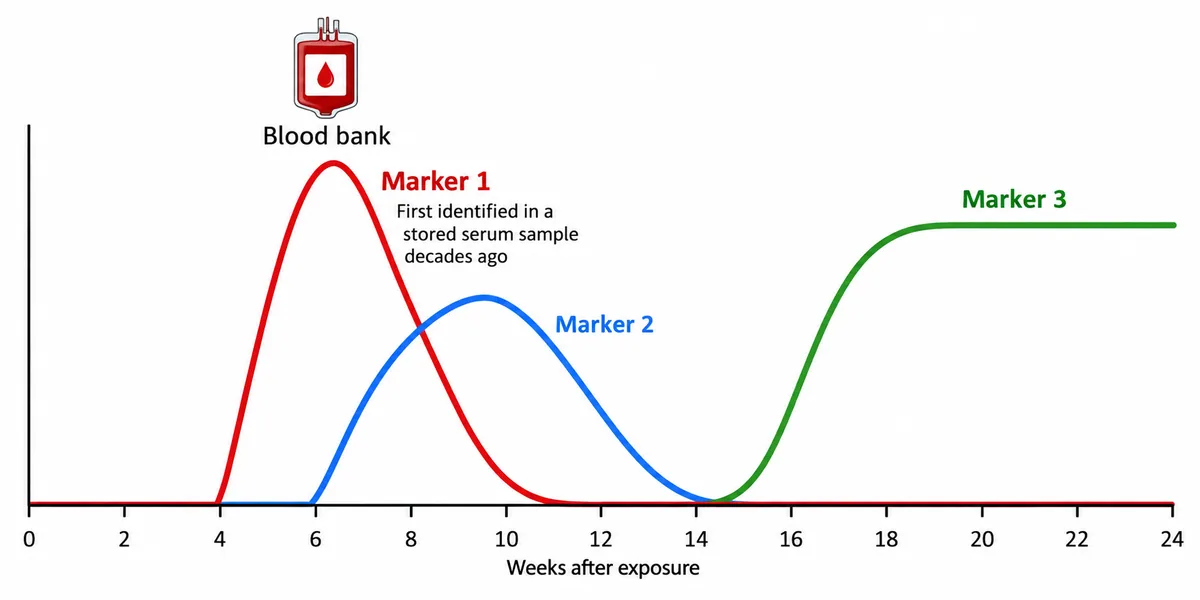
A timeline is drawn in the figure across the weeks after hepatitis B exposure, with three markers rising in sequence and a blood bank icon marking only one of them. What is that marker?
Look first: find the marker that rises first, before either antibody.
 View larger ↗⤢ Tap to enlarge
- AHepatitis B surface antigen
- BAntibody to surface antigen
- CIgM antibody to core antigen
- DHepatitis B e antigen
Show the answer and explanation
Answer: A. Hepatitis B surface antigen
A. Hepatitis B surface antigen. It was once called the Australia antigen, after the serum sample it was first isolated from. It rises within weeks of exposure, before either antibody appears, so testing donated blood for it catches an infected donation in the earliest infectious period. Waiting for an antibody would miss donors who are already infectious.
Why the other options lose: antibody to surface antigen (B) rises only once the antigen has cleared, so it would miss every donation still carrying the virus. IgM core antibody (C) is the earliest antibody, but it still rises after the antigen. Hepatitis B e antigen (D) marks active replication; it appears after the surface antigen and is not the screening test.
Recallab question 57894 · Microbiology › Hepatitis Viruses · reference: Jawetz, Melnick & Adelberg's Medical Microbiology
Acute or chronic
Recallab example 2 · coinfection or superinfection
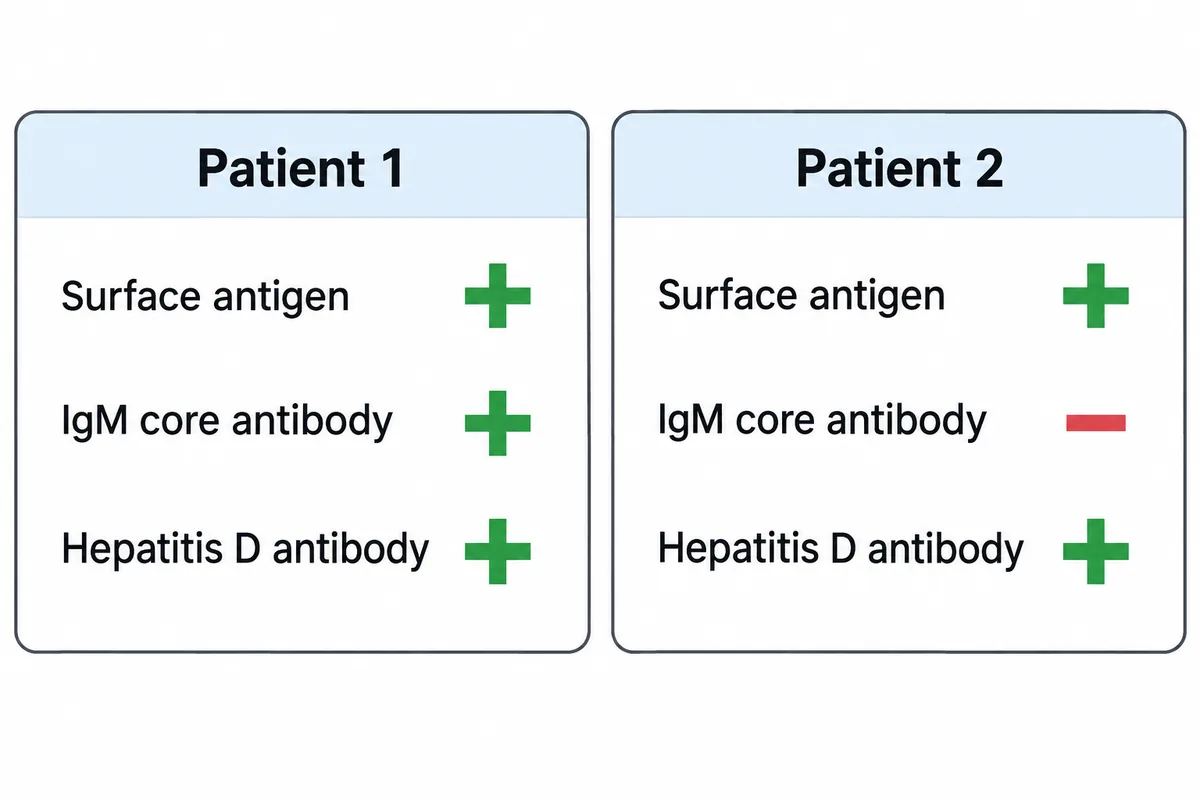
Two patients with a positive hepatitis D antibody test are drawn in the figure with their hepatitis B marker panels. Patient 2 has a hepatitis D superinfection on top of chronic hepatitis B, while patient 1 has a coinfection. Which marker separates them?
Look first: both have surface antigen; ask which marker tells you how old the hepatitis B is.
 View larger ↗⤢ Tap to enlarge
- ASurface antibody
- BIgM core antibody
- CHepatitis D antibody
- DSurface antigen
Show the answer and explanation
Answer: B. IgM core antibody
B. IgM core antibody. It is high-titre in acute hepatitis B and absent or low-titre in a carrier. Patient 1 has a positive IgM core antibody, so the hepatitis B is fresh and the hepatitis D arrived with it: a coinfection. Patient 2 is surface-antigen positive with a negative IgM core antibody, so the hepatitis B is chronic, and hepatitis D added on top is a superinfection. Hepatitis D can only replicate where hepatitis B surface antigen is being made.
Why the other options lose: surface antibody (A) marks recovery or vaccination; it does not date an infection that is still present. Hepatitis D antibody (C) and surface antigen (D) are positive in both patients, so neither separates them.
Recallab question 56494 · Microbiology › Hepatitis Viruses · reference: Jawetz, Melnick & Adelberg's Medical Microbiology
Reading a whole household
Recallab example 3 · a carrier at home
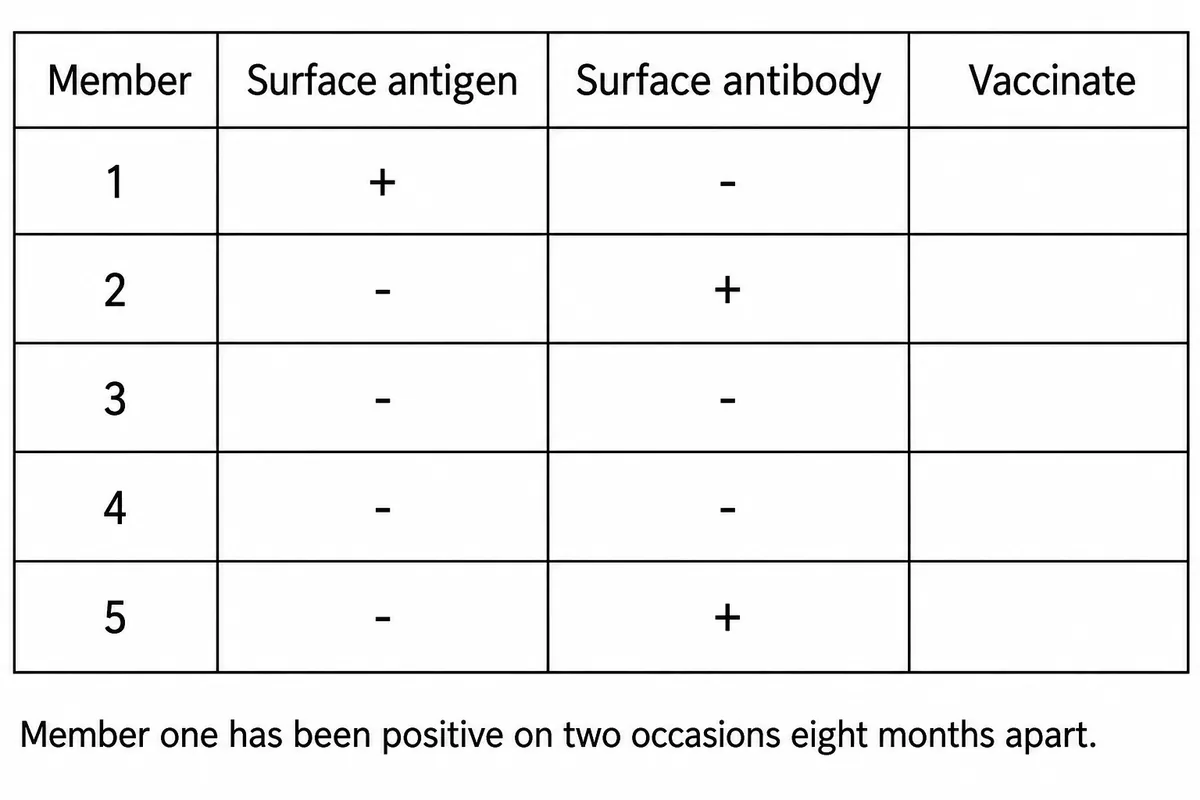
A man's hepatitis B surface antigen has been positive on two occasions eight months apart, and he lives with four other adults. All five have now been tested. The figure draws each person's marker panel beside an empty column. Who should be vaccinated?
Look first: read each row: antigen means infected, antibody means protected, neither means susceptible.
 View larger ↗⤢ Tap to enlarge
- ANobody in the house
- BAll four household contacts
- CMembers with neither marker
- DEverybody in the house
Show the answer and explanation
Answer: C. Members with neither marker
C. Members with neither marker. Surface antigen positive twice, eight months apart, makes the man a chronic carrier, so the household is exposed every day. Surface antigen in a row means that person is already infected, and a vaccine offers them nothing. Surface antibody means that person is already protected. A row with neither marker is a susceptible person living with a carrier, and vaccinating them is what lowers the household's risk.
Why the other options lose: nobody (A) leaves the susceptible members exposed for life. All four contacts (B) would vaccinate two people whose surface antibody already protects them. Everybody (D) adds doses for the infected and the immune that change nobody's risk.
Recallab question 59594 · Microbiology › Hepatitis Viruses · reference: Park's Textbook of Preventive and Social Medicine
Practise more NEET PG questions →, or watch one-minute teaching shorts in Scroll inside the app.
Why candidates use Recallab
- Built towards 22,000 — a batch at a time
- Illustrations drawn for the question
- Every option explained, not just the right one
- AI study tools that are live today
- Start free, today
Or see the plans, or try a timed mock section.
Register to practise NEET PG microbiology questionsFree account, no card needed. Practise with every option explained and a reference on every question.Drawn from questions #57894, #56494, #59594, #50233, #61700, #54624 in the Recallab bank, each with its own verified answer and current-edition reference. Last reviewed 29 October 2026.