
Recallab › Question bank › Pathology › Blood WBC & Lymphoma › #50001
Follicular lymphoma
A 58-year-old man reports painless neck and axillary swellings that have waxed and waned over 18 months without fever or weight loss. Excision biopsy shows effacement of nodal architecture by closely packed follicles of small cleaved cells mixed with larger cells. The cells are CD20 positive, CD10 positive and BCL2 positive. Which translocation is most likely?
- correctA. t(14;18)(q32;q21)
- B. t(11;14)(q13;q32)
- C. t(8;14)(q24;q32)
- D. t(11;18)(q21;q21)
Explanation
Key fact
Follicular lymphoma is t(14;18), which moves BCL2 next to the immunoglobulin heavy chain promoter and blocks apoptosis.
t(14;18)(q32;q21). A CD10-positive follicular pattern that is also BCL2 positive is follicular lymphoma, and BCL2 is switched on by this translocation.
Why
The nodular pattern of small cleaved centrocytes and larger centroblasts is germinal-centre architecture.
CD10 and BCL6 confirm a germinal-centre origin.
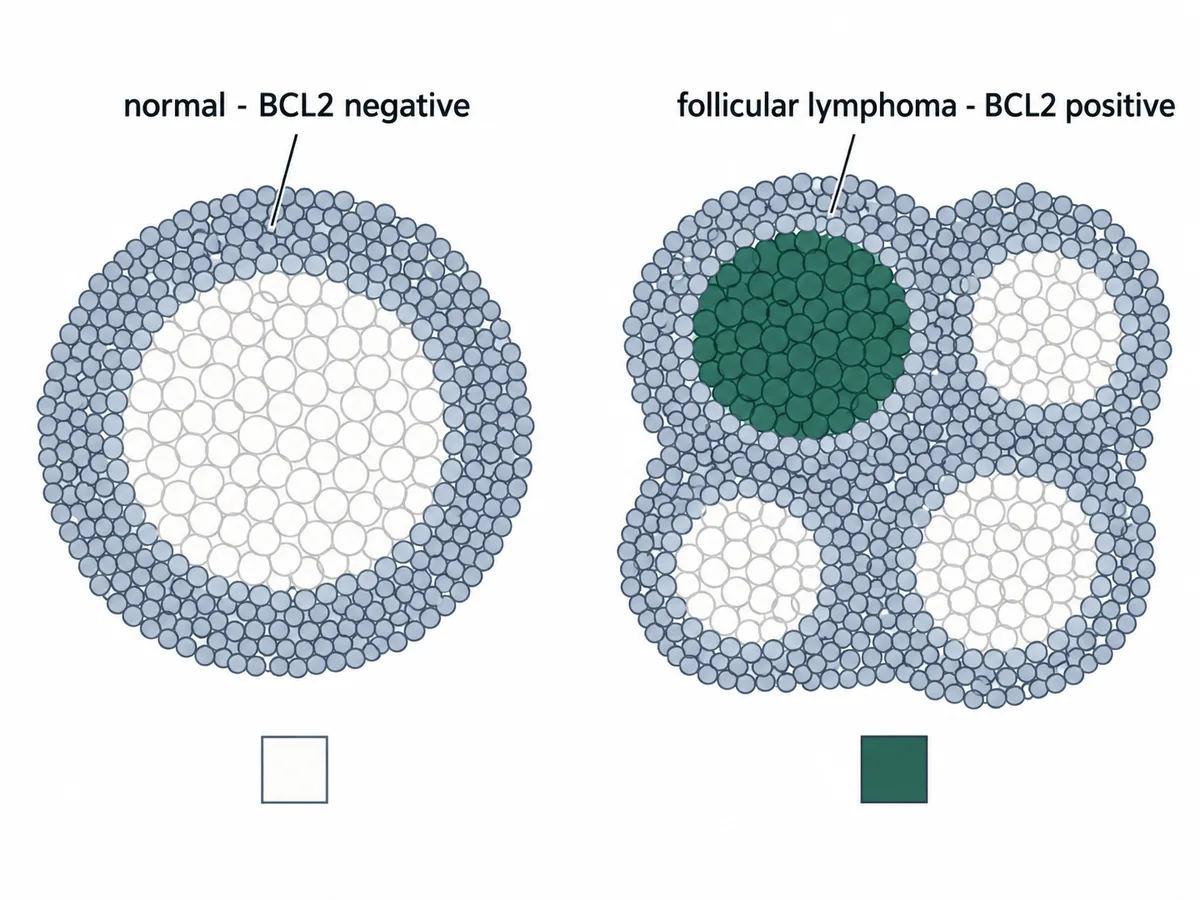
BCL2 is the discriminator. A normal germinal centre is BCL2 negative.
t(14;18) puts BCL2 under the IgH promoter, so the cells stop dying on schedule.
A slow, waxing and waning lymphadenopathy fits an anti-apoptotic, not a proliferative, lymphoma.
The four translocations that carry the lymphoma questions
| Translocation | Gene | Lymphoma |
|---|---|---|
| t(14;18) | BCL2 | Follicular |
| t(11;14) | CCND1 (cyclin D1) | Mantle cell |
| t(8;14) | MYC | Burkitt |
| t(11;18) | API2-MALT1 | MALT (gastric) |
BCL2 in a follicle means cancer
Why not the others
- B. t(11;14)(q13;q32) — is mantle cell lymphoma. Those cells are cyclin D1 positive and CD5 positive but CD10 negative, the reverse of this case.
- C. t(8;14)(q24;q32) — is Burkitt lymphoma. It is CD10 positive too, but the biopsy would show a starry-sky sheet with a near-100% Ki-67, not slow nodules.
- D. t(11;18)(q21;q21) — is extranodal marginal zone (MALT) lymphoma, typically gastric and driven by *Helicobacter pylori*, not nodal follicles.
Remember
BCL2 in a follicle means cancer. Normal germinal centres are BCL2 negative, so staining positive inside a follicular pattern is the whole answer.
Go deeper
Grading counts centroblasts per high-power field; grade 3B behaves like a diffuse large B-cell lymphoma and is treated as one.
Transformation to diffuse large B-cell lymphoma occurs in a minority and is suggested by one node suddenly outgrowing the rest.
Robbins, Cotran & Kumar Pathologic Basis of Disease, 11th ed. (Elsevier, 2025).