
Recallab › Question bank › Physiology › Endocrinology › #50018
Central diabetes insipidus
A 28-year-old man is recovering from a severe head injury. He is passing more than 8 litres of dilute urine a day and is constantly thirsty. Serum sodium is 152 mEq/L, serum osmolality 310 mOsm/kg and urine osmolality 90 mOsm/kg. Blood glucose is normal. Damage to which pair of hypothalamic nuclei best explains this?
- correctA. Supraoptic and paraventricular
- B. Suprachiasmatic and arcuate
- C. Ventromedial and dorsomedial
- D. Posterior and mammillary
Explanation
Key fact
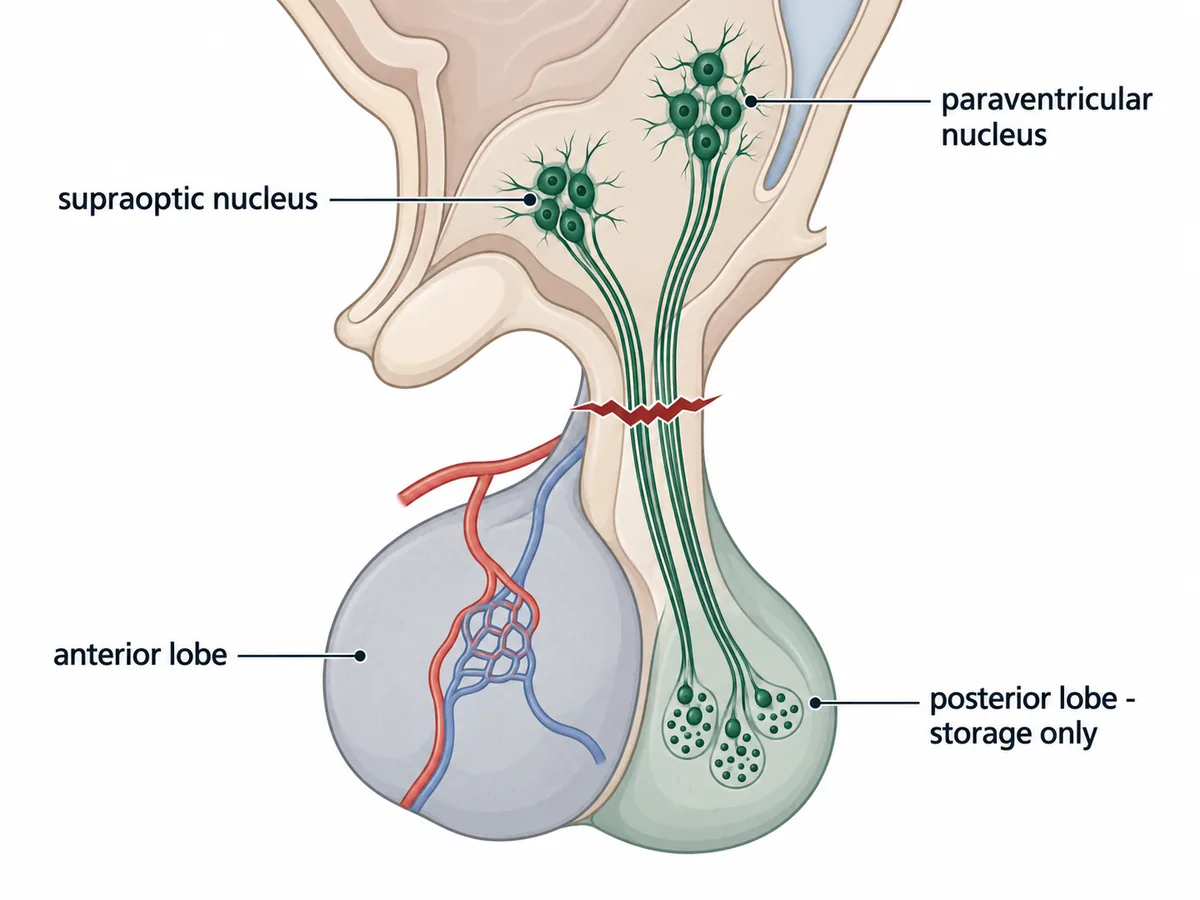
Vasopressin is made in the supraoptic and paraventricular nuclei and merely stored in the posterior pituitary - so hypothalamic damage causes central diabetes insipidus.
Supraoptic and paraventricular. These are the magnocellular nuclei that synthesise vasopressin, and losing them gives dilute urine with concentrated blood.
How it happens
- Dilute urine with hypernatraemia means water is being lost against need.
- Normal glucose excludes an osmotic diuresis.
- Urine osmolality of 90 against a serum of 310 means the collecting duct is not reabsorbing water.
- That points to absent vasopressin action.
- Vasopressin is synthesised in the supraoptic and paraventricular nuclei.
- Their axons run down the pituitary stalk, which trauma commonly shears.
Made above, stored below
Why not the others
- B. Suprachiasmatic and arcuate — run the circadian clock and the GnRH/growth-hormone axis. Neither controls water.
- C. Ventromedial and dorsomedial — govern satiety and feeding. Damage causes hyperphagia and obesity, not polyuria.
- D. Posterior and mammillary — handle thermoregulation and memory circuits. The posterior pituitary stores vasopressin, but the posterior hypothalamic nucleus does not make it.
Remember
SON and PVN make it; the posterior pituitary only stores it. That is why a stalk or hypothalamic injury, not a pituitary adenoma, causes diabetes insipidus.
Go deeper
Desmopressin separates the two forms: urine concentrates in central diabetes insipidus and does not in the nephrogenic type.
Post-traumatic diabetes insipidus is often triphasic - an initial polyuria, a transient antidiuretic phase as stored hormone leaks out, then permanent deficiency.
Ganong's Review of Medical Physiology, 27th ed. (McGraw Hill, 2025); Harrison's Principles of Internal Medicine, 22nd ed. (McGraw Hill, 2025).