
Recallab › Question bank › Biochemistry › Nutrition › #50021
Riboflavin
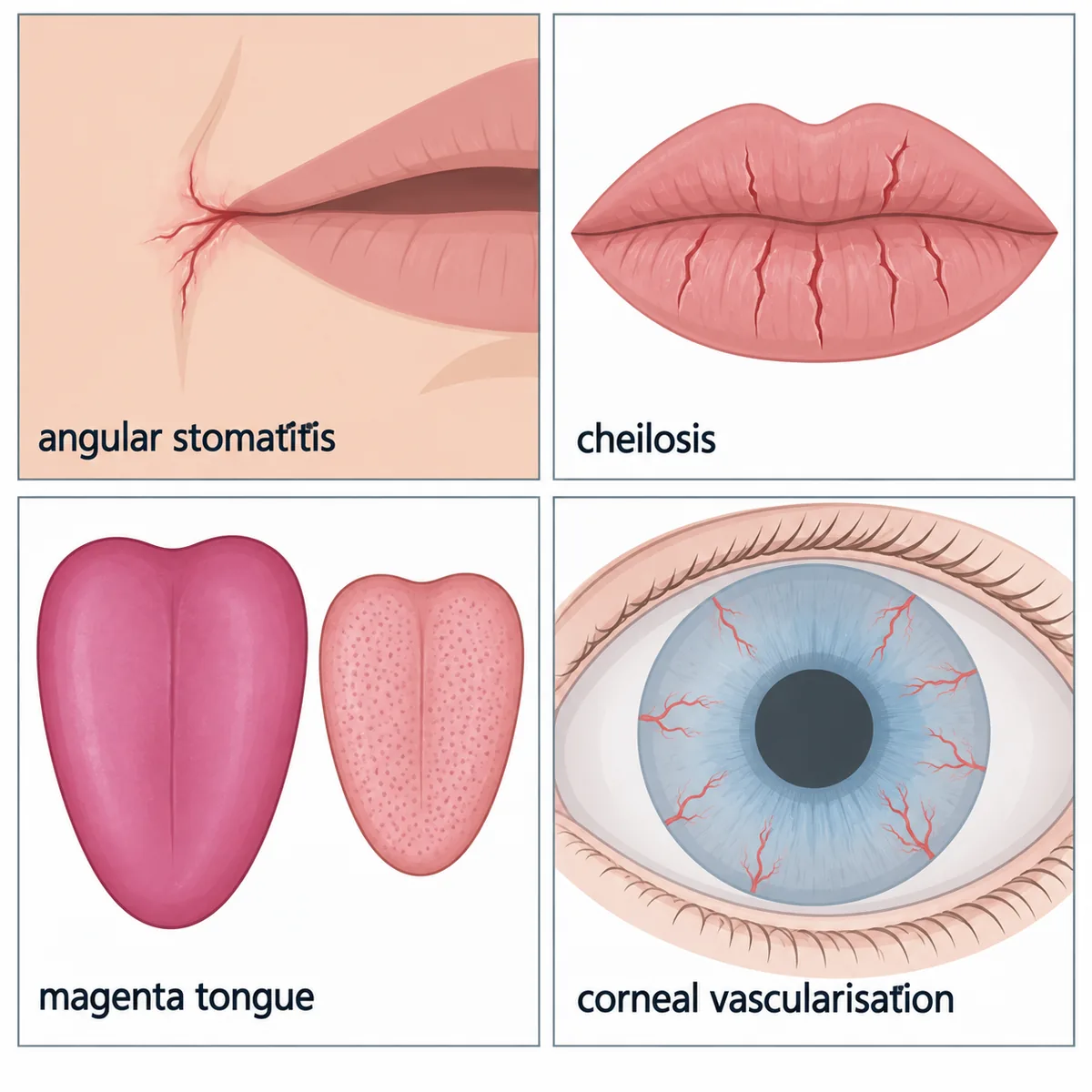
A 30-year-old woman on a restricted diet has angular stomatitis, cheilosis, a smooth magenta tongue and fine vascularisation of the cornea. Which laboratory test best confirms the suspected deficiency?
- correctA. Erythrocyte glutathione reductase activation coefficient
- B. Erythrocyte transketolase activity
- C. Urinary N-methylnicotinamide excretion
- D. Plasma pyridoxal phosphate
Explanation
Key fact
Riboflavin status is measured by the erythrocyte glutathione reductase activation coefficient - the enzyme is FAD-dependent, so it responds to added FAD.
Erythrocyte glutathione reductase activation coefficient. The clinical picture is riboflavin deficiency, and this is its functional assay.
Why
Angular stomatitis, cheilosis, magenta glossitis and corneal vascularisation are the riboflavin tetrad.
Riboflavin becomes FMN and FAD, the flavin coenzymes.
Glutathione reductase needs FAD, so it works poorly when riboflavin is short.
Adding FAD to the sample restores its activity, and the ratio is the coefficient.
A high coefficient means the enzyme was starved of cofactor.
The functional assay belongs to the vitamin, not the symptom
| Vitamin | Coenzyme | Functional assay |
|---|---|---|
| Riboflavin (B2) | FAD, FMN | Erythrocyte glutathione reductase |
| Thiamine (B1) | TPP | Erythrocyte transketolase |
| Niacin (B3) | NAD, NADP | Urinary N-methylnicotinamide |
| Pyridoxine (B6) | PLP | Plasma pyridoxal phosphate |
Four places at once
Why not the others
- B. Erythrocyte transketolase activity — is the thiamine assay. Thiamine deficiency gives beriberi or Wernicke's, not cheilosis.
- C. Urinary N-methylnicotinamide — is the niacin assay. Pellagra gives a photosensitive dermatitis, diarrhoea and dementia.
- D. Plasma pyridoxal phosphate — measures B6, whose deficiency causes a peripheral neuropathy and sideroblastic anaemia.
Remember
Riboflavin is the flavin, and flavins run reductases. Glutathione reductase is the one you can measure in a red cell.
Go deeper
Riboflavin is destroyed by light, which is why milk in clear bottles loses it and why phototherapy can precipitate deficiency in a neonate.
It is rarely deficient alone; a diet short of riboflavin is usually short of the other B vitamins too.
Harper's Illustrated Biochemistry, 33rd ed. (McGraw Hill, 2025); Lippincott Illustrated Reviews: Biochemistry, 9th ed. (Wolters Kluwer, 2025).