
Recallab › Question bank › Pathology › #50030
Mycosis fungoides
A 56-year-old man has had scaly, slightly itchy reddish-brown patches on his buttocks and thighs for six years, treated as eczema without lasting benefit. Skin biopsy shows atypical lymphocytes with cerebriform nuclei infiltrating the epidermis and gathering in small intraepidermal clusters. What is the diagnosis?
- correctA. Mycosis fungoides
- B. Chronic plaque psoriasis
- C. Nummular eczema
- D. Primary cutaneous B-cell lymphoma
Explanation
Key fact
Epidermotropism with Pautrier microabscesses is mycosis fungoides - a CD4-positive T-cell lymphoma that spends years pretending to be eczema.
Mycosis fungoides. Cerebriform lymphocytes climbing into the epidermis and clustering there are diagnostic; no inflammatory dermatosis does that.
Why
Years of 'eczema' in sun-protected sites that never fully clears is the classic history.
The buttocks and thighs are the typical bathing-trunk distribution.
Cerebriform nuclei are the convoluted nuclei of neoplastic CD4 T cells.
Their migration into the epidermis is epidermotropism.
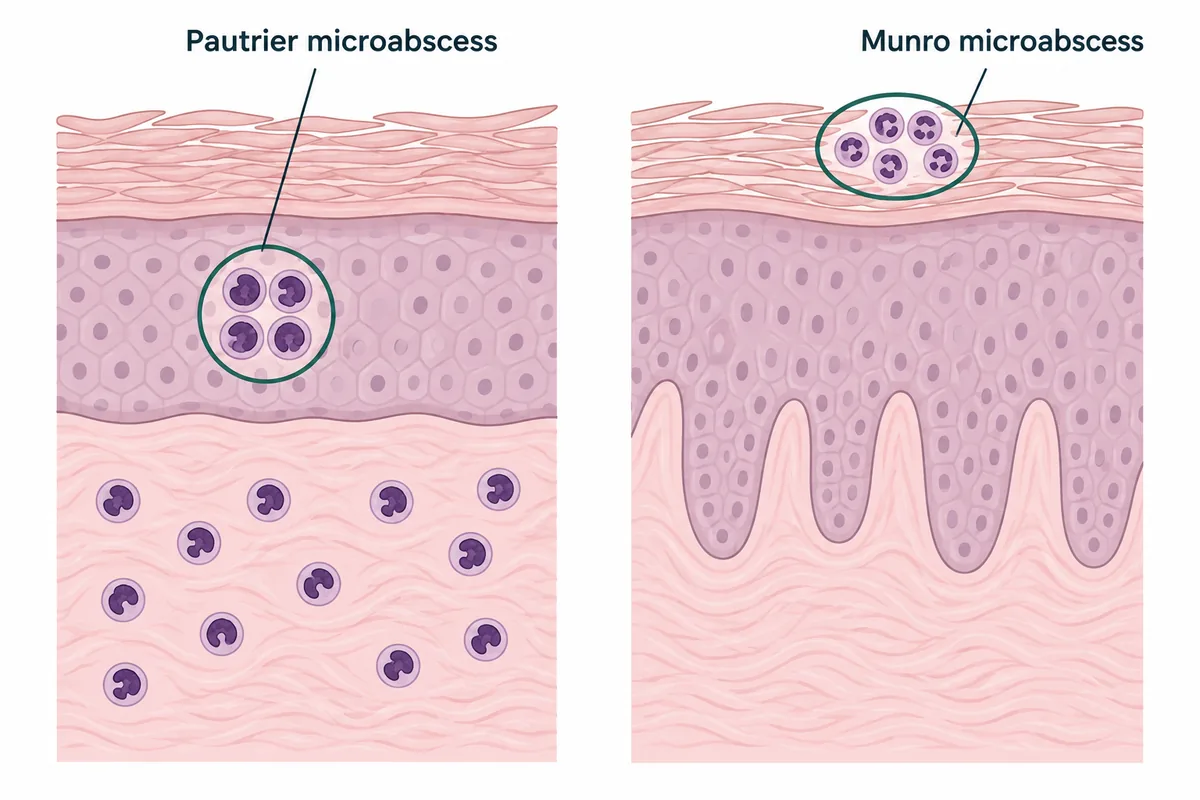
The intraepidermal clusters are Pautrier microabscesses.
Depth of the cluster is the diagnosis
Why not the others
- B. Chronic plaque psoriasis — shows parakeratosis, acanthosis with elongated rete ridges and neutrophils in Munro microabscesses, not atypical lymphocytes.
- C. Nummular eczema — shows spongiosis with a mixed dermal infiltrate. The lymphocytes are normal in appearance and do not cluster in the epidermis.
- D. Primary cutaneous B-cell lymphoma — forms nodules and tumours in the dermis, spares the epidermis, and is CD20 positive.
Remember
Pautrier is a pile of T cells in the epidermis; Munro is a pile of neutrophils. One is lymphoma, the other psoriasis.
Go deeper
Sezary syndrome is the leukaemic form: erythroderma, lymphadenopathy and circulating Sezary cells.
Early disease is treated on the skin - topical steroids, phototherapy, topical chemotherapy - and behaves indolently for decades.
Robbins, Cotran & Kumar Pathologic Basis of Disease, 11th ed. (Elsevier, 2025); Fitzpatrick's Dermatology, 9th ed. (McGraw Hill, 2019).