
Recallab › Question bank › Social & Preventive Medicine › Epidemiology › #50045
Retrospective cohort
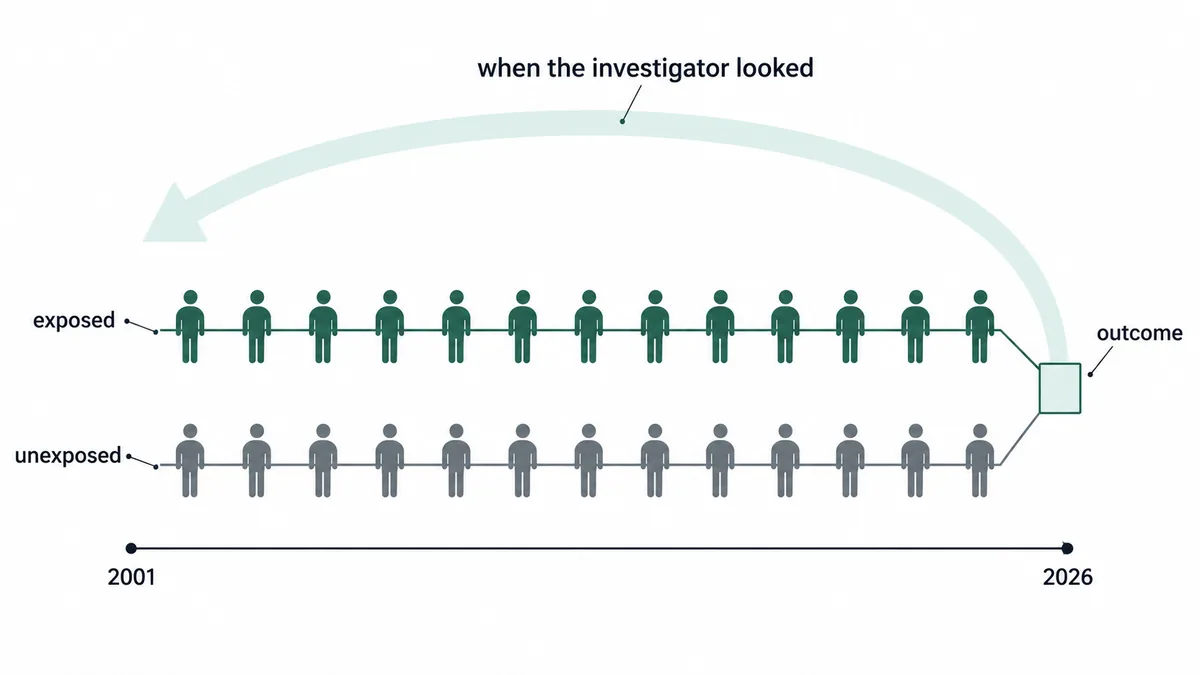
In 2026 an investigator opens the personnel records of a dye factory, identifies every worker employed in the aniline unit in 2001 and every office worker employed the same year, and then searches the cancer registry to see who developed bladder cancer between 2001 and 2026. What is this study design?
- correctA. Retrospective cohort study
- B. Case-control study
- C. Prospective cohort study
- D. Nested case-control study
Explanation
Key fact
A cohort is defined by exposure, whenever it is assembled. Looking backwards through records does not make a study case-control.
Retrospective cohort study. Groups were formed by exposure in 2001 and then followed forward through records to the outcome.
Why
Ask what defined the groups. Here it is exposure: aniline unit or office.
Outcome was unknown at the point the groups were formed.
The direction of reasoning therefore runs exposure to outcome - a cohort.
Only the investigator's calendar is backwards; the logic still runs forwards.
This design allows a genuine relative risk to be calculated.
What defines the groups is what names the design
| Design | Groups defined by | Measure |
|---|---|---|
| Cohort, prospective or retrospective | Exposure | Relative risk |
| Case-control | Outcome | Odds ratio |
| Cross-sectional | Neither - both measured at once | Prevalence |
| Ecological | Populations, not people | Correlation |
Forward logic, backward look
Why not the others
- B. Case-control study — would start from people with and without bladder cancer and look back at their exposure. Cancer status was not known at the start here.
- C. Prospective cohort study — would enrol workers today and wait years for the cancers. The exposure and the outcomes have both already happened.
- D. Nested case-control study — samples cases and matched controls from within an existing cohort. No such sampling was done - everyone was included.
Remember
Retrospective cohort is still a cohort. The clue is that nobody was chosen because they were ill.
Go deeper
The design is fast and cheap when good historical records exist, which is why it is the workhorse of occupational epidemiology.
Its weakness is that it inherits whatever the records happened to capture; exposure detail is often crude.
Park K. Park's Textbook of Preventive and Social Medicine, 28th ed. (Bhanot, 2025).