
Recallab › Question bank › Psychiatry › #50065
Delirium tremens
A 46-year-old man who drinks about half a bottle of spirits daily is admitted after a fracture. On the third day of admission he becomes disoriented and agitated, with a coarse tremor, drenching sweats, pulse 122 and a temperature of 38.1 degrees Celsius. He is frightened by insects he sees crawling on the bedsheets. What is the first-line pharmacological treatment?
- correctA. A benzodiazepine such as chlordiazepoxide or lorazepam
- B. Haloperidol alone
- C. Disulfiram
- D. Naltrexone
Explanation
Key fact
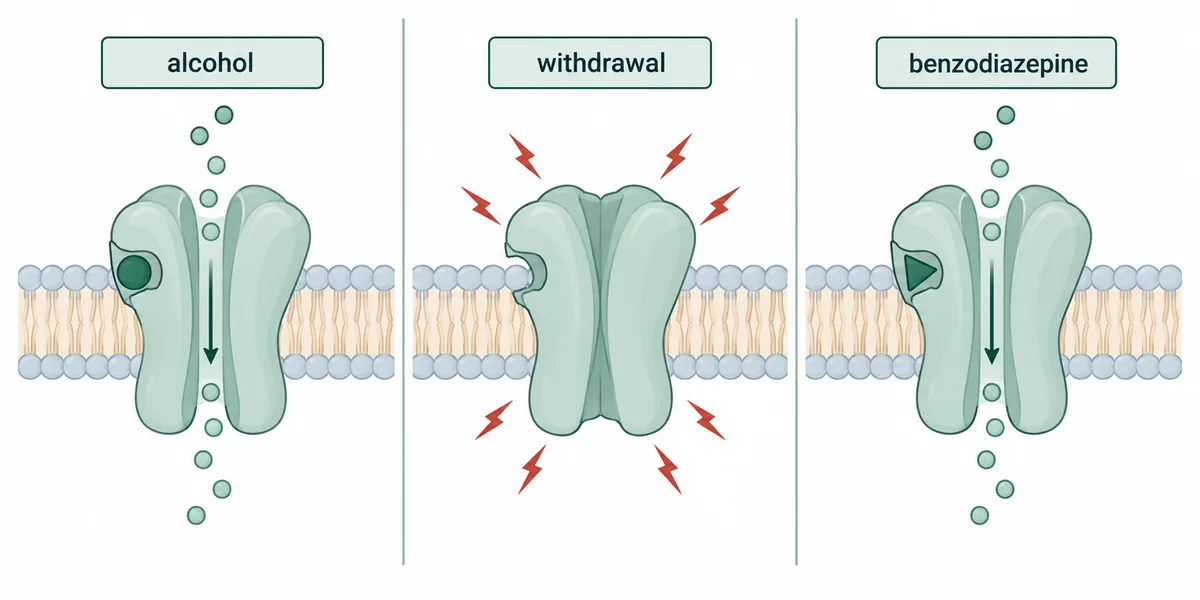
Benzodiazepines are the only drugs that reduce mortality in delirium tremens. They substitute for the alcohol at the same receptor.
A benzodiazepine. Alcohol and benzodiazepines act on the same GABA-A receptor, so a benzodiazepine replaces what has been withdrawn.
Why
Onset on the third day with autonomic overactivity and visual hallucinations is delirium tremens.
Chronic alcohol suppresses GABA transmission and upregulates glutamate.
Sudden withdrawal leaves unopposed excitation.
Benzodiazepines restore GABA inhibition and prevent seizures.
Give thiamine as well, and before any glucose, to prevent Wernicke's encephalopathy.
Same pocket, different key
Why not the others
- B. Haloperidol alone — lowers the seizure threshold and does not treat the underlying withdrawal. It is added only for hallucinations not controlled by adequate benzodiazepine.
- C. Disulfiram — is a deterrent used in maintained abstinence. Given during withdrawal it is useless and potentially dangerous.
- D. Naltrexone — reduces craving in relapse prevention. It has no role in acute withdrawal.
Remember
Delirium tremens still kills. Untreated mortality is around 15%, and benzodiazepines given early are what change that.
Go deeper
Chlordiazepoxide is preferred generally; lorazepam is safer in liver disease because it is glucuronidated and has no active metabolites.
Symptom-triggered dosing guided by a withdrawal scale uses less drug and shortens treatment compared with fixed schedules.
The sequence of withdrawal is tremor at 6 to 12 hours, seizures at 12 to 48, and delirium tremens at 48 to 96.
Kaplan & Sadock's Synopsis of Psychiatry, 12th ed. (Wolters Kluwer, 2022).