
Recallab › Question bank › Orthopaedics › #50075
Fat embolism syndrome
A 22-year-old man sustained a closed midshaft femoral fracture in a road accident and was placed in traction. Thirty-six hours later he becomes confused and breathless. Respiratory rate is 32, oxygen saturation 87% on air, and there is a fine petechial rash across the anterior chest, axillae and conjunctivae. What is the most likely diagnosis?
- correctA. Fat embolism syndrome
- B. Pulmonary thromboembolism
- C. Aspiration pneumonia
- D. Acute alcohol withdrawal
Explanation
Key fact
The petechial rash is the discriminator. Hypoxia plus confusion plus petechiae, 24 to 72 hours after a long bone fracture, is fat embolism syndrome.
Fat embolism syndrome. The triad of respiratory failure, cerebral dysfunction and a petechial rash at 36 hours is close to diagnostic.
Why
The interval is right: symptoms begin 24 to 72 hours after the fracture.
Marrow fat enters torn venous sinusoids and reaches the lungs.
It is hydrolysed to free fatty acids, which injure the alveolar capillary membrane.
Hypoxia and confusion follow from lung and cerebral involvement.
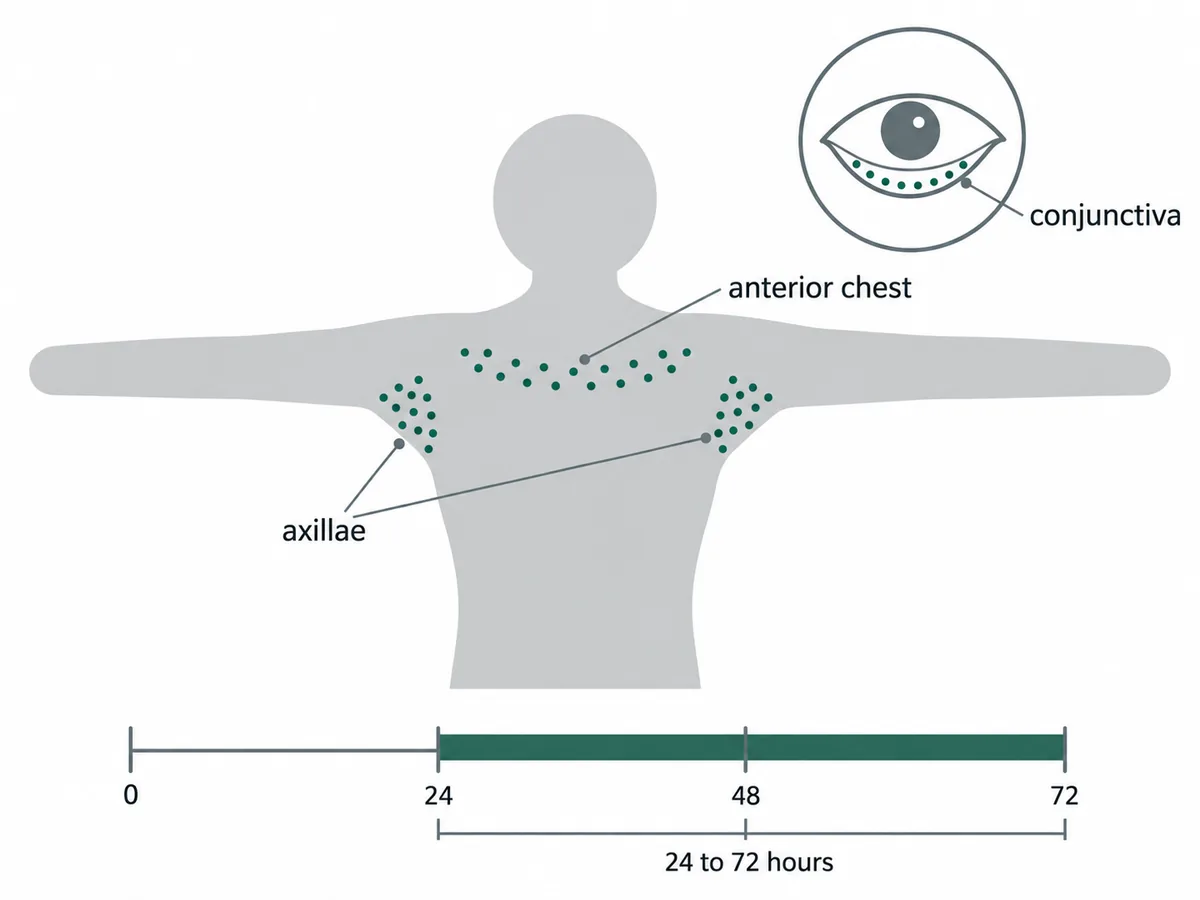
The petechiae appear in the upper body - axillae, conjunctivae, chest - and are transient.
Upper body only, and only between 24 and 72 hours
Why not the others
- B. Pulmonary thromboembolism — typically occurs later, causes pleuritic pain with a normal conscious level, and does not cause a petechial rash.
- C. Aspiration pneumonia — gives fever, purulent sputum and focal consolidation, with no petechiae and no early confusion.
- D. Acute alcohol withdrawal — causes confusion and autonomic overactivity but does not cause hypoxia with petechiae.
Remember
Look in the axilla and at the conjunctiva. The rash fades within a day, so it is missed if it is not looked for early.
Go deeper
Gurd's criteria formalise the diagnosis: the major features are respiratory insufficiency, cerebral involvement and a petechial rash.
Treatment is supportive - oxygen and ventilation as needed. Steroids and heparin are not established.
Early fixation of long bone fractures is the best prevention, which is why prolonged traction has largely been abandoned.
Apley & Solomon's System of Orthopaedics and Trauma, 10th ed. (CRC Press, 2018); Maheshwari J, Mhaskar VA. Essential Orthopaedics, 8th ed. (Jaypee, 2026).