
Recallab › Question bank › Radiology › #50078
Achalasia cardia
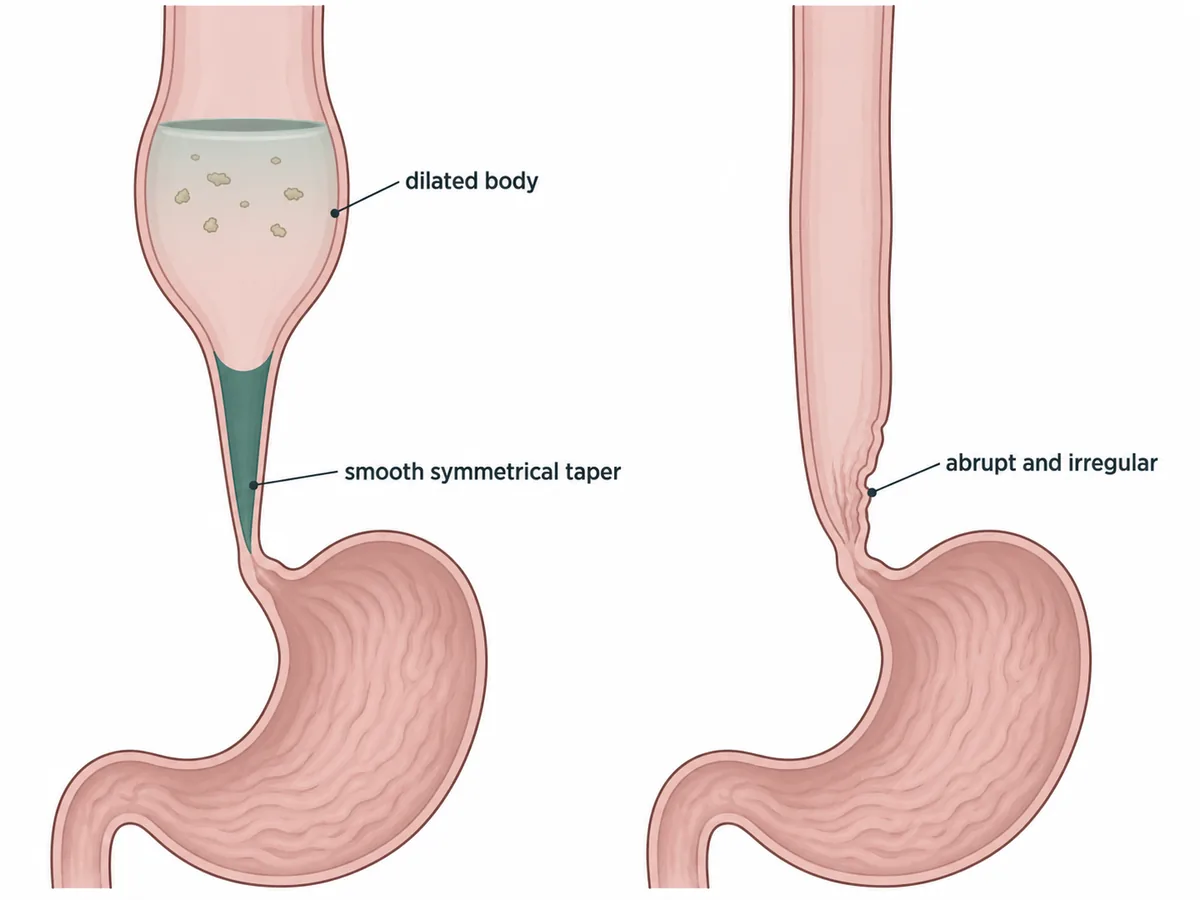
A 35-year-old woman has two years of difficulty swallowing both solids and liquids from the outset, with regurgitation of undigested food at night. Barium swallow shows a dilated oesophageal body tapering to a smooth, symmetrical narrowing at the gastro-oesophageal junction. What would manometry be expected to show?
- correctA. Absent oesophageal peristalsis with incomplete relaxation of the lower oesophageal sphincter
- B. Simultaneous high-amplitude contractions with normal sphincter relaxation
- C. A hypotensive lower oesophageal sphincter with normal peristalsis
- D. Normal peristalsis and normal sphincter relaxation
Explanation
Key fact
Achalasia is failure of the sphincter to relax plus loss of peristalsis - both, and manometry is the confirmatory test.
Absent peristalsis with incomplete relaxation of the lower oesophageal sphincter. That combination defines achalasia.
Why
Dysphagia to solids and liquids from the start points to a motility disorder, not a stricture.
A mechanical obstruction affects solids first and liquids much later.
The smooth symmetrical tapering is the bird's beak of achalasia.
The underlying lesion is loss of inhibitory neurones in the myenteric plexus.
Without them the sphincter cannot relax and the body cannot generate a peristaltic wave.
Smooth and symmetrical is what makes it achalasia
Why not the others
- B. Simultaneous high-amplitude contractions with normal sphincter relaxation — describes distal oesophageal spasm, which gives a corkscrew appearance and intermittent chest pain.
- C. A hypotensive lower oesophageal sphincter with normal peristalsis — is gastro-oesophageal reflux disease, which causes heartburn rather than regurgitation of undigested food.
- D. Normal peristalsis and normal sphincter relaxation — would not explain two years of progressive dysphagia.
Remember
Solids and liquids together means motility; solids first means a stricture. One question in the history halves the differential.
Go deeper
Endoscopy is still required to exclude pseudoachalasia from a tumour at the cardia, particularly in older patients with rapid weight loss.
Treatment options are pneumatic dilatation, laparoscopic Heller myotomy with a partial fundoplication, or peroral endoscopic myotomy.
Chagas disease produces an identical picture by destroying the same plexus.
Harrison's Principles of Internal Medicine, 22nd ed. (McGraw Hill, 2025); Bailey & Love's Short Practice of Surgery, 28th ed. (CRC Press, 2023).