
Recallab › Question bank › Obstetrics › #50088
Shoulder dystocia
During the delivery of a 4.1 kg baby to a woman with gestational diabetes, the head delivers but then retracts against the perineum and the shoulders do not deliver with the next contraction or with routine downward traction. What is the first manoeuvre that should be performed?
- correctA. McRoberts manoeuvre with suprapubic pressure
- B. Fundal pressure
- C. Immediate symphysiotomy
- D. The Zavanelli manoeuvre
Explanation
Key fact
McRoberts with suprapubic pressure resolves most shoulder dystocias, is non-invasive, and is always first. Fundal pressure is never used.
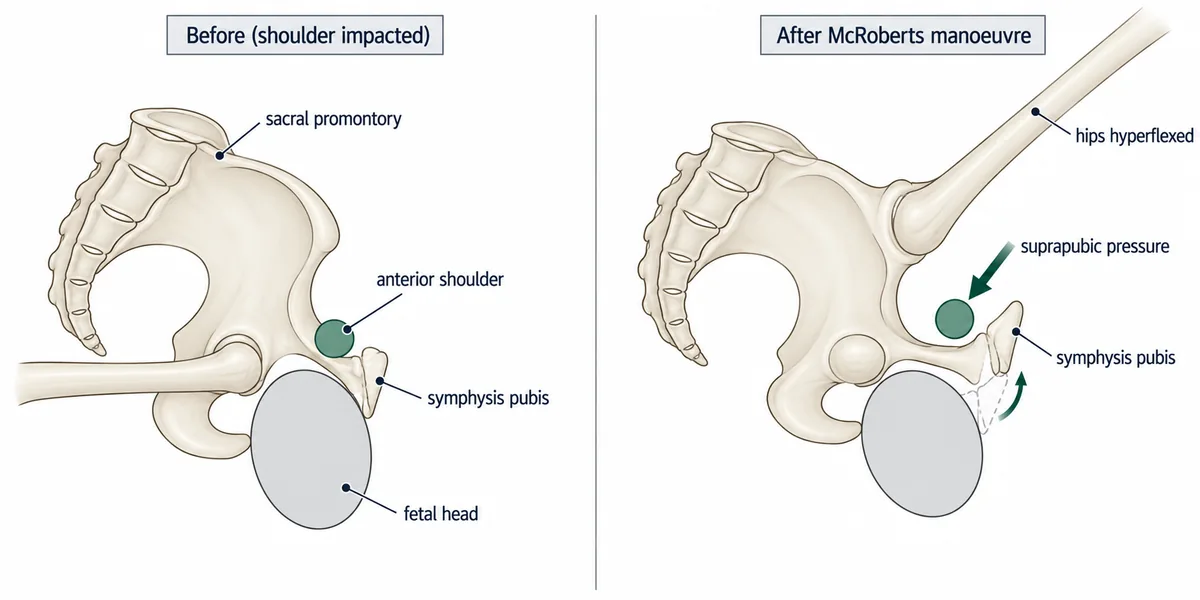
McRoberts manoeuvre with suprapubic pressure. Hyperflexing the hips rotates the symphysis and frees the impacted anterior shoulder.
Why
The turtle sign - the head retracting against the perineum - is shoulder dystocia.
The anterior shoulder is impacted behind the symphysis pubis.
McRoberts hyperflexes and abducts the maternal hips onto the abdomen.
That rotates the symphysis upwards and straightens the sacrum.
Suprapubic pressure pushes the shoulder into the wider oblique diameter.
The two together resolve the great majority of cases.
Hyperflexing the hips rotates the symphysis out of the way
Why not the others
- B. Fundal pressure — is contraindicated. It drives the shoulder harder against the symphysis and risks uterine rupture.
- C. Immediate symphysiotomy — is a last resort where no other option exists, with high maternal morbidity.
- D. The Zavanelli manoeuvre — replaces the head into the uterus for caesarean delivery. It is the final step after everything else has failed.
Remember
HELPERR, and never the fundus. Help, Episiotomy consideration, Legs (McRoberts), Pressure suprapubic, Enter for internal rotation, Remove the posterior arm, Roll onto all fours.
Go deeper
Note and record the time from delivery of the head; the risk of hypoxic injury rises after about 5 minutes.
Complications are brachial plexus injury, usually Erb palsy and usually transient, clavicular or humeral fracture, and postpartum haemorrhage.
Macrosomia, maternal diabetes, obesity and a previous dystocia raise the risk, but over half of cases occur without any of them.
Williams Obstetrics, 26th ed. (McGraw Hill, 2022); DC Dutta's Textbook of Obstetrics, 11th ed. (Jaypee, 2026).