
Recallab › Question bank › ENT › Nose › #50097
Maxillary sinus drainage
Why is the maxillary sinus the most frequently infected of the paranasal sinuses?
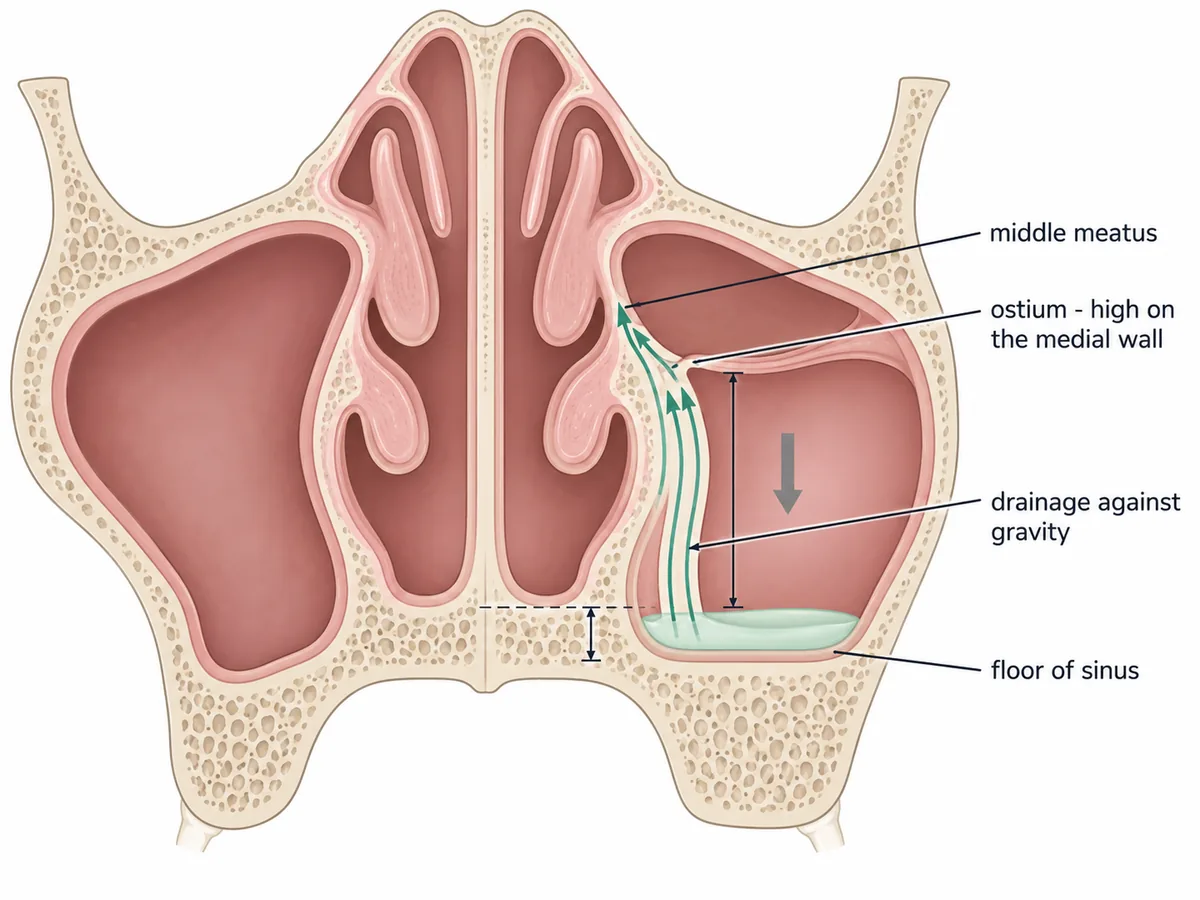
- correctA. Its ostium lies high on the medial wall, so drainage is against gravity
- B. It is the smallest of the paranasal sinuses
- C. It is lined by non-ciliated squamous epithelium
- D. It drains into the superior meatus, behind the turbinate
Explanation
Key fact
The maxillary ostium sits high on the medial wall, so the sinus has to clear itself upwards, against gravity, by ciliary action alone.
Its ostium lies high on the medial wall. The floor of the sinus is well below the opening, so secretions pool.
Why
The sinus floor lies about a centimetre below the nasal floor in an adult.
The ostium opens near the roof of the medial wall, into the middle meatus.
Drainage therefore runs uphill and depends entirely on the mucociliary escalator.
Anything that slows the cilia or blocks the ostium leaves the sinus stagnant.
It is also the largest sinus and the first to develop, so it is exposed longest.
The sinus has to drain uphill
Why not the others
- B. It is the smallest of the paranasal sinuses — is factually wrong. The maxillary sinus is the largest.
- C. It is lined by non-ciliated squamous epithelium — is wrong. All the paranasal sinuses are lined by ciliated pseudostratified columnar epithelium, and it is those cilia that do the draining.
- D. It drains into the superior meatus, behind the turbinate — is the wrong meatus. The maxillary, frontal and anterior ethmoid sinuses all drain into the middle meatus.
Remember
A sink with the plughole near the rim. Only the cilia empty it, so anything that stops them fills it.
Go deeper
The osteomeatal complex in the middle meatus is the common drainage pathway for the maxillary, frontal and anterior ethmoid sinuses, which is why one blockage infects three sinuses.
Dental roots of the upper premolars and molars project into the floor, so periapical infection is a recognised cause of unilateral maxillary sinusitis.
Functional endoscopic sinus surgery works by restoring ventilation and drainage through this complex rather than by stripping mucosa.
Dhingra PL, Dhingra S. Diseases of Ear, Nose and Throat, 9th ed. (Elsevier, 2025).