
Recallab › Question bank › Microbiology › #50130
Enterobius vermicularis
A 5-year-old girl has intense perianal itching that wakes her at night, and her younger brother has the same complaint. Routine stool examination on three occasions has been negative. Which is the most appropriate investigation?
- A. Duodenal aspirate examined for larvae
- correctB. Cellophane tape swab of the perianal skin taken early in the morning before washing
- C. A further stool sample concentrated by formol-ether
- D. Serology for anti-helminth antibodies
Explanation
Key fact
Pinworm eggs are laid on perianal skin, not passed in stool. That is why stool examination is negative and the tape swab is positive.
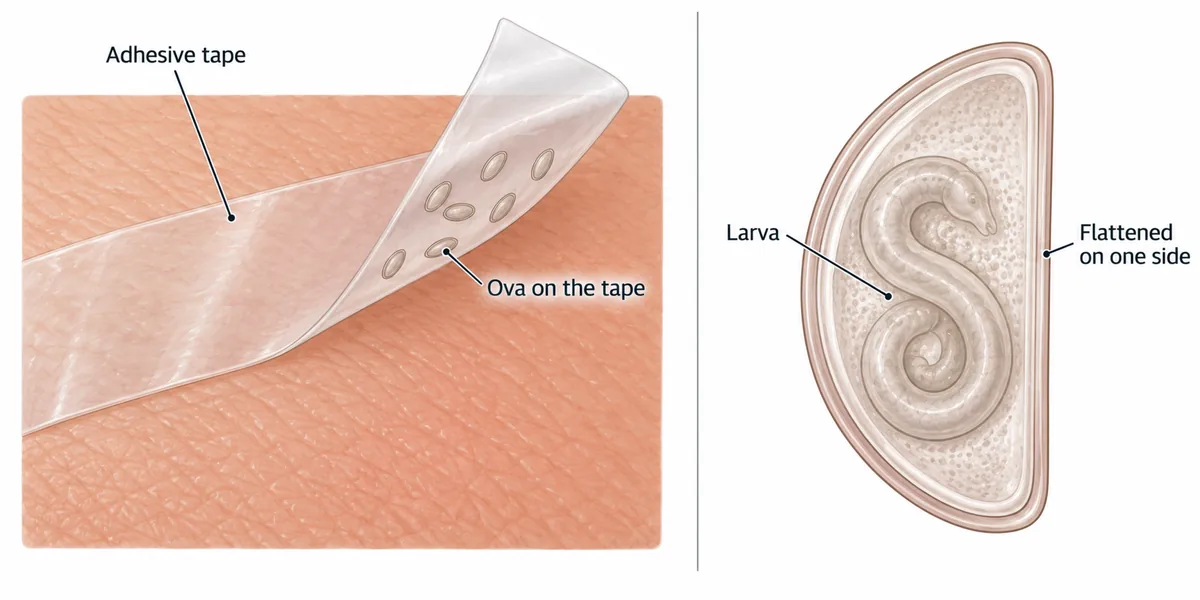
Cellophane tape swab of the perianal skin, taken early before washing. The gravid female deposits her eggs there overnight.
Why
Nocturnal perianal itching in a child, with a sibling affected, is Enterobius vermicularis.
The gravid female migrates out through the anus at night to lay.
The eggs stick to perianal skin and rarely reach the stool.
So stool microscopy is negative in the great majority of cases.
The NIH swab lifts the eggs off the skin; take it before the child washes or opens the bowels.
The eggs are on the tape, not in the stool
Why not the others
- A. Duodenal aspirate examined for larvae — is used for Strongyloides and giardiasis, neither of which causes nocturnal perianal itching.
- C. A further stool sample concentrated by formol-ether — will almost certainly be negative again. Only a small minority of cases show eggs in stool, however many samples are taken.
- D. Serology for anti-helminth antibodies — is not used for pinworm; the infection is superficial and provokes little systemic antibody.
Remember
Ova on the skin, not in the stool. Tape before the bath, and repeat on three consecutive mornings to raise the yield.
Go deeper
The egg is characteristically flattened on one side - a plano-convex D shape with a larva inside.
Treat with albendazole or mebendazole and repeat after two weeks to catch the next cycle, and treat the whole household at once.
Autoinfection through scratching and hand-to-mouth transfer is why it persists in families and institutions.
Ananthanarayan and Paniker's Textbook of Microbiology, 11th ed. (Universities Press, 2020); Jawetz, Melnick & Adelberg's Medical Microbiology, 29th ed. (McGraw Hill, 2025).