
Recallab › Question bank › Physiology › Cardio Vasular Physiology › #50209
Baroreceptor reflex
A healthy volunteer stands up quickly from lying. Arterial pressure momentarily falls. Which sequence describes the baroreceptor response?
- A. Reduced carotid sinus firing, more vagal tone, bradycardia and vasodilatation
- B. No change in firing, with the response driven by chemoreceptors instead
- correctC. Reduced carotid sinus firing, less vagal tone, more sympathetic outflow, rise in heart rate and vasoconstriction
- D. Increased carotid sinus firing, more vagal tone, less sympathetic outflow, fall in heart rate
Explanation
Key fact
Baroreceptors are stretch receptors: they fire faster when pressure rises. Falling pressure means falling firing, which releases the brake on the sympathetic system.
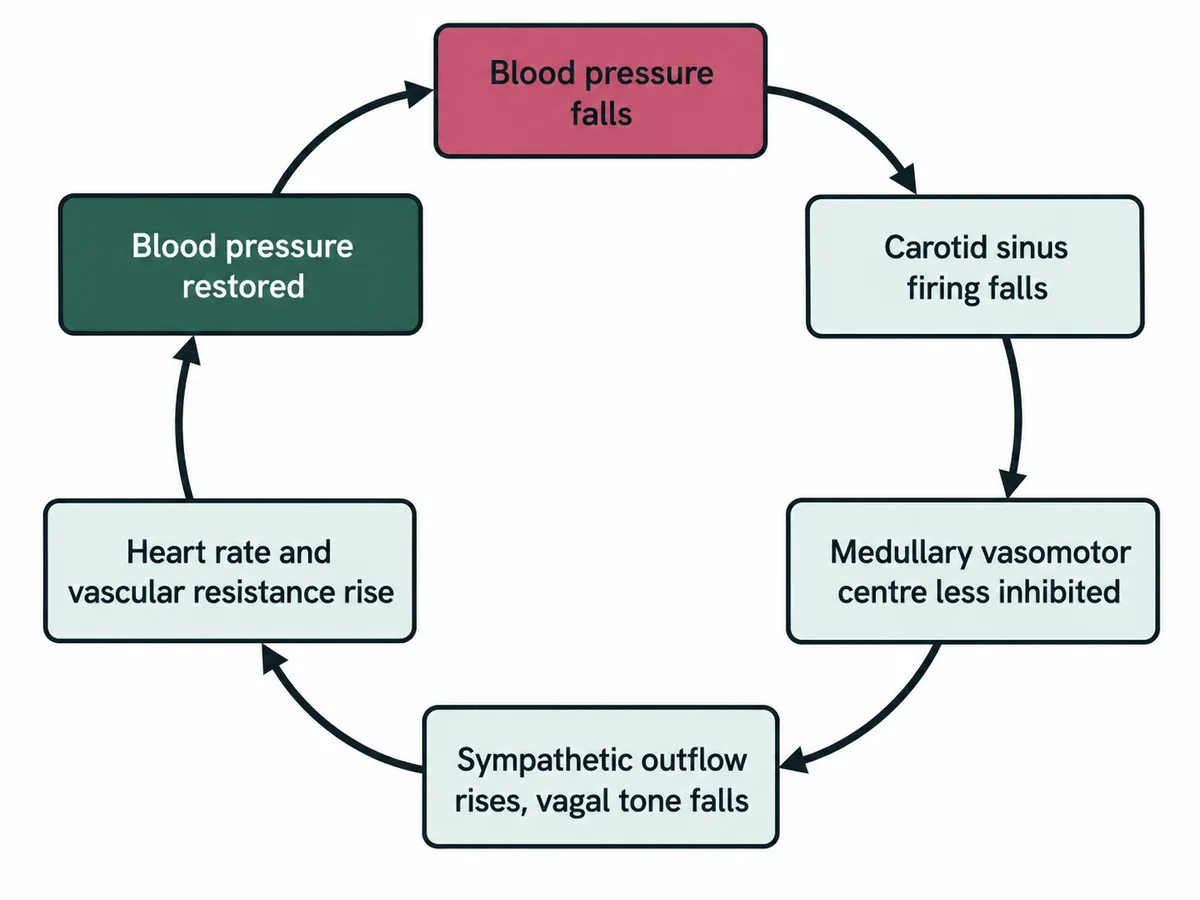
Reduced firing, less vagal tone, more sympathetic outflow, tachycardia and vasoconstriction. It is a negative feedback loop correcting the fall.
How it happens
- Standing pools blood in the legs, so venous return and pressure fall.
- Stretch in the carotid sinus and aortic arch falls, so firing falls.
- Those afferents run in the glossopharyngeal and vagus to the medulla.
- Less afferent traffic means less inhibition of the vasomotor centre.
- Vagal tone falls and sympathetic outflow rises.
- Heart rate, contractility and vascular resistance all rise, restoring the pressure.
The baroreceptor reflex as a negative feedback loop
Why not the others
- A. Reduced carotid sinus firing, more vagal tone, bradycardia and vasodilatation — gets the firing right but the efferent limb backwards, and would deepen the hypotension.
- B. No change in firing, with the response driven by chemoreceptors instead — is wrong: chemoreceptors respond to oxygen, carbon dioxide and pH, and become important only at pressures below about 60 mmHg.
- D. Increased carotid sinus firing, more vagal tone, less sympathetic outflow, fall in heart rate — is the response to a rise in pressure - the opposite situation.
Remember
Baroreceptors fire when stretched. Every step of the reflex follows from that one fact, in either direction.
Go deeper
The reflex is the fastest blood pressure control, acting within one heartbeat, and its afferents fire mainly during systole, when the vessel is most stretched.
It resets within days to a sustained new pressure, which is why it cannot cause or cure chronic hypertension.
Carotid sinus massage exploits the same reflex to slow the heart, which is how a supraventricular tachycardia is terminated at the bedside.
Ganong's Review of Medical Physiology, 27th ed. (McGraw Hill, 2025); Guyton and Hall Textbook of Medical Physiology, 15th ed. (Elsevier, 2026).