
Recallab › Question bank › Biochemistry › Metabolism › #50211
Lipoprotein lipase deficiency
A 6-year-old boy has had three episodes of acute pancreatitis. He has eruptive xanthomas over the buttocks and hepatosplenomegaly. A fasting blood sample separates into a creamy layer over clear plasma. Triglycerides are 2,400 mg/dL and cholesterol is only mildly raised. Which enzyme is deficient?
- A. Lecithin-cholesterol acyltransferase
- B. Hormone-sensitive lipase
- C. Hepatic lipase
- correctD. Lipoprotein lipase
Explanation
Key fact
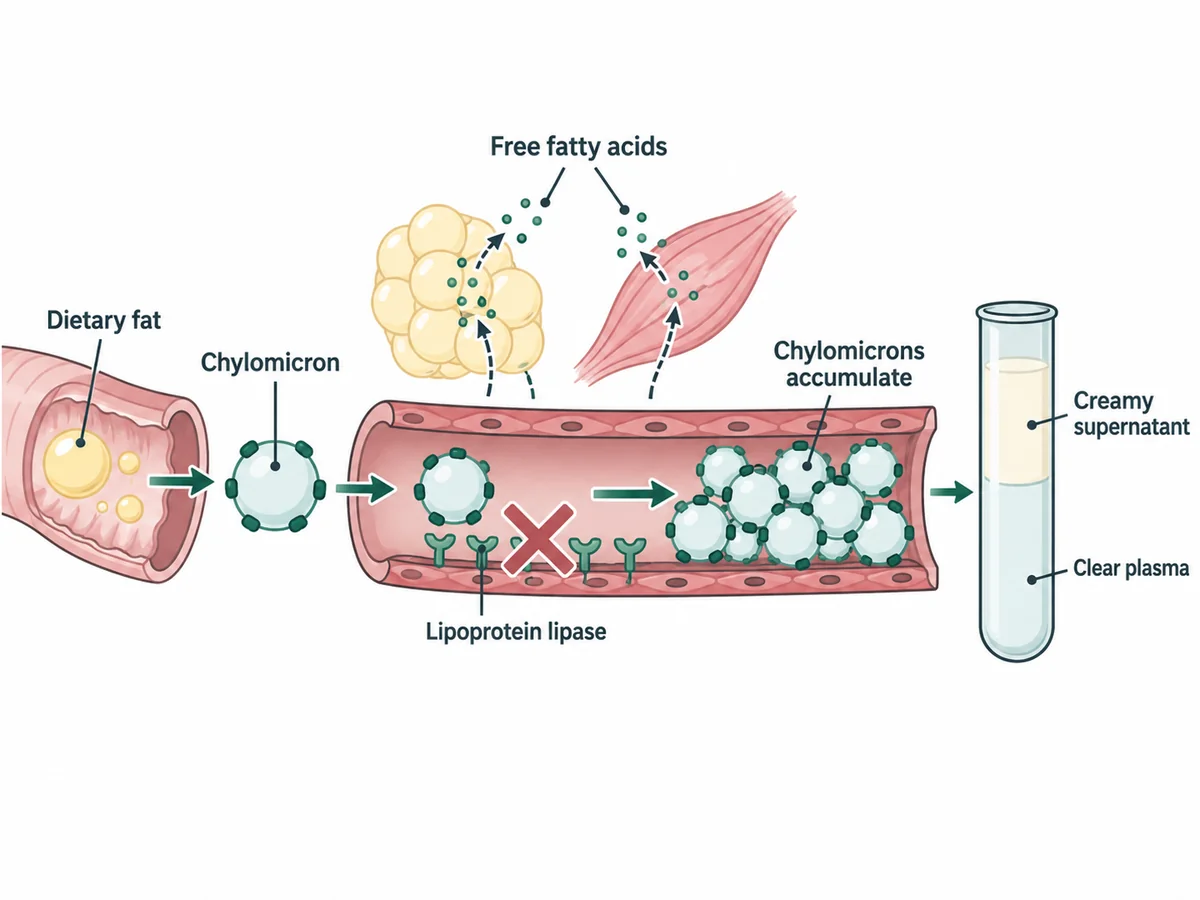
Lipoprotein lipase clears chylomicrons from the blood. Without it they accumulate, and a fasting sample separates into a creamy layer.
Lipoprotein lipase. Type I hyperlipoproteinaemia - massive hypertriglyceridaemia from unhydrolysed chylomicrons.
Why
Chylomicrons carry dietary triglyceride from the gut.
Lipoprotein lipase sits on capillary endothelium in muscle and adipose tissue.
It hydrolyses that triglyceride so the tissues can take up the fatty acids.
Without it, chylomicrons persist for days instead of hours.
They are large and light, so they float - the creamy supernatant over clear plasma.
Cholesterol is only mildly raised because chylomicrons carry little of it.
Where the block is, and why the plasma separates
Why not the others
- A. Lecithin-cholesterol acyltransferase — esterifies cholesterol within HDL. Its deficiency causes corneal opacity, anaemia and renal disease, with low HDL.
- B. Hormone-sensitive lipase — releases fatty acids from adipose stores during fasting. Its deficiency would not load the plasma with chylomicrons.
- C. Hepatic lipase — acts on intermediate density lipoprotein and remnants. Its deficiency raises remnants and HDL, not chylomicrons to this degree.
Remember
A creamy layer means chylomicrons; a turbid plasma means VLDL. The test tube left overnight in the fridge separates the two.
Go deeper
Apo C-II is the essential activator of lipoprotein lipase, and its deficiency produces an identical clinical picture.
The danger is acute pancreatitis, which is why triglycerides above about 1,000 mg/dL are treated urgently. Atherosclerosis risk is not raised - chylomicrons are too large to enter the arterial wall.
Treatment is a strict very low fat diet with medium-chain triglycerides, which are absorbed directly into the portal blood and bypass chylomicron formation entirely.
Harper's Illustrated Biochemistry, 33rd ed. (McGraw Hill, 2025); Lippincott Illustrated Reviews: Biochemistry, 9th ed. (Wolters Kluwer, 2025).