
Recallab › Question bank › Pathology › Central Nervous System › #50217
Vestibular schwannoma
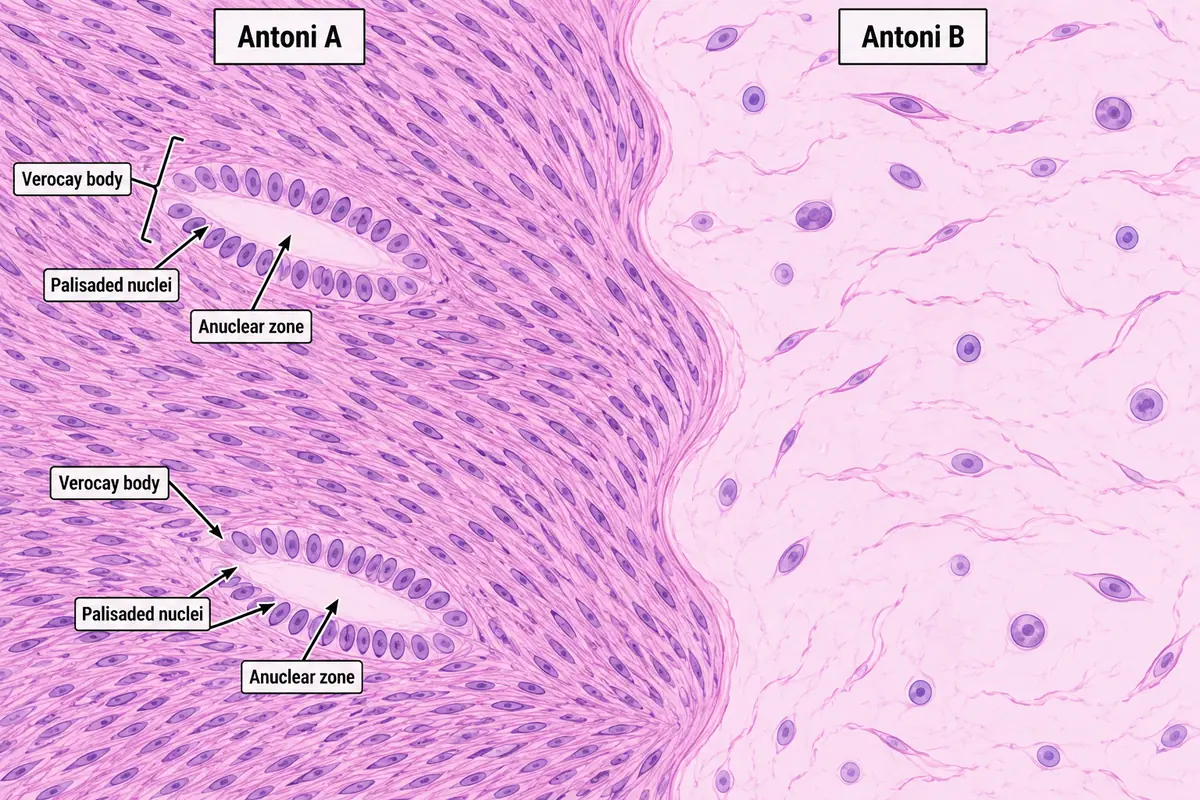
A 46-year-old woman has two years of progressive right-sided hearing loss with tinnitus and mild unsteadiness. MRI shows a mass at the right cerebellopontine angle extending into the internal acoustic meatus. Histology shows compact spindle cells in palisades around anuclear zones, alternating with a loose myxoid area. Which tumour is this?
- A. Ependymoma
- correctB. Schwannoma
- C. Meningioma
- D. Neurofibroma
Explanation
Key fact
Antoni A with Verocay bodies, alternating with loose Antoni B, is a schwannoma - and at the cerebellopontine angle it is a vestibular schwannoma.
Schwannoma. Nuclear palisades around anuclear zones are Verocay bodies, and the two-pattern architecture is diagnostic.
Why
Antoni A is the compact area: spindle cells in fascicles and palisades.
The palisaded nuclei flanking an anuclear zone form a Verocay body.
Antoni B is the loose, myxoid, hypocellular area.
The alternation of the two is characteristic of schwannoma and of nothing else.
It arises from Schwann cells on the vestibular division of the eighth nerve.
Hearing loss follows from compression of the cochlear division alongside it.
Antoni A and Antoni B areas with a Verocay body
Why not the others
- A. Ependymoma — arises from the ventricular lining and shows perivascular pseudorosettes, not palisades, and would not sit in the cerebellopontine angle.
- C. Meningioma — at this site is the main differential, but it shows whorls and psammoma bodies, sits on a dural base with a tail, and rarely enters the internal acoustic meatus.
- D. Neurofibroma — is a mixed tumour of Schwann cells, fibroblasts and axons that infiltrates the nerve, so the nerve cannot be separated from it. A schwannoma displaces the nerve and can be shelled out.
Remember
Schwannoma pushes the nerve aside; neurofibroma grows through it. That is why one can be excised with the nerve preserved and the other cannot.
Go deeper
Schwannomas are S100 positive, reflecting their neural crest origin.
Bilateral vestibular schwannomas define neurofibromatosis type 2, from a merlin mutation on chromosome 22.
Malignant transformation of a schwannoma is very rare; it is the plexiform neurofibroma of NF1 that carries that risk.
Robbins, Cotran & Kumar Pathologic Basis of Disease, 11th ed. (Elsevier, 2025).