
Recallab › Question bank › Pathology › Cellular Pathology › #50218
Pyroptosis
Which feature distinguishes pyroptosis from apoptosis?
- correctA. The cell membrane ruptures and inflammatory contents are released
- B. Caspases are activated
- C. The nucleus condenses and the DNA is cleaved
- D. It requires no energy
Explanation
Key fact
Apoptosis is tidy and silent; pyroptosis is deliberately messy and inflammatory. Both use caspases, which is why caspase activation cannot separate them.
The cell membrane ruptures and inflammatory contents are released. Pyroptosis exists to raise an alarm, so it must spill.
Why
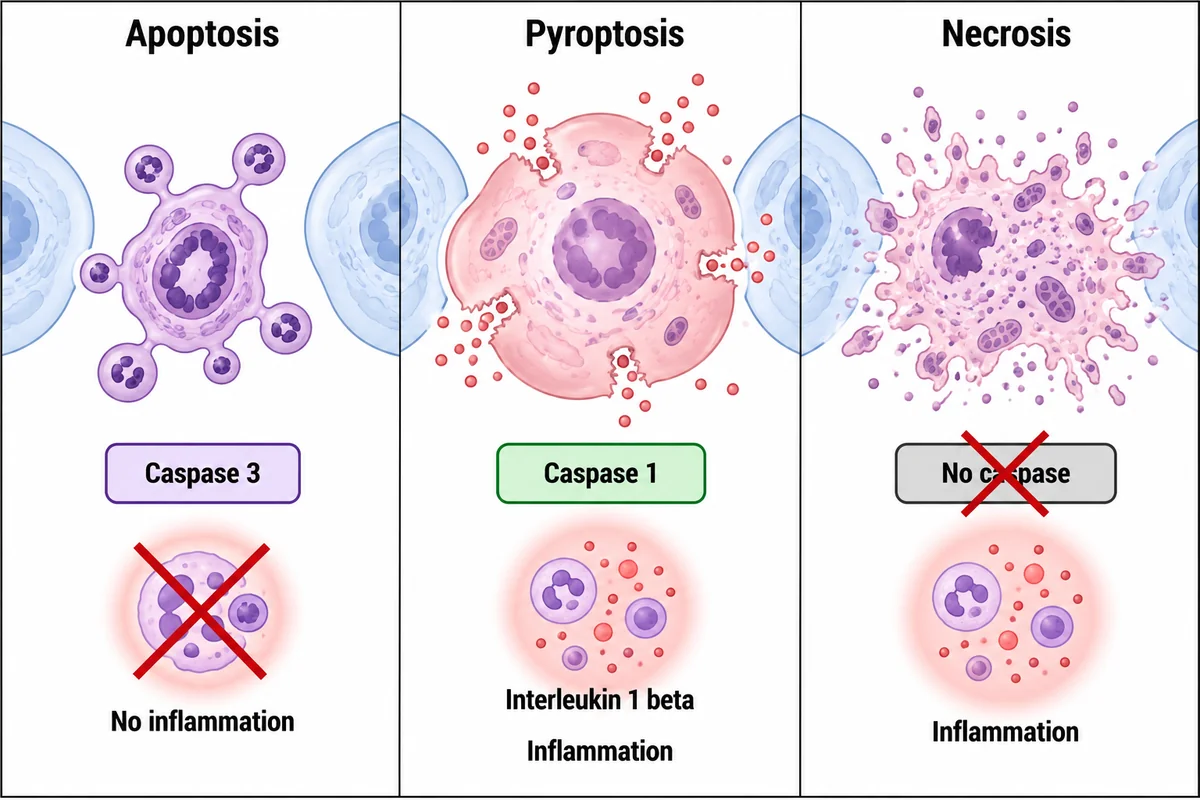
Apoptosis keeps the membrane intact and packages the cell into blebs.
Those blebs are cleared by phagocytes with no inflammation.
Pyroptosis follows inflammasome activation, usually NLRP3.
Caspase-1 activates interleukin-1 beta and cleaves gasdermin D.
Gasdermin D punches pores in the membrane, the cell swells and bursts.
The released interleukin-1 beta is what makes it inflammatory.
Three ways a cell can die
Why not the others
- B. Caspases are activated — is true of both. Apoptosis uses caspases 3, 8 and 9; pyroptosis uses caspase 1. This is precisely why it cannot be the distinguishing feature.
- C. The nucleus condenses and the DNA is cleaved — happens in apoptosis, and chromatin condensation occurs in pyroptosis too. It does not separate them.
- D. It requires no energy — is wrong for both. Both are active, ATP-dependent programmes; only necrosis is passive.
Remember
Pyro means fire. The name tells you it is the inflammatory one.
Go deeper
Pyroptosis is a defence against intracellular pathogens: bursting the cell exposes them and summons neutrophils.
Excessive inflammasome activity underlies the periodic fever syndromes, and interleukin-1 blockade with anakinra is the treatment.
Other regulated forms worth knowing: necroptosis (RIPK-driven, caspase-independent) and ferroptosis (iron-dependent lipid peroxidation).
Robbins, Cotran & Kumar Pathologic Basis of Disease, 11th ed. (Elsevier, 2025).