
Recallab › Question bank › Pathology › #50222
Primary biliary cholangitis
A 55-year-old woman has had itching and fatigue for a year. Alkaline phosphatase is four times normal with mildly raised transaminases and a normal bilirubin. Antimitochondrial antibody is positive at high titre. Ultrasound shows no biliary dilatation. What is the diagnosis?
- A. Autoimmune hepatitis
- B. Primary sclerosing cholangitis
- correctC. Primary biliary cholangitis
- D. Choledocholithiasis
Explanation
Key fact
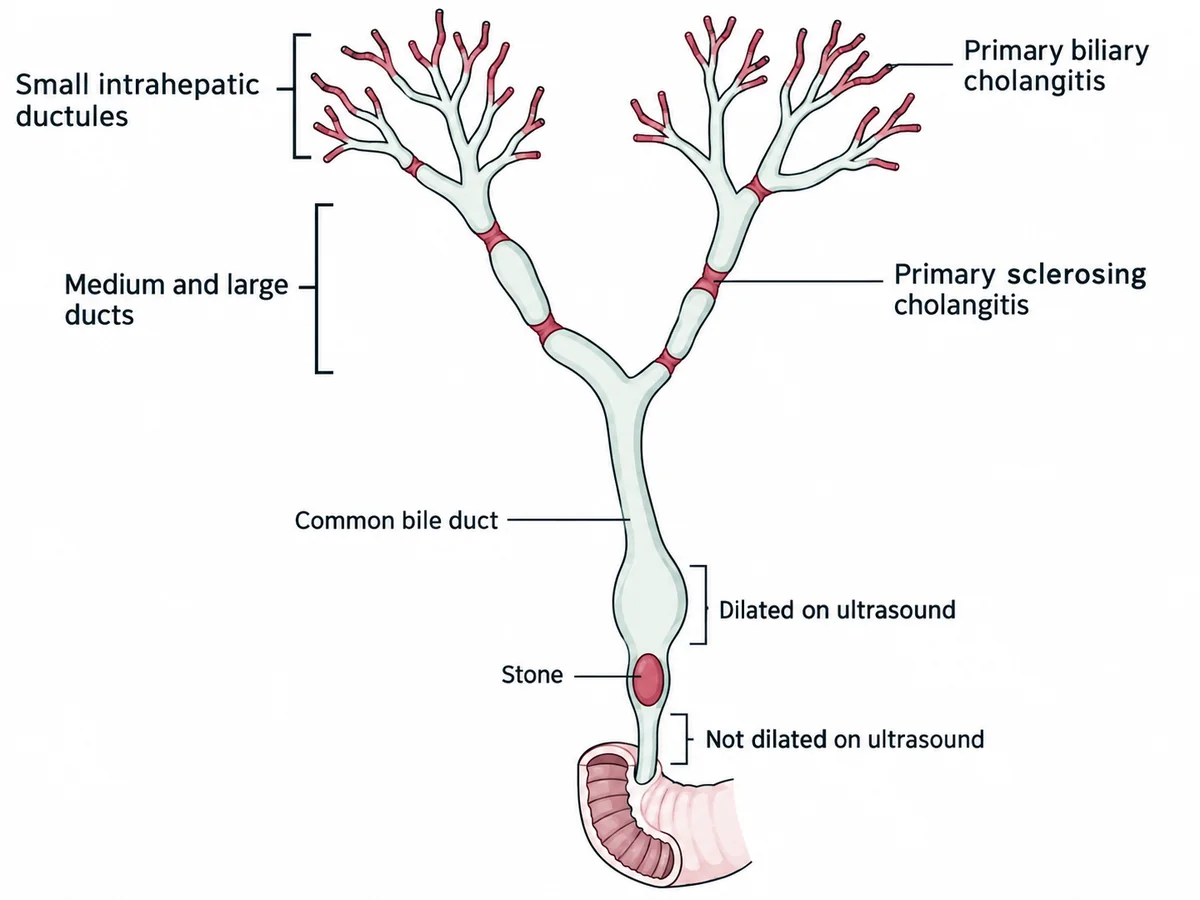
Antimitochondrial antibody plus a cholestatic pattern with undilated ducts is primary biliary cholangitis - the small intrahepatic ducts are destroyed.
Primary biliary cholangitis. The disease is in ducts too small to dilate, which is why the ultrasound is normal.
Why
A raised alkaline phosphatase with modest transaminases is a cholestatic pattern.
Itching often precedes jaundice by months or years.
Antimitochondrial antibody is positive in over 95% and is highly specific.
The target is the small interlobular bile ducts, which are destroyed by granulomatous inflammation.
Those ducts are microscopic, so obstruction never dilates anything visible.
Where each cholestatic disease sits in the biliary tree
Why not the others
- A. Autoimmune hepatitis — gives a hepatitic pattern with transaminases many times normal, anti-smooth muscle antibody and a raised IgG.
- B. Primary sclerosing cholangitis — affects larger ducts, gives beaded strictures on magnetic resonance cholangiography, is associated with ulcerative colitis and is commoner in men. Antimitochondrial antibody is negative.
- D. Choledocholithiasis — obstructs a large duct, so the ducts dilate on ultrasound and the bilirubin rises. Neither is the case here.
Remember
Small ducts cannot dilate. A normal ultrasound with a cholestatic profile points inwards, not to an obstruction.
Go deeper
Ursodeoxycholic acid slows progression and is started as soon as the diagnosis is made; obeticholic acid or a fibrate is added if the response is inadequate.
Itch is treated with cholestyramine; fat-soluble vitamin deficiency and osteoporosis need surveillance.
Associated autoimmune disease is common - thyroid disease, Sjogren syndrome, coeliac disease and the CREST variant of systemic sclerosis.
Robbins, Cotran & Kumar Pathologic Basis of Disease, 11th ed. (Elsevier, 2025); Harrison's Principles of Internal Medicine, 22nd ed. (McGraw Hill, 2025).