
Recallab › Question bank › Pathology › Genetics › #50223
Marfan syndrome
A 19-year-old man is 196 cm tall with an arm span exceeding his height, long slender fingers, pectus excavatum and a high arched palate. Echocardiography shows an aortic root diameter of 42 mm. Which is the most important element of his long-term management?
- A. Growth hormone suppression to limit further height
- B. Annual slit-lamp examination alone
- correctC. Serial echocardiography with a beta blocker and avoidance of isometric exercise
- D. Long-term anticoagulation
Explanation
Key fact
Marfan syndrome kills through the aortic root. Everything else is inconvenience; the aorta is the reason for lifelong follow-up.
Serial echocardiography with a beta blocker and avoidance of isometric exercise. Progressive root dilatation leads to dissection.
Why
The defect is in fibrillin-1, the scaffold of elastic microfibrils.
Loss of fibrillin also releases excess TGF-beta signalling, weakening the media.
Cystic medial degeneration of the aortic root follows.
The root dilates progressively and dissects, usually as a type A dissection.
Beta blockade reduces the rate of rise of aortic pressure and slows dilatation.
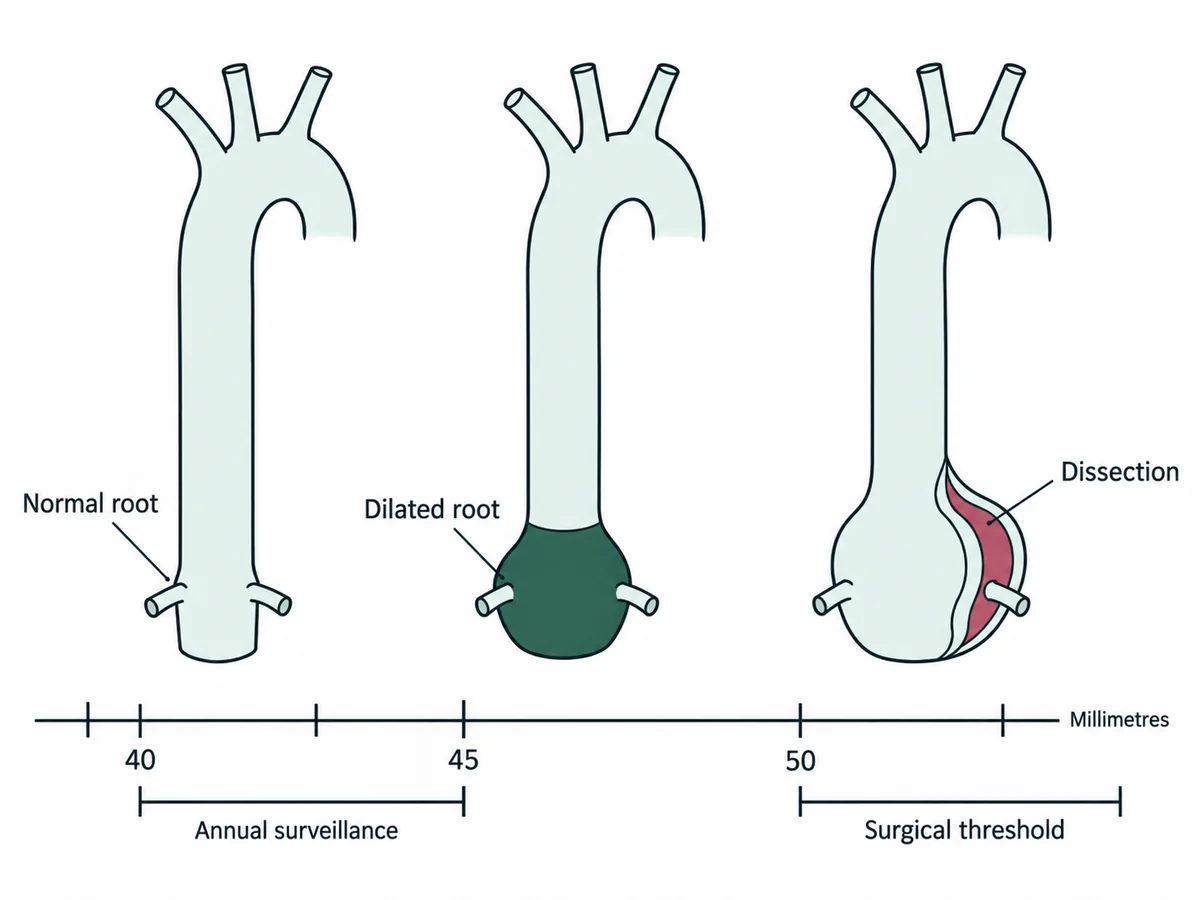
Elective root replacement is offered at about 50 mm, or earlier with a family history of dissection or rapid growth.
Why the aortic root is measured every year
Why not the others
- A. Growth hormone suppression to limit further height — is not standard management and does not affect the aorta.
- B. Annual slit-lamp examination alone — is needed - upward lens dislocation and retinal detachment occur - but eyes do not kill and this cannot be the most important element.
- D. Long-term anticoagulation — has no role. Marfan syndrome is not a thrombophilia; that is homocystinuria.
Remember
Measure the root, beta-block, and no heavy lifting. Three things, repeated for life.
Go deeper
Angiotensin receptor blockers reduce TGF-beta signalling and are used, often alongside a beta blocker.
Pregnancy carries a high risk of dissection once the root exceeds about 40 mm, and needs pre-pregnancy counselling.
Screen first-degree relatives: it is autosomal dominant with high penetrance, and about a quarter of cases are new mutations.
Robbins, Cotran & Kumar Pathologic Basis of Disease, 11th ed. (Elsevier, 2025); Harrison's Principles of Internal Medicine, 22nd ed. (McGraw Hill, 2025).