
Recallab › Question bank › Microbiology › Bacteriology › #50230
Pseudomonas aeruginosa in burns
A patient with 70% burns develops greenish discolouration of the dressings with a sweet grape-like odour on day six. Culture of a wound swab on nutrient agar produces colonies with a blue-green diffusible pigment, and the organism grows at 42 degrees Celsius and is oxidase positive. Which organism is this?
- correctA. Pseudomonas aeruginosa
- B. Klebsiella pneumoniae
- C. Staphylococcus aureus
- D. Acinetobacter baumannii
Explanation
Key fact
Blue-green pigment, grape-like smell, growth at 42 degrees and oxidase positive - four findings that together are only Pseudomonas aeruginosa.
Pseudomonas aeruginosa. It is the classic late coloniser of a burn wound and the commonest cause of burn sepsis.
Why
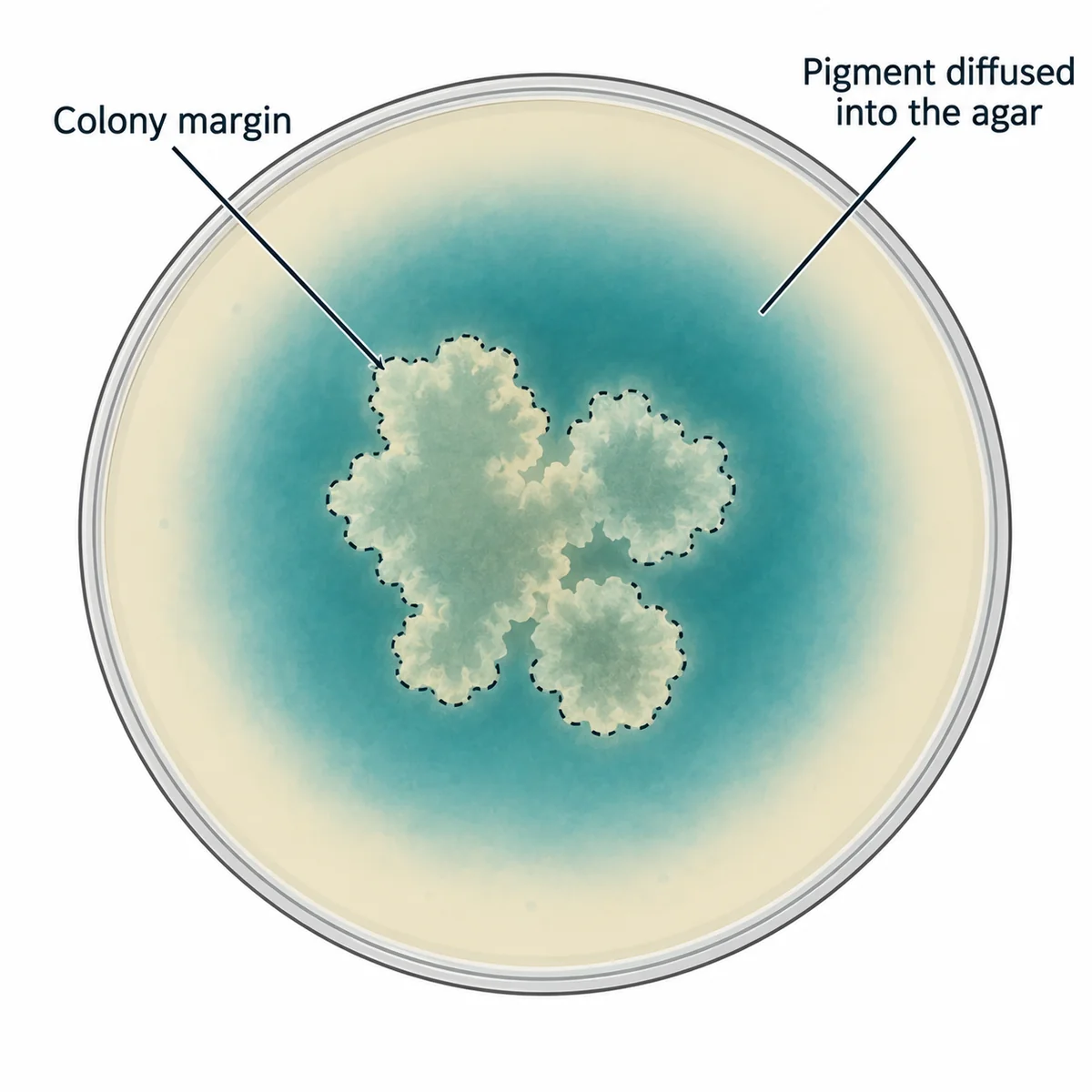
The blue-green colour is pyocyanin, with yellow-green fluorescent pyoverdin.
The sweet grape or fruity odour comes from 2-aminoacetophenone.
Growth at 42 degrees separates it from other fluorescent pseudomonads.
It is oxidase positive, which excludes the Enterobacterales at once.
It is a non-fermenter, so it is a strict aerobe using oxidative metabolism.
Pyocyanin diffusing through the agar
Why not the others
- B. Klebsiella pneumoniae — is a lactose-fermenting, oxidase-negative, non-motile organism with mucoid colonies, not a green diffusible pigment.
- C. Staphylococcus aureus — produces golden colonies, is catalase positive and oxidase negative, and does not diffuse pigment through the agar. It colonises burns earlier, in the first few days.
- D. Acinetobacter baumannii — is an important burn and intensive care pathogen but is oxidase negative and produces no pigment.
Remember
Green, grapes, forty-two. Three cues and the plate names itself.
Go deeper
Burn wound sepsis is suggested by colour change, rapid eschar separation and systemic deterioration; quantitative biopsy culture above 10^5 organisms per gram distinguishes invasion from colonisation.
Ecthyma gangrenosum - a painless necrotic ulcer with a black eschar - is the cutaneous sign of pseudomonal bacteraemia.
It is intrinsically resistant to many antibiotics through efflux pumps and low outer membrane permeability, so antipseudomonal cover must be chosen deliberately.
Ananthanarayan and Paniker's Textbook of Microbiology, 11th ed. (Universities Press, 2020); Jawetz, Melnick & Adelberg's Medical Microbiology, 29th ed. (McGraw Hill, 2025).