
Recallab › Question bank › Social & Preventive Medicine › Communicable Diseases › #50246
Antigenic shift and pandemics
Why can influenza A cause pandemics while influenza B does not?
- A. Influenza A is transmitted by droplets and influenza B is not
- B. Influenza A has a DNA genome that recombines readily
- C. Influenza A mutates its surface proteins more gradually than influenza B
- correctD. Influenza A has animal reservoirs and a segmented genome, so it can undergo antigenic shift
Explanation
Key fact
Shift needs two things: an animal reservoir and a segmented genome. Influenza A has both; influenza B has neither.
Animal reservoirs plus a segmented genome allow antigenic shift. A wholly new surface protein appears, and nobody has immunity to it.
Why
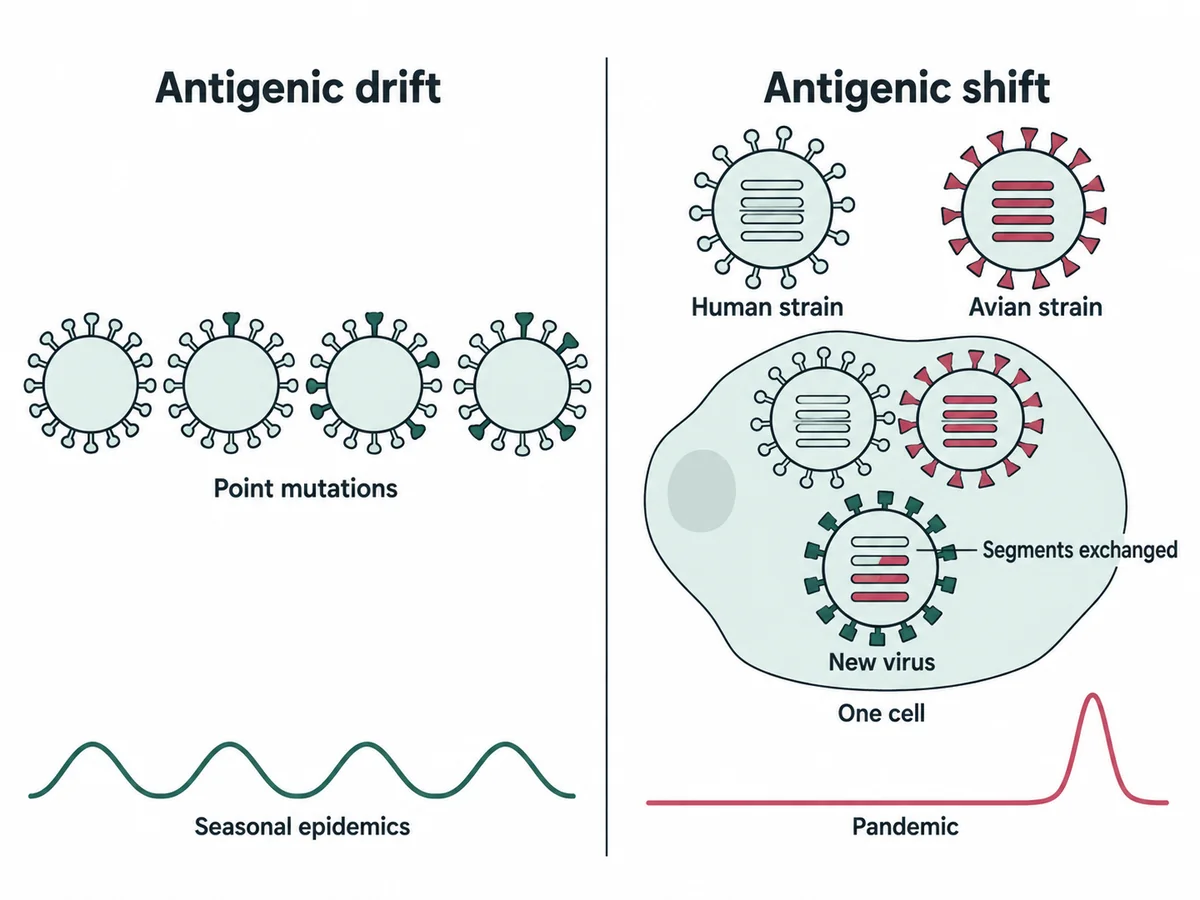
Influenza has eight separate RNA segments.
If two different strains infect one cell, segments can be swapped - reassortment.
That needs a second strain, which comes from birds or pigs.
Influenza A infects birds, pigs, horses and humans; influenza B is essentially human only.
The result is a virus with a completely new haemagglutinin - antigenic shift.
With no population immunity, a pandemic follows.
Drift against shift
Why not the others
- A. Influenza A is transmitted by droplets and influenza B is not — is wrong. Both spread by droplets and both cause seasonal illness.
- B. Influenza A has a DNA genome that recombines readily — is wrong twice: influenza is an RNA virus, and the mechanism is reassortment of segments, not recombination.
- C. Influenza A mutates its surface proteins more gradually than influenza B — describes drift, which both types undergo and which causes seasonal epidemics rather than pandemics.
Remember
Drift is a small change, shift is a swap. Drift needs a new vaccine each year; shift needs a new vaccine altogether.
Go deeper
The 2009 pandemic was H1N1, a quadruple reassortant containing avian, swine and human segments; the pig is the classic mixing vessel because it has receptors for both avian and human viruses.
H5N1 and H7N9 avian strains cause severe human disease but have not acquired efficient human-to-human transmission, which is the remaining barrier to a pandemic.
Influenza C causes mild illness and influenza D infects cattle; neither is a pandemic threat.
Park K. Park's Textbook of Preventive and Social Medicine, 28th ed. (Bhanot, 2025); Ananthanarayan and Paniker's Textbook of Microbiology, 11th ed. (Universities Press, 2020).