
Recallab › Question bank › Medicine › Immunology & Rheumatology › #50253
Systemic sclerosis subsets
A 44-year-old woman has had Raynaud phenomenon for 12 years, with tight shiny skin confined to the fingers and face, telangiectasia, calcinosis over the fingertips and reflux symptoms. Anticentromere antibody is positive. Which complication is she at greatest long-term risk of?
- correctA. Pulmonary arterial hypertension
- B. Erosive arthritis of the small joints
- C. Rapidly progressive interstitial lung disease
- D. Scleroderma renal crisis
Explanation
Key fact
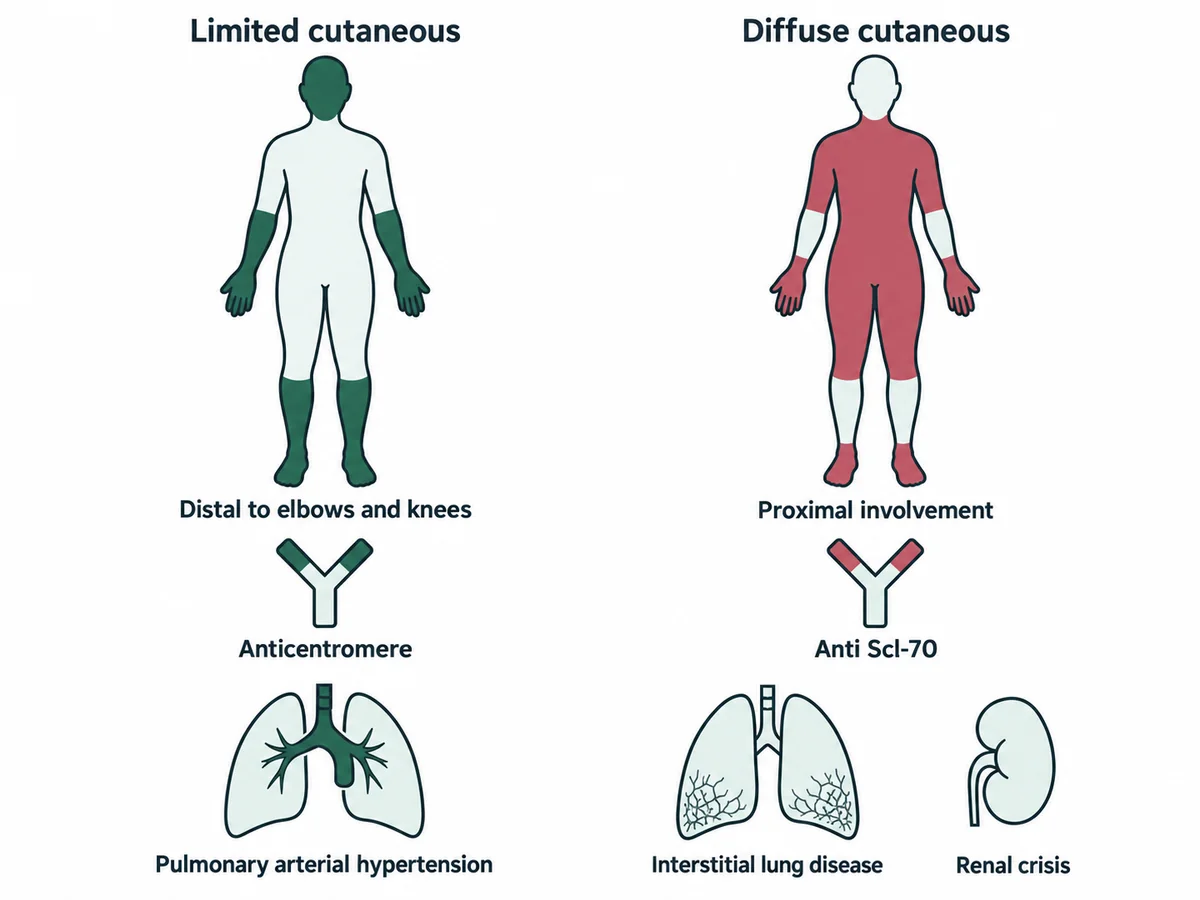
Limited disease with anticentromere antibody threatens the pulmonary arteries; diffuse disease with anti-Scl-70 threatens the lungs and kidneys.
Pulmonary arterial hypertension. Long-standing limited cutaneous disease with anticentromere antibody carries the highest risk of it.
Why
Skin thickening distal to the elbows and knees plus the face defines limited disease.
A long history of Raynaud phenomenon preceding the skin change is typical of it.
Calcinosis, Raynaud, oesophageal dysmotility, sclerodactyly and telangiectasia is the CREST pattern.
Anticentromere antibody is the associated marker.
This subset develops isolated pulmonary arterial hypertension late, without much lung fibrosis.
Two subsets, two antibodies, two dangers
Why not the others
- B. Erosive arthritis of the small joints — is rheumatoid arthritis. Systemic sclerosis causes contractures from skin tightening, not joint erosion.
- C. Rapidly progressive interstitial lung disease — is the hazard of diffuse disease with anti-Scl-70. Limited disease can develop fibrosis, but slowly and less severely.
- D. Scleroderma renal crisis — occurs mainly in diffuse disease with anti-RNA polymerase III, in the first few years, and is precipitated by corticosteroids.
Remember
Anticentromere, arteries. Scl-70, scarring. The antibody predicts the organ.
Go deeper
Screen limited disease annually with echocardiography and lung function; a falling gas transfer with preserved lung volumes suggests pulmonary hypertension.
Renal crisis is treated with an ACE inhibitor, which transformed a uniformly fatal complication. Steroids should be avoided or minimised in diffuse disease.
Nailfold capillaroscopy showing dilated loops and dropout distinguishes secondary from primary Raynaud phenomenon.
Harrison's Principles of Internal Medicine, 22nd ed. (McGraw Hill, 2025).