
Recallab › Question bank › Medicine › Gastroenterology › #50257
Whipple disease
A 52-year-old man has two years of migratory large joint arthralgia, followed by diarrhoea, steatorrhoea and 14 kg weight loss. He is now mildly confused and has developed abnormal eye movements. Duodenal biopsy shows blunted villi packed with foamy macrophages that stain magenta with periodic acid-Schiff. What is the diagnosis?
- A. Coeliac disease
- correctB. Whipple disease
- C. Mycobacterium avium complex enteritis
- D. Intestinal tuberculosis
Explanation
Key fact
PAS-positive foamy macrophages in the lamina propria, with arthralgia preceding the diarrhoea, is Whipple disease - *Tropheryma whipplei*.
Whipple disease. The joint symptoms come years first, and the neurological involvement is what makes it urgent.
Why
*Tropheryma whipplei* is an actinobacterium that macrophages ingest but cannot kill.
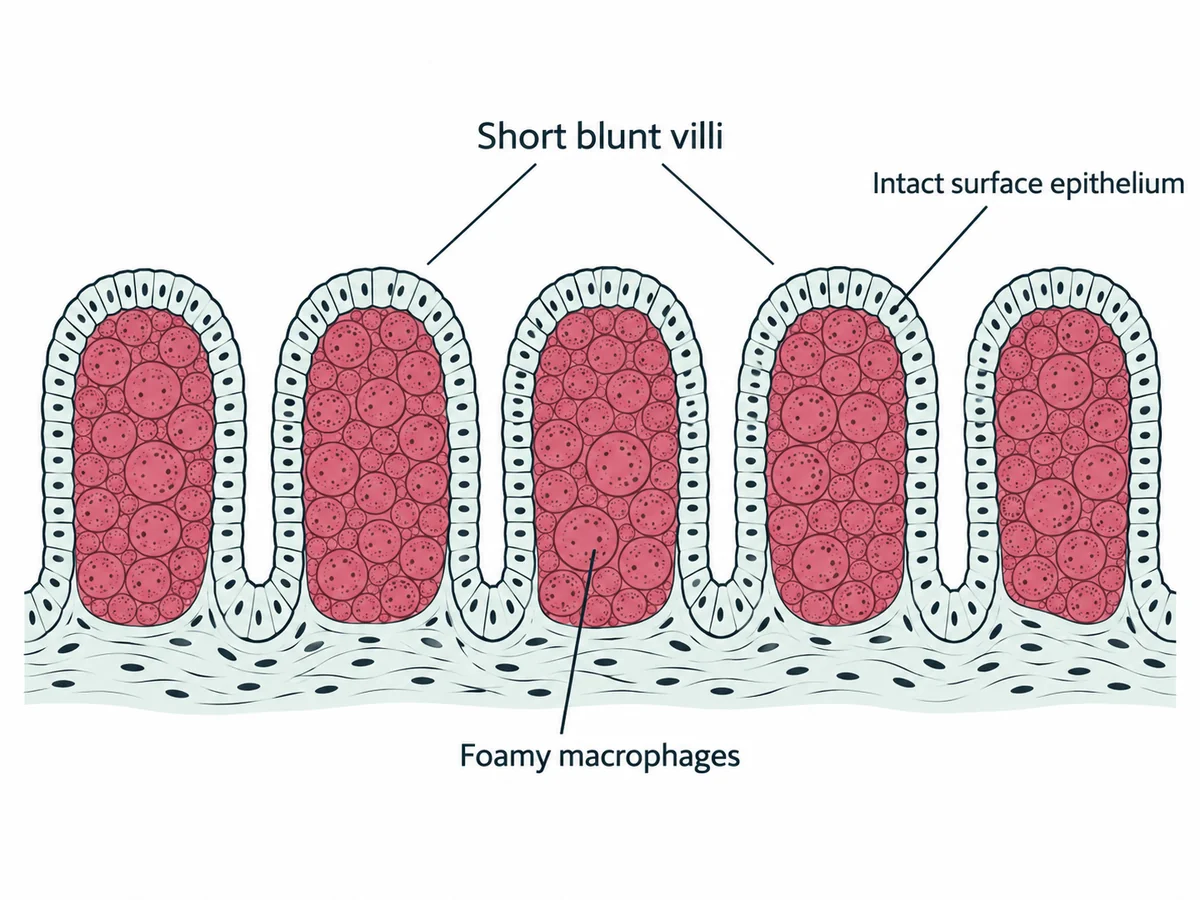
The macrophages accumulate in the lamina propria, distending the villi.
Their glycoprotein-rich contents stain magenta with periodic acid-Schiff.
Migratory arthralgia precedes the gut disease by years in most patients.
Central nervous system involvement - confusion, ophthalmoplegia, myoclonus - is the feared complication.
PAS-positive macrophages distending the villi
Why not the others
- A. Coeliac disease — gives villous atrophy with intraepithelial lymphocytosis and crypt hyperplasia, no foamy macrophages, and responds to gluten withdrawal.
- C. Mycobacterium avium complex enteritis — also fills macrophages and is PAS positive, but the organisms are acid-fast, and it occurs in advanced HIV infection.
- D. Intestinal tuberculosis — produces caseating granulomas with acid-fast bacilli, typically ileocaecal, and does not cause this neurological picture.
Remember
Joints first, gut second, brain last. The arthralgia is often dismissed for years before the diarrhoea arrives.
Go deeper
Treatment must cross the blood-brain barrier: ceftriaxone or meropenem for two weeks, then co-trimoxazole for a year. Shorter regimens relapse in the brain.
Confirm with PCR or immunohistochemistry for *Tropheryma whipplei*, because the PAS stain alone does not exclude mycobacteria - a Ziehl-Neelsen stain is always done alongside.
Immune reconstitution inflammatory syndrome can follow treatment and may need steroids.
Harrison's Principles of Internal Medicine, 22nd ed. (McGraw Hill, 2025); Robbins, Cotran & Kumar Pathologic Basis of Disease, 11th ed. (Elsevier, 2025).