
Recallab › Question bank › Medicine › Respiratory › #50258
Allergic bronchopulmonary aspergillosis
A 34-year-old woman with long-standing asthma has become steroid-dependent, coughs up brownish mucus plugs, and has fleeting pulmonary infiltrates. Total IgE is 2,400 IU/mL, she has 12% eosinophils, and skin prick testing to Aspergillus fumigatus is strongly positive. Which additional finding would you expect?
- A. An intracavitary fungal ball with an air crescent
- B. Peripheral bronchiectasis with normal proximal airways
- correctC. Central bronchiectasis with normal distal airways
- D. Diffuse subpleural honeycombing
Explanation
Key fact
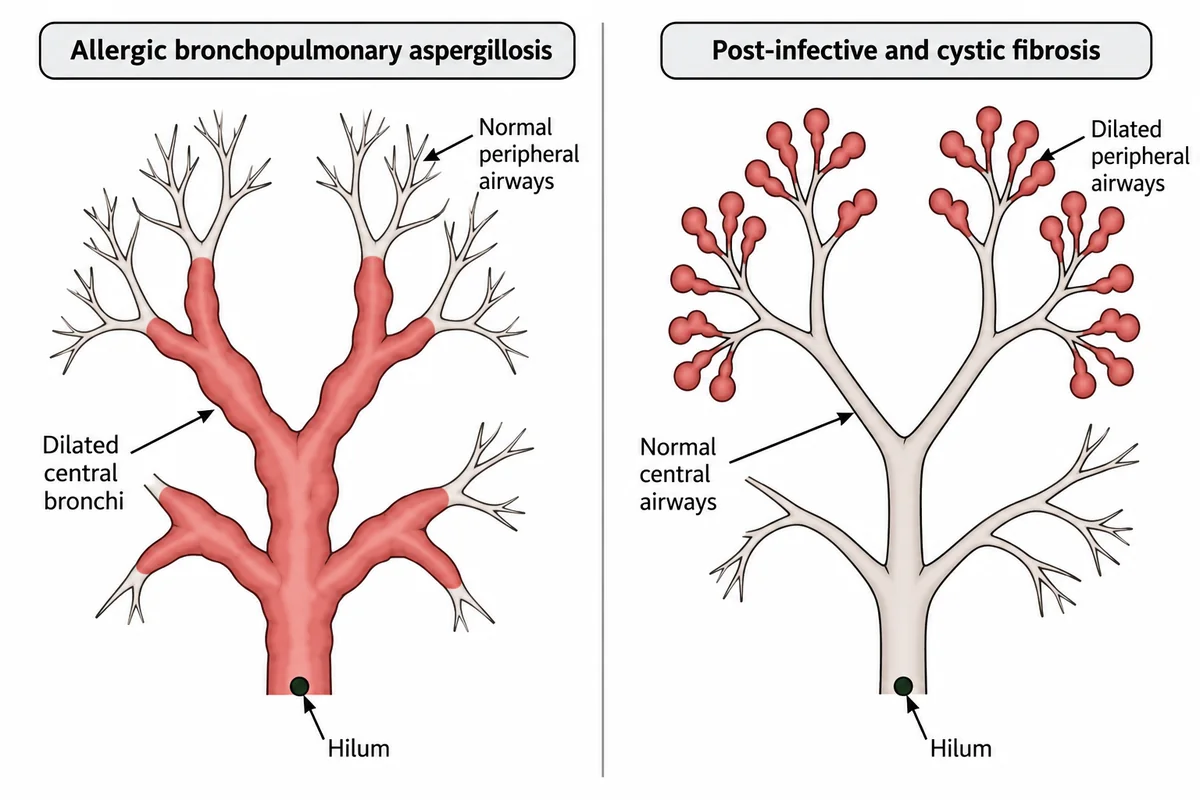
Central bronchiectasis is the radiological signature of ABPA. Most other causes of bronchiectasis are peripheral.
Central bronchiectasis with normal distal airways. The inflammatory reaction is to fungus colonising the proximal airways.
Why
Aspergillus colonises the airway without invading it.
The reaction is a type I and type III hypersensitivity, not an infection.
That damages the proximal, central bronchi, sparing the periphery.
The mucus plugs are thick and brown and contain hyphae.
Fleeting infiltrates come and go as plugs form and clear.
A very high total IgE, above 1,000 IU/mL, is a diagnostic criterion.
Where the bronchiectasis sits
Why not the others
- A. An intracavitary fungal ball with an air crescent — is an aspergilloma, which colonises a pre-existing cavity and causes haemoptysis, not asthma with high IgE.
- B. Peripheral bronchiectasis with normal proximal airways — is the usual pattern in post-infective bronchiectasis and in cystic fibrosis - the opposite distribution.
- D. Diffuse subpleural honeycombing — is the usual interstitial pneumonia pattern of pulmonary fibrosis, unrelated to Aspergillus hypersensitivity.
Remember
Central bronchiectasis in an asthmatic means think ABPA. Nothing else damages the proximal airways preferentially.
Go deeper
The four things that must be present: asthma or cystic fibrosis, immediate Aspergillus hypersensitivity, total IgE above 1,000 IU/mL, and raised specific IgE or IgG to Aspergillus.
Treatment is oral corticosteroids for exacerbations with itraconazole as a steroid-sparing agent; total IgE is followed to judge response.
Distinguish the whole Aspergillus family: allergic disease in the atopic, aspergilloma in a cavity, chronic pulmonary aspergillosis in structural lung disease, and invasive disease in the neutropenic.
Harrison's Principles of Internal Medicine, 22nd ed. (McGraw Hill, 2025).