
Recallab › Question bank › Medicine › Neurology › #50263
Thrombolysis in ischaemic stroke
A 66-year-old man is brought 2 hours after the sudden onset of right hemiparesis and aphasia. Blood pressure is 168/94, glucose 6.8 mmol/L, INR 1.0 and platelets normal. Non-contrast computed tomography of the head shows no haemorrhage and no established infarct. What is the most appropriate immediate treatment?
- correctA. Intravenous thrombolysis with alteplase or tenecteplase
- B. Aspirin 300 mg and admission to the stroke unit
- C. Intravenous heparin infusion
- D. Lower the blood pressure to below 140/90 before any other treatment
Explanation
Key fact
The window is 4.5 hours from the time the patient was last known well, and the only imaging needed before thrombolysis is a scan excluding haemorrhage.
Intravenous thrombolysis. He is 2 hours in, the scan excludes haemorrhage and there is no contraindication.
Why
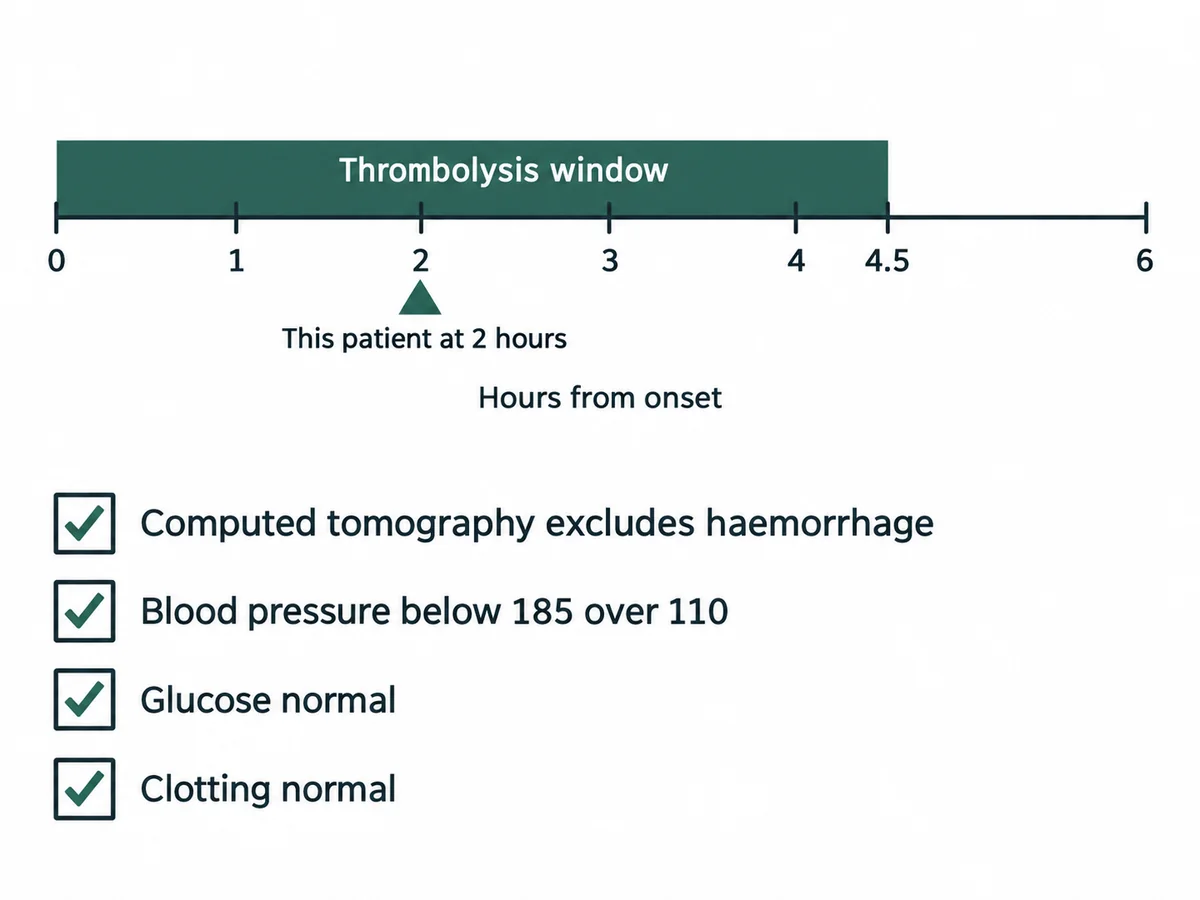
Onset was 2 hours ago, inside the 4.5-hour window.
Computed tomography excludes haemorrhage, which is all it needs to do.
Blood pressure of 168/94 is below the 185/110 threshold, so it does not block treatment.
Glucose, INR and platelets are all acceptable.
Benefit falls steeply with time, so door-to-needle time is the quality measure.
Aspirin is given, but 24 hours after thrombolysis, not before.
The clock, and what has to be true at each point
Why not the others
- B. Aspirin 300 mg and admission to the stroke unit — is correct management for someone outside the window or with a contraindication, and is given 24 hours after thrombolysis. Giving it now would preclude thrombolysis.
- C. Intravenous heparin infusion — has no role in acute ischaemic stroke and increases haemorrhagic transformation.
- D. Lower the blood pressure to below 140/90 before any other treatment — is wrong. Aggressive lowering reduces perfusion of the penumbra; the threshold before thrombolysis is 185/110, not 140/90.
Remember
Time is brain. Every minute of delay costs about 1.9 million neurones, and the number needed to treat rises steeply across the window.
Go deeper
Mechanical thrombectomy extends treatment to 6 hours routinely and up to 24 hours in selected patients with a large vessel occlusion and favourable perfusion imaging.
Wake-up stroke can still be treated if MRI shows a diffusion-FLAIR mismatch, indicating the infarct is recent.
The main contraindications are recent intracranial haemorrhage or surgery, active bleeding, an INR above 1.7, and a platelet count below 100,000.
Harrison's Principles of Internal Medicine, 22nd ed. (McGraw Hill, 2025).