
Recallab › Question bank › Surgery › #50268
Branchial cyst
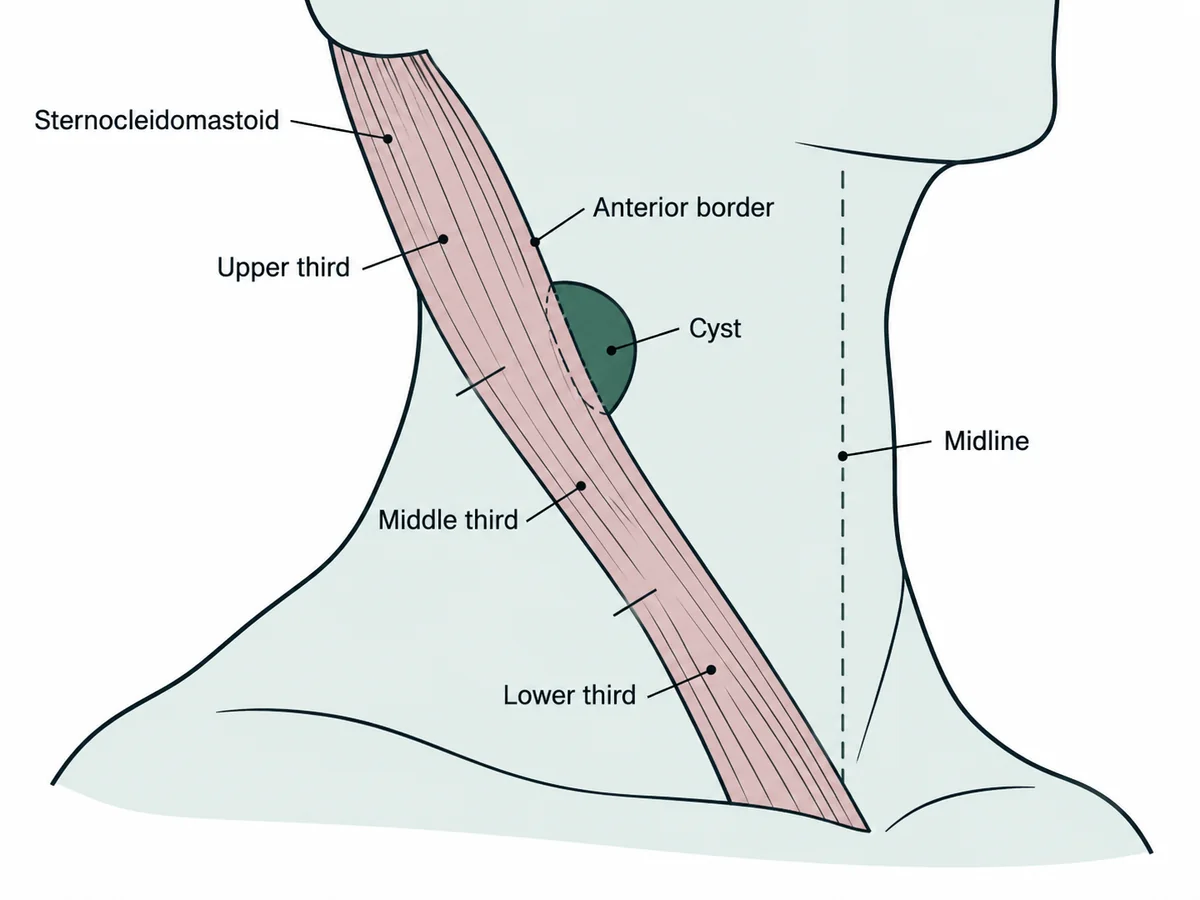
A 22-year-old man has a smooth, fluctuant, non-tender swelling in the left side of the neck that appeared after an upper respiratory infection. It lies deep to the anterior border of sternocleidomastoid at the junction of its upper and middle thirds, and does not move on swallowing or on tongue protrusion. What is the diagnosis?
- correctA. Branchial cyst
- B. Thyroglossal duct cyst
- C. Cystic hygroma
- D. Metastatic cervical lymph node
Explanation
Key fact
Branchial cyst: lateral, deep to the upper third of sternocleidomastoid, in a young adult, often appearing after an infection.
Branchial cyst. The site is characteristic and it is fixed to neither the thyroid nor the tongue base.
Why
It is a remnant of the second branchial cleft.
The classic site is at the anterior border of sternocleidomastoid, at the junction of its upper and middle thirds.
It becomes apparent in the second or third decade.
An upper respiratory infection swells the lymphoid tissue in its wall and reveals it.
It does not move on swallowing, which excludes a thyroid-related swelling.
It does not move on tongue protrusion, which excludes a thyroglossal cyst.
The site of a second branchial cleft cyst
Why not the others
- B. Thyroglossal duct cyst — is midline and moves upwards on protrusion of the tongue, because it is tethered to the foramen caecum.
- C. Cystic hygroma — presents in infancy in the posterior triangle, is soft, compressible and brilliantly transilluminant.
- D. Metastatic cervical lymph node — is firm or hard and usually fixed, occurs in older patients, and demands a search for a primary in the upper aerodigestive tract.
Remember
Midline moves with the tongue; lateral does not move at all. Two questions separate the two commonest congenital neck swellings.
Go deeper
The cyst contains turbid fluid with cholesterol crystals, and its wall is lined by squamous epithelium with lymphoid tissue.
Treatment is complete excision. The tract, when present, passes between the internal and external carotid arteries to the tonsillar fossa.
Never assume a lateral neck cyst in a patient over 40 is branchial - a cystic metastasis from a papillary thyroid or oropharyngeal carcinoma looks identical and is far commoner at that age.
Bailey & Love's Short Practice of Surgery, 28th ed. (CRC Press, 2023); Sabiston Textbook of Surgery, 22nd ed. (Elsevier, 2025).