
Recallab › Question bank › Surgery › #50270
Prostate cancer
In which zone of the prostate do most carcinomas arise, and why does this explain the clinical presentation?
- A. The central zone, which is why cancer presents with haematospermia
- B. The transition zone, which is why cancer causes early urinary obstruction
- C. The anterior fibromuscular stroma, which is why cancer is impalpable and asymptomatic
- correctD. The peripheral zone, which is why cancer is felt on rectal examination and causes urinary symptoms late
Explanation
Key fact
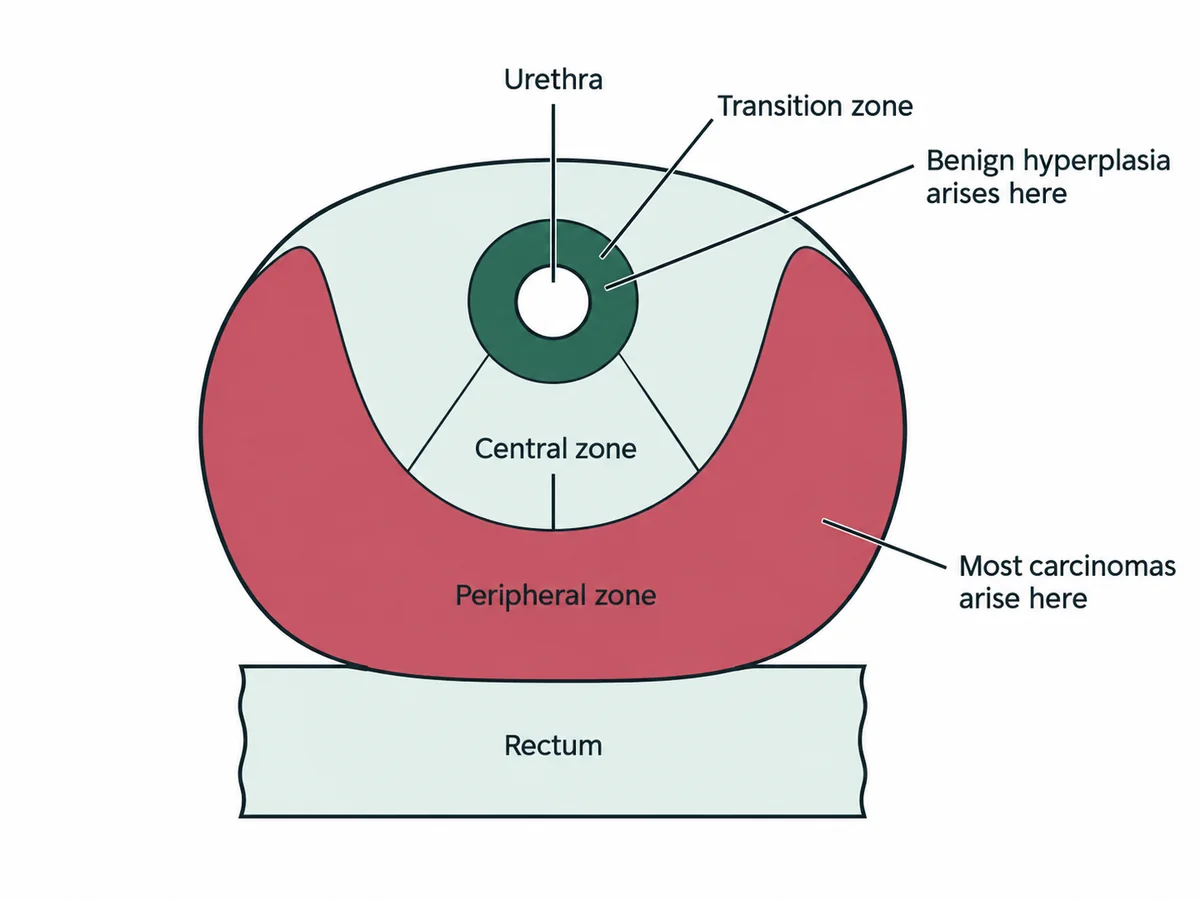
Cancer starts in the peripheral zone; benign hyperplasia starts in the transition zone. That single difference explains almost every clinical contrast between them.
The peripheral zone, which lies against the rectum and away from the urethra - so it is palpable early and obstructs late.
Why
About 70% of prostate cancers arise in the peripheral zone.
That zone forms the posterior surface, directly against the rectal wall.
So a nodule or asymmetry is felt on digital rectal examination.
It is far from the urethra, so obstruction is a late feature.
Benign hyperplasia arises in the transition zone, which surrounds the urethra, and obstructs early.
That is why urinary symptoms are a poor screening tool for cancer.
The zones, the urethra and the rectum
Why not the others
- A. The central zone, which is why cancer presents with haematospermia — accounts for under 10% of cancers, and haematospermia is not a characteristic presentation.
- B. The transition zone, which is why cancer causes early urinary obstruction — describes benign prostatic hyperplasia. Only about 20% of cancers arise there.
- C. The anterior fibromuscular stroma, which is why cancer is impalpable and asymptomatic — contains no glands, so carcinoma does not arise there.
Remember
Cancer at the back, hyperplasia in the middle. One you feel, the other you hear about from the patient.
Go deeper
Multiparametric MRI before biopsy improves detection of significant cancer and spares many men an unnecessary biopsy; PI-RADS scores the likelihood.
The Gleason score grades the two commonest architectural patterns; the ISUP grade groups 1 to 5 are now the reported form.
Metastases are characteristically osteoblastic and go to the lumbar spine and pelvis through the valveless vertebral venous plexus of Batson.
Bailey & Love's Short Practice of Surgery, 28th ed. (CRC Press, 2023); Sabiston Textbook of Surgery, 22nd ed. (Elsevier, 2025).