
Recallab › Question bank › Orthopaedics › #50271
Chordoma
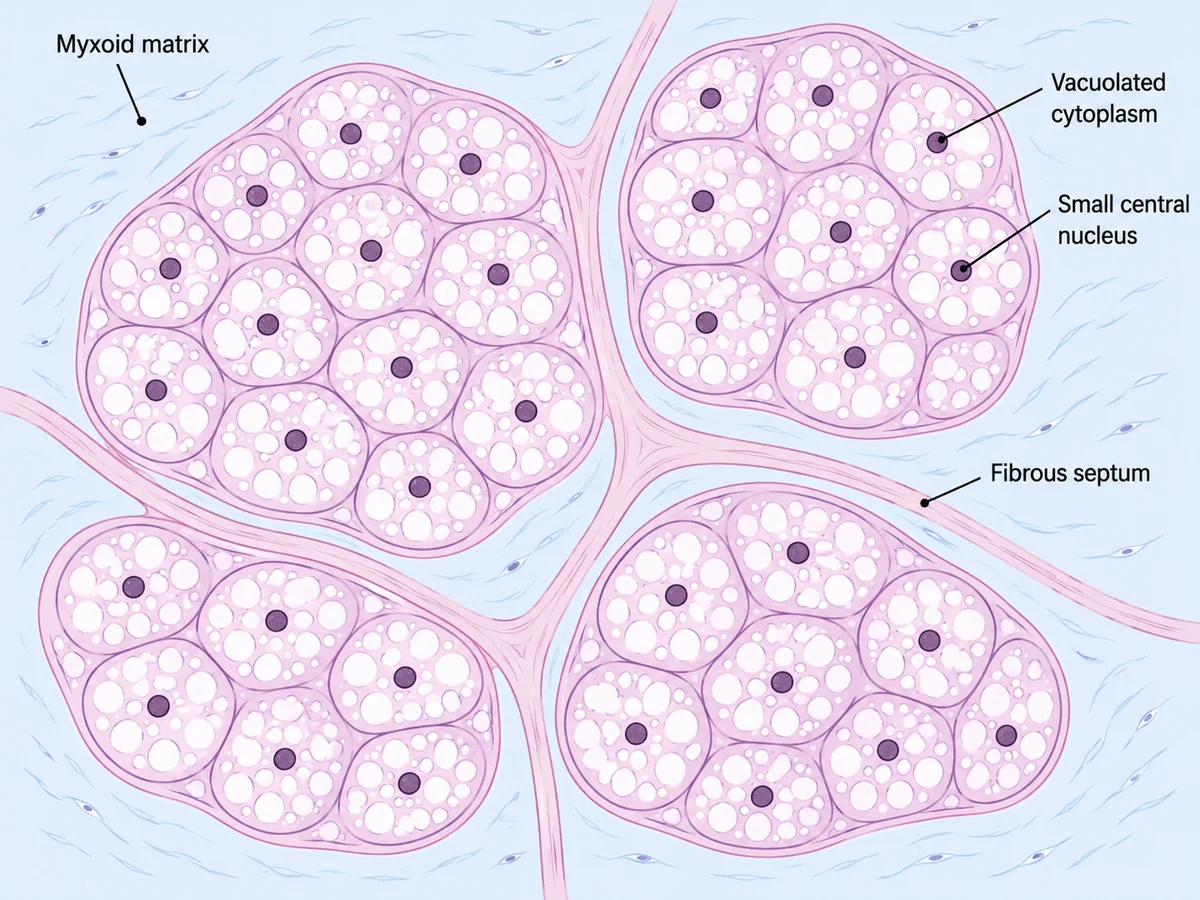
A 58-year-old man has 18 months of deep sacral pain with recent constipation and perineal numbness. Imaging shows a midline destructive lesion of the sacrum with a large soft tissue mass. Histology shows lobules of cells with vacuolated, bubbly cytoplasm in a myxoid matrix. What is the diagnosis?
- A. Giant cell tumour
- B. Ewing sarcoma
- C. Chondrosarcoma
- correctD. Chordoma
Explanation
Key fact
Chordoma is a midline tumour of notochord remnants, and its physaliphorous bubbly cells are diagnostic.
Chordoma. A midline sacral destructive lesion with physaliphorous cells is chordoma and nothing else.
Why
The notochord runs in the midline and regresses, leaving remnants.
Tumours from those remnants therefore arise in the midline.
Half are sacrococcygeal, a third at the clivus, the rest in the vertebral bodies.
Physaliphorous cells - bubbly, vacuolated cytoplasm - are the histological signature.
They are brachyury positive on immunohistochemistry, which confirms notochordal origin.
Growth is slow but relentless, which is why symptoms are present for many months.
Physaliphorous cells in a myxoid matrix
Why not the others
- A. Giant cell tumour — arises at the epiphysis of a long bone, usually around the knee in a young adult, and shows osteoclast-like giant cells in a mononuclear stroma.
- B. Ewing sarcoma — affects children and adolescents, arises in the diaphysis with an onion-skin periosteal reaction, and shows small round blue cells.
- C. Chondrosarcoma — produces malignant cartilage with punctate or ring-and-arc calcification, is usually in the pelvis or proximal femur, and is not midline sacral.
Remember
Midline, notochord, bubbly cells. Sacrum and clivus are the two ends of the same embryological line.
Go deeper
Treatment is wide en bloc resection, which is difficult in the sacrum and often costs bladder, bowel and sexual function; sacrifice of S3 and below is usually tolerated.
It is relatively radioresistant, so proton beam therapy is used where available.
Local recurrence is the rule if the margin is breached, and late metastases to lung and bone occur.
Apley & Solomon's System of Orthopaedics and Trauma, 10th ed. (CRC Press, 2018); Robbins, Cotran & Kumar Pathologic Basis of Disease, 11th ed. (Elsevier, 2025).