
Recallab › Question bank › Radiology › #50276
Carotid body tumour
A 46-year-old woman has a slowly enlarging, painless, pulsatile mass at the angle of the jaw that can be moved from side to side but not up and down. A bruit is audible over it. What is the most appropriate next investigation?
- A. Plain radiograph of the neck
- B. Incisional biopsy under local anaesthetic
- C. Fine needle aspiration cytology of the mass
- correctD. Duplex ultrasound followed by contrast angiography
Explanation
Key fact
Never needle a pulsatile neck mass. A carotid body tumour is a highly vascular paraganglioma, and biopsy risks torrential haemorrhage.
Duplex ultrasound followed by angiography. Imaging makes the diagnosis and plans the operation.
Why
A pulsatile mass at the carotid bifurcation with a bruit is a carotid body tumour.
It is tethered to the bifurcation, so it moves side to side but not vertically - Fontaine's sign.
It is a paraganglioma, richly supplied by the ascending pharyngeal artery.
Duplex shows a hypervascular mass splaying the bifurcation.
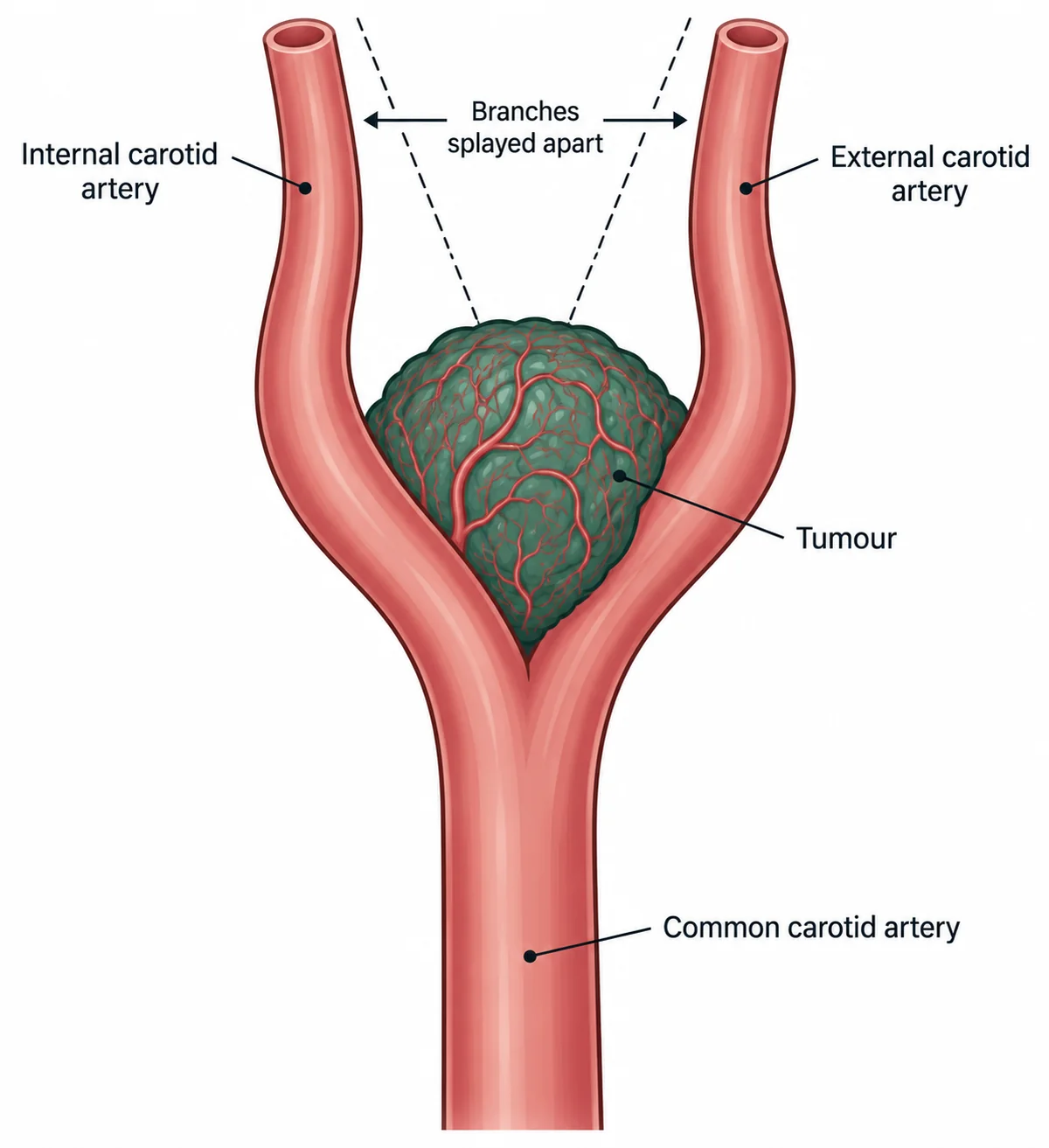
Angiography confirms the lyre sign - the internal and external carotids splayed apart like the arms of a lyre.
Imaging also allows preoperative embolisation to be planned.
The lyre sign
Why not the others
- A. Plain radiograph of the neck — adds nothing. It cannot show a soft tissue vascular mass or its relationship to the carotid.
- B. Incisional biopsy under local anaesthetic — is worse still, for the same reason, and outside an operating theatre it is dangerous.
- C. Fine needle aspiration cytology of the mass — risks severe haemorrhage and is contraindicated in a pulsatile vascular neck mass.
Remember
Pulsatile plus a bruit means image, never needle. The same rule covers juvenile nasopharyngeal angiofibroma.
Go deeper
The Shamblin classification grades how far the tumour encircles the carotid and predicts operative difficulty and the need for vascular reconstruction.
Most are non-functioning, but a minority secrete catecholamines - so ask about headache, palpitations and sweating and screen with plasma metanephrines before surgery.
About a third are familial, associated with succinate dehydrogenase mutations, and those are more often multiple and bilateral - so genetic testing is offered.
Bailey & Love's Short Practice of Surgery, 28th ed. (CRC Press, 2023); Sabiston Textbook of Surgery, 22nd ed. (Elsevier, 2025).