
Recallab › Question bank › Gynaecology › Disorders In Menstruation › #50279
Heavy menstrual bleeding: first-line treatment
A 38-year-old woman, para 2, has heavy periods soaking through protection hourly for two days each cycle. Examination, ultrasound and endometrial biopsy are all normal, and she does not wish to conceive again. Haemoglobin is 9.8 g/dL. What is the most appropriate first-line treatment?
- A. Hysterectomy
- B. Cyclical oral norethisterone from day 5 to 26
- C. Endometrial ablation
- correctD. A levonorgestrel-releasing intrauterine system
Explanation
Key fact
The levonorgestrel intrauterine system is first-line for heavy menstrual bleeding with a normal uterus. It reduces blood loss by around 90% and is reversible.
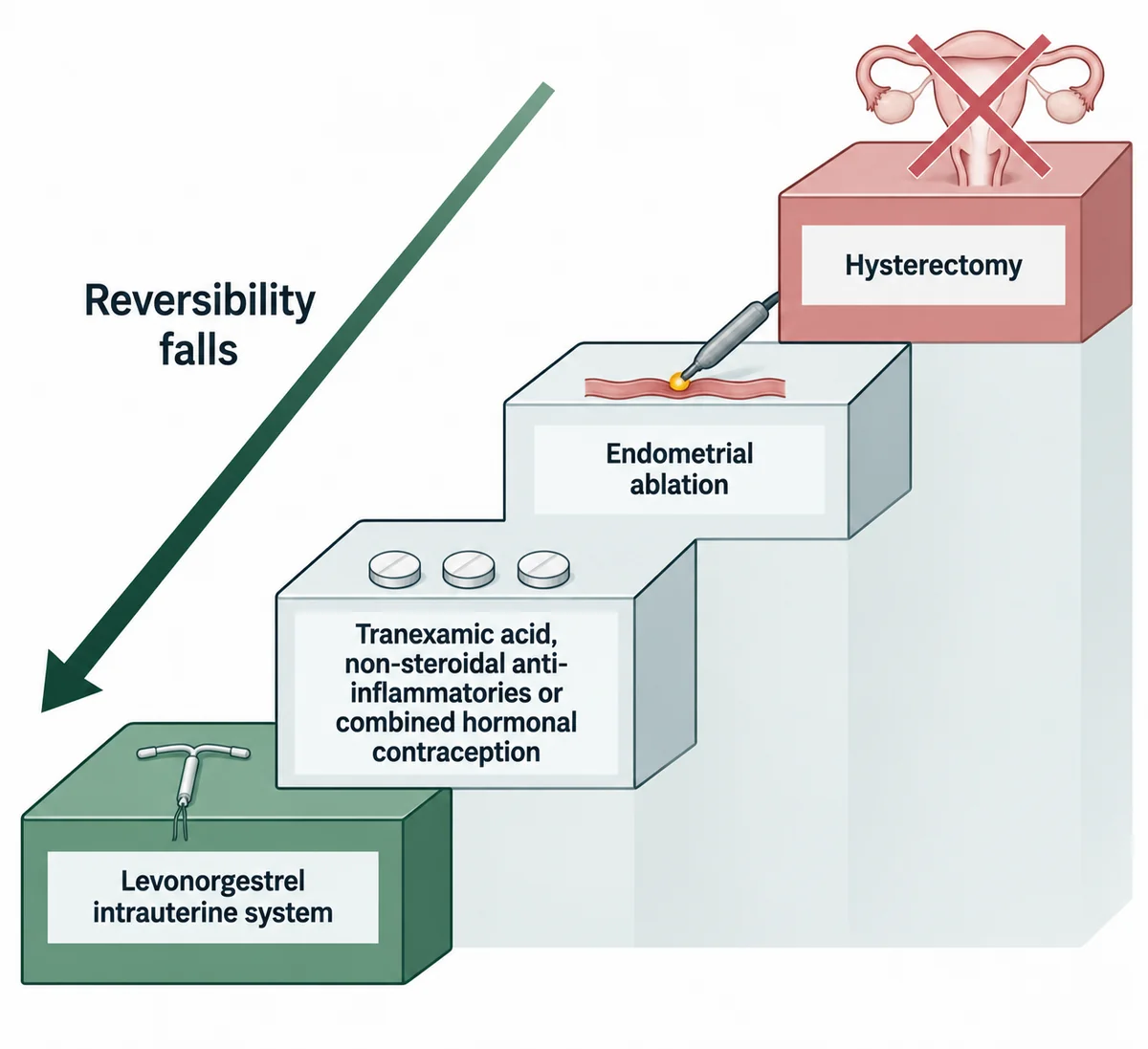
A levonorgestrel-releasing intrauterine system. It is the most effective medical option, and it is also contraception.
Why
Investigation is normal, so this is heavy bleeding with no structural cause.
The system releases levonorgestrel directly into the cavity.
The endometrium becomes atrophic, and blood loss falls by about 90%.
Systemic absorption is low, so side effects are far fewer than with oral progestogen.
It provides contraception, which she needs, and is fully reversible.
It is also the first step before considering any surgical option.
Escalating treatment for heavy menstrual bleeding
Why not the others
- A. Hysterectomy — is definitive but is a major operation and is reserved for failure of everything else, or where the woman requests it after counselling.
- B. Cyclical oral norethisterone from day 5 to 26 — is less effective than the intrauterine system, has more systemic side effects, and is not first-line. Luteal-phase-only progestogen is ineffective.
- C. Endometrial ablation — is effective but ends fertility and is a second-line option after medical treatment has failed.
Remember
Start with the system, not the scalpel. Nine out of ten women avoid surgery on it.
Go deeper
Investigate before treating: endometrial biopsy is indicated over 45, or younger with risk factors, intermenstrual bleeding or treatment failure.
Non-hormonal options for a woman wanting to conceive are tranexamic acid and mefenamic acid, both taken only during the period.
Always check a full blood count and ferritin, and treat the iron deficiency as well as the bleeding.
DC Dutta's Textbook of Gynecology, 9th ed. (Jaypee, 2023); Williams Gynecology, 4th ed. (McGraw Hill, 2020).