
Recallab › Question bank › Gynaecology › #50281
Female sterilisation
A 32-year-old woman, para 3, requests permanent contraception. She is counselled that the method is intended to be irreversible and has a small failure rate. What is the most important specific warning about a pregnancy occurring after tubal sterilisation?
- A. A high chance of twin pregnancy
- B. A high chance of a molar pregnancy
- C. A high chance of fetal anomaly
- correctD. A disproportionately high chance that it will be ectopic
Explanation
Key fact
Any pregnancy after sterilisation is ectopic until proved otherwise. The absolute risk is small, but the proportion that are ectopic is very high.
A disproportionately high chance that it will be ectopic. A damaged tube that recanalises still cannot transport an embryo normally.
Why
Sterilisation occludes the tube; failure means it has partially recanalised or a fistula has formed.
Sperm can traverse such a channel, but the fertilised ovum cannot be transported normally.
So implantation occurs in the tube far more often than in an unsterilised woman.
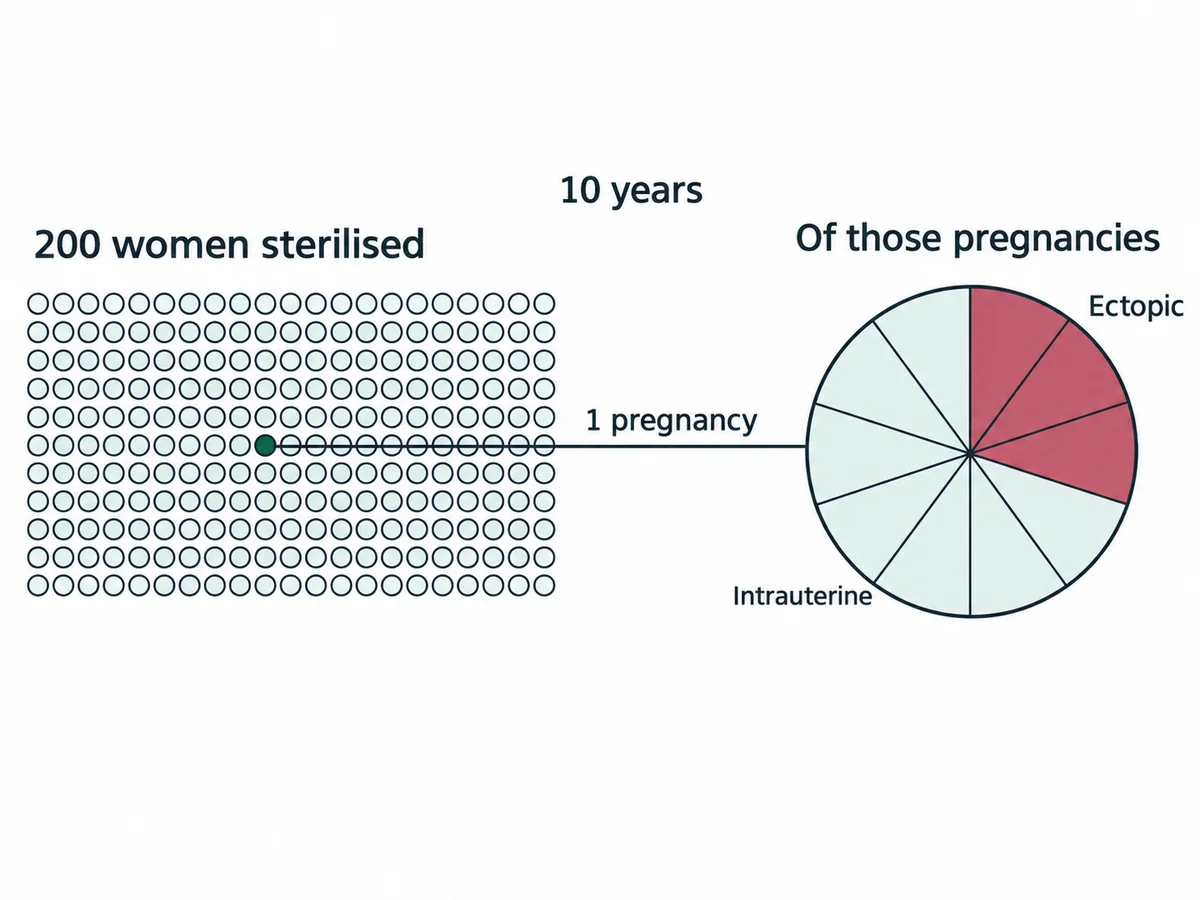
The overall failure rate is low, around 1 in 200 over ten years.
But of the pregnancies that do occur, a large proportion are ectopic.
So any woman with amenorrhoea after sterilisation needs a test and a scan urgently.
Small absolute risk, high conditional risk
Why not the others
- A. A high chance of twin pregnancy — has no association with sterilisation.
- B. A high chance of a molar pregnancy — is unrelated. Molar pregnancy risk relates to age and previous molar pregnancy.
- C. A high chance of fetal anomaly — is not associated with sterilisation. The procedure does not affect the fetus.
Remember
Amenorrhoea after sterilisation is an ectopic until a scan says otherwise. It is one of the classic missed diagnoses.
Go deeper
Timing matters in programme practice: interval sterilisation is done in the follicular phase; postpartum minilaparotomy within 7 days; and concurrently with caesarean section.
Written informed consent must record that it is permanent, that failure can occur, and that alternatives including vasectomy were discussed.
Vasectomy is simpler, safer and cheaper, and is not effective until azoospermia is confirmed - usually after about 3 months or 20 ejaculations.
DC Dutta's Textbook of Gynecology, 9th ed. (Jaypee, 2023); Park K. Park's Textbook of Preventive and Social Medicine, 28th ed. (Bhanot, 2025).