
Recallab › Question bank › Ophthalmology › #50298
Cataract surgery decision
A 68-year-old man has had gradually failing vision in the right eye for two years, and now has sudden severe pain, redness and haloes in that eye. The cornea is hazy, the anterior chamber is shallow, the lens is white and swollen, and the intraocular pressure is 46 mmHg. What has happened?
- A. Acute anterior uveitis
- B. Primary open angle glaucoma
- correctC. Phacomorphic glaucoma from an intumescent cataract
- D. Phacolytic glaucoma from leaked lens protein
Explanation
Key fact
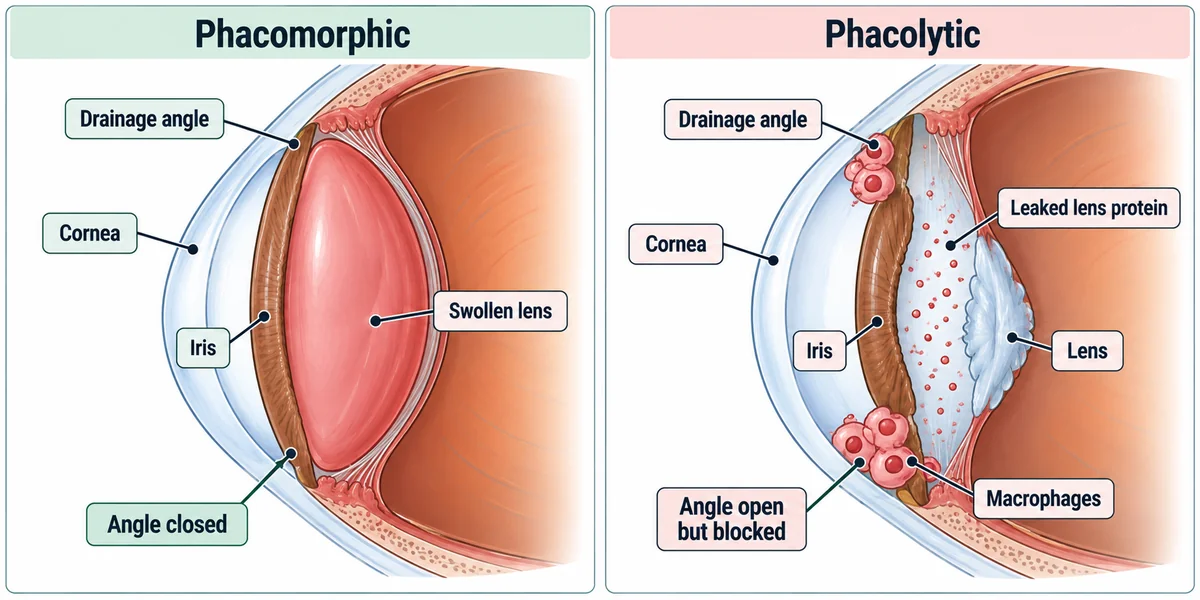
A swollen lens pushes the iris forward and closes the angle mechanically - phacomorphic glaucoma. Phacolytic glaucoma blocks an open angle with protein.
Phacomorphic glaucoma. The intumescent lens has physically shallowed the chamber and closed the angle.
Why
As a cataract matures it can absorb water and swell - intumescent.
The swollen lens pushes the iris-lens diaphragm forwards.
The anterior chamber becomes shallow and the drainage angle closes.
Aqueous cannot leave, so pressure rises abruptly.
The picture is that of acute angle closure: pain, redness, haloes and a hazy cornea.
The definitive treatment is removal of the lens once the pressure is controlled.
Two lens-induced glaucomas, two mechanisms
Why not the others
- A. Acute anterior uveitis — causes pain, redness and photophobia with a small irregular pupil and cells in the anterior chamber. The pressure is usually normal or low, and the lens is not white and swollen.
- B. Primary open angle glaucoma — is painless and chronic, with a normal-depth chamber and a gradually cupping disc.
- D. Phacolytic glaucoma from leaked lens protein — occurs with a hypermature lens whose protein leaks through an intact capsule and is engulfed by macrophages that block an open trabecular meshwork. The chamber is deep, not shallow.
Remember
Shallow chamber means the lens is pushing; deep chamber means the lens is leaking. One sign separates the two lens glaucomas.
Go deeper
Treat the pressure first - topical and systemic agents - then remove the cataract; the lens is both the cause and the cure.
Always examine the other eye: a narrow angle there indicates the anatomical predisposition and may warrant prophylactic laser iridotomy.
Other lens-induced glaucomas: phacoantigenic uveitis after capsule rupture, and lens particle glaucoma after incomplete cataract surgery.
Khurana AK. Comprehensive Ophthalmology, 10th ed. (Jaypee, 2025).