
Recallab › Question bank › Ophthalmology › #50300
Cherry-red spot
A 14-month-old boy has lost the ability to sit, has an exaggerated startle to sound, and fundoscopy shows a cherry-red spot at each macula. The liver and spleen are not enlarged. Which enzyme is deficient?
- A. Glucocerebrosidase
- B. Alpha-galactosidase A
- C. Sphingomyelinase
- correctD. Hexosaminidase A
Explanation
Key fact
Cherry-red spot with a normal-sized liver and spleen is Tay-Sachs; with hepatosplenomegaly it is Niemann-Pick. The abdomen makes the distinction.
Hexosaminidase A. Tay-Sachs disease - regression, an exaggerated startle and a cherry-red spot, with no organomegaly.
How it happens
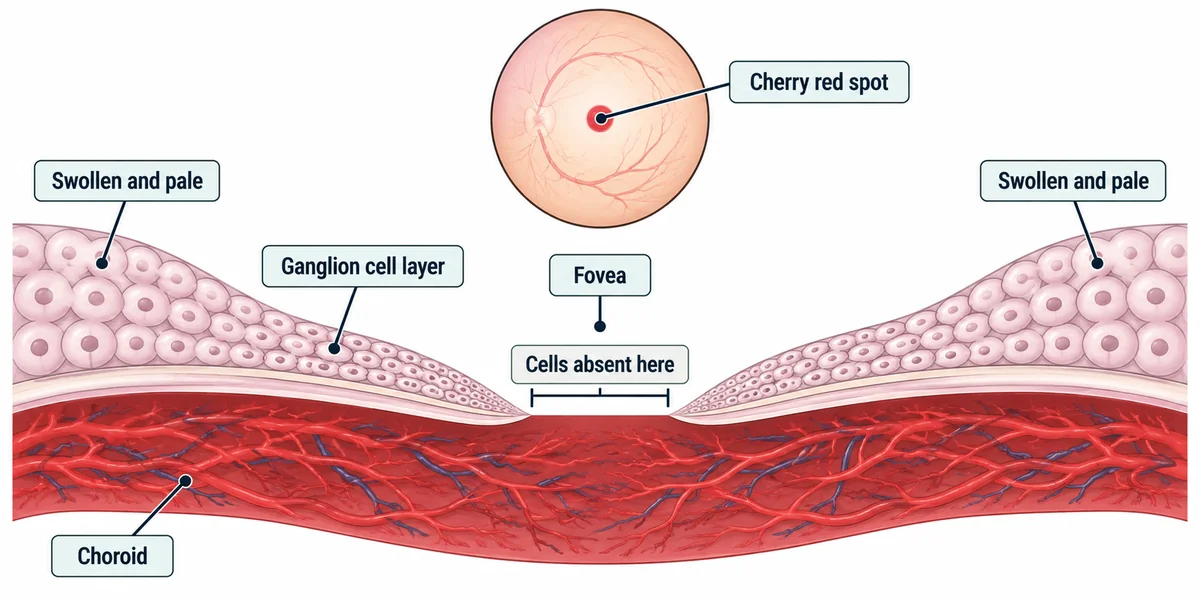
- Ganglioside accumulates in retinal ganglion cells, which are thick around the macula.
- The macula itself - the fovea - has no ganglion cells.
- So the fovea stays transparent and the choroidal red shows through it.
- The surrounding pale swollen retina frames it - hence a cherry-red spot.
- Tay-Sachs stores GM2 ganglioside from hexosaminidase A deficiency.
- It does not accumulate in liver or spleen, so the abdomen is normal - the key discriminator.
Why the fovea looks red
Why not the others
- A. Glucocerebrosidase — deficiency is Gaucher disease, with hepatosplenomegaly, bone pain and pancytopenia, but no cherry-red spot in the common type 1.
- B. Alpha-galactosidase A — deficiency is Fabry disease, causing acroparaesthesiae, angiokeratomas and renal failure, with a corneal verticillata rather than a cherry-red spot.
- C. Sphingomyelinase — deficiency is Niemann-Pick disease, which also gives a cherry-red spot but with marked hepatosplenomegaly. The abdomen here is normal.
Remember
Cherry-red spot: feel the abdomen. Normal means Tay-Sachs; enlarged means Niemann-Pick.
Go deeper
The commonest cause of a cherry-red spot in an adult is central retinal artery occlusion - the same optical explanation, with a pale ischaemic retina instead of a storage-swollen one.
Tay-Sachs is autosomal recessive and markedly commoner in Ashkenazi Jewish populations, where carrier screening has reduced incidence dramatically.
The exaggerated startle to sound - hyperacusis - is an early and distinctive feature that often precedes the regression.
Khurana AK. Comprehensive Ophthalmology, 10th ed. (Jaypee, 2025); Robbins, Cotran & Kumar Pathologic Basis of Disease, 11th ed. (Elsevier, 2025).