
Recallab › Question bank › Pathology › #50319
Capillary haemangioma
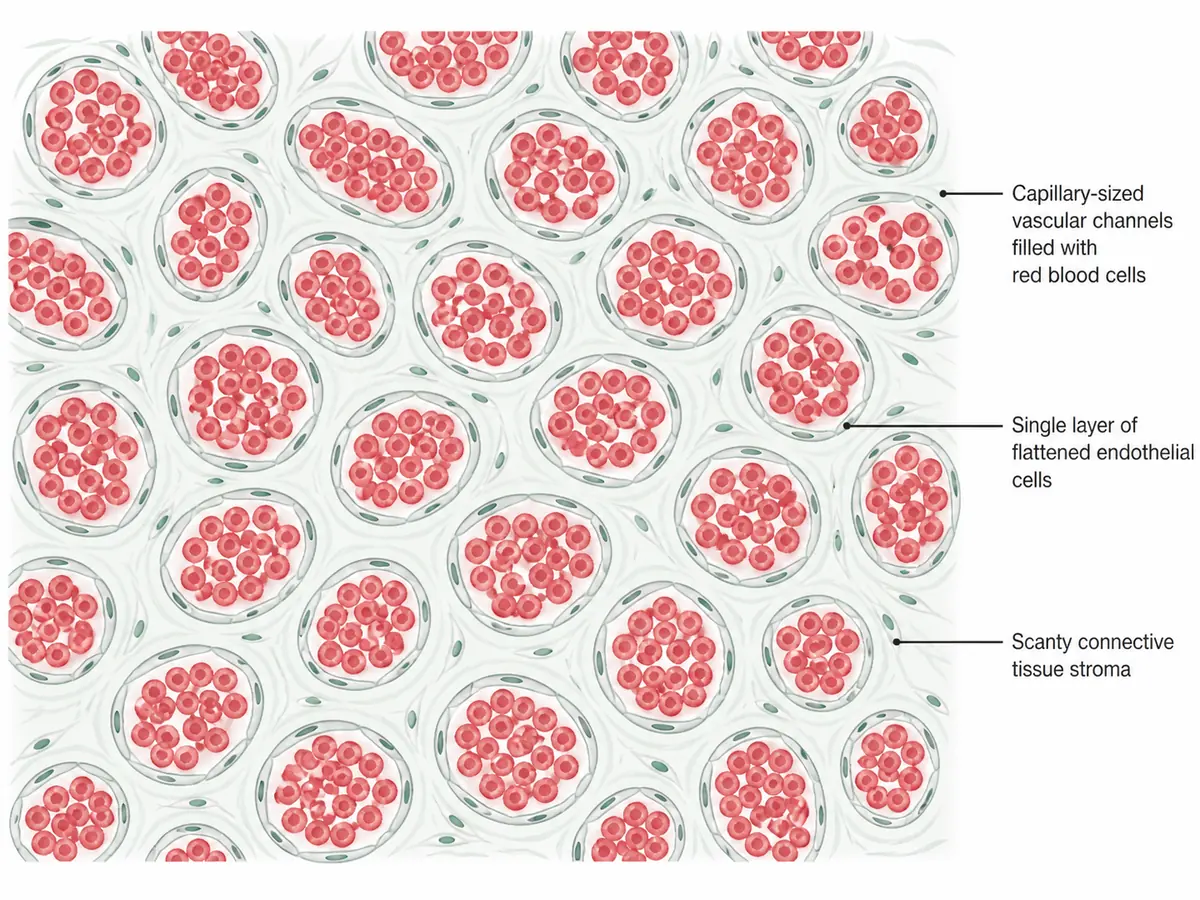
A 3-month-old infant has a bright red, compressible swelling over the sternum that has grown since birth. Biopsy shows closely packed capillary-sized channels lined by a single layer of flat endothelium, separated by scant stroma. What is the diagnosis?
- correctA. Capillary haemangioma
- B. Kaposi sarcoma
- C. Pyogenic granuloma
- D. Angiosarcoma
Explanation
Key fact
Well-formed capillary channels with flat, bland endothelium is a benign haemangioma. Malignancy shows piled-up, atypical endothelium instead.
Capillary haemangioma. A compressible red lesion present from infancy with orderly capillary channels is the commonest tumour of infancy.
Why
The channels are capillary-sized and regularly formed, not slit-like or ragged.
The lining is a single flat layer with no nuclear atypia or mitoses.
Compressibility on examination confirms a blood-filled space.
Onset at birth with early growth is the natural history of an infantile haemangioma.
Capillary haemangioma: packed, well-formed channels with flat endothelium
Why not the others
- B. Kaposi sarcoma — shows spindle cells with slit-like vascular spaces and extravasated red cells, and is a disease of immunosuppression, not infancy.
- C. Pyogenic granuloma — is a lobular capillary proliferation with a surface ulcer and heavy inflammation, usually after minor trauma, and it grows in weeks not months.
- D. Angiosarcoma — shows piled-up atypical endothelium forming irregular, anastomosing slit-like channels that dissect through tissue. Nothing here is atypical.
Remember
Flat endothelium, formed channels, benign. Piled-up endothelium is the red flag.
Go deeper
Most infantile haemangiomas involute spontaneously by school age, so observation is the default and biopsy is rarely needed.
Propranolol has replaced steroids for lesions that threaten the airway, the eye or feeding, and works within days.
The cavernous variant has large dilated spaces rather than capillaries, involutes less reliably, and may trap platelets - the Kasabach-Merritt phenomenon.
Robbins, Cotran & Kumar Pathologic Basis of Disease, 11th ed. (Elsevier, 2025); Fitzpatrick's Dermatology, 9th ed. (McGraw Hill, 2019).