
Recallab › Question bank › Microbiology › Parasitology › #50330
Malaria species on the blood film
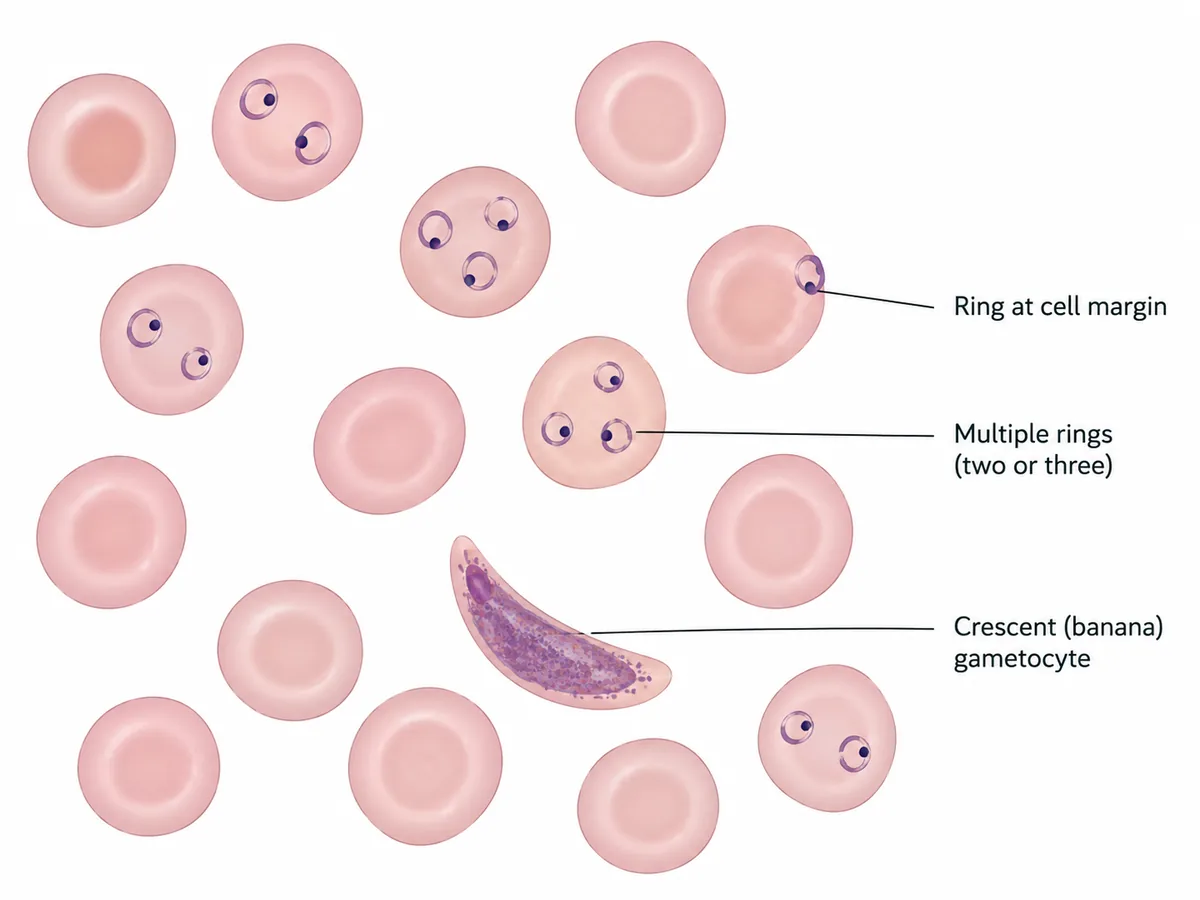
A traveller returning from West Africa has fever and confusion. The thin film shows red cells of normal size, many carrying two or more delicate ring forms, some rings at the cell margin, and a single banana-shaped gametocyte. Which species is this?
- A. Plasmodium ovale
- B. Plasmodium malariae
- C. Plasmodium vivax
- correctD. Plasmodium falciparum
Explanation
Key fact
Multiple rings per cell, appliqué forms and a banana gametocyte mean falciparum. No other species makes a crescentic gametocyte.
Plasmodium falciparum. The film shows the three features that are effectively diagnostic of it.
Why
Falciparum invades red cells of any age, so parasitaemia climbs high.
High parasitaemia gives multiple rings in one cell.
Rings pushed to the rim are called accolé or appliqué forms.
The crescentic banana gametocyte is unique to this species.
The red cells stay normal in size, unlike the enlarged cells of vivax.
Falciparum on a thin film: multiple rings and a banana gametocyte
Why not the others
- A. Plasmodium ovale — enlarges and ovalises the cell, often with a fimbriated edge, and also has a round gametocyte.
- B. Plasmodium malariae — gives band-form trophozoites in normal-sized cells and a low parasitaemia. Multiple rings per cell would be very unusual.
- C. Plasmodium vivax — enlarges the red cell, stippling it with Schuffner dots, and makes an amoeboid trophozoite with a round gametocyte.
Remember
Bananas and crowded rings: falciparum. It is the only one that kills quickly.
Go deeper
Only falciparum causes cerebral malaria, because infected cells express proteins that make them adhere to the endothelium and sequester in small vessels.
That sequestration means the peripheral parasitaemia can understate the true burden, since mature forms are hidden in the microvasculature.
Falciparum and malariae have no hepatic hypnozoite stage, so primaquine radical cure is needed only for vivax and ovale.
Ananthanarayan and Paniker's Textbook of Microbiology, 11th ed. (Universities Press, 2020); Jawetz, Melnick & Adelberg's Medical Microbiology, 29th ed. (McGraw Hill, 2025).