
Recallab › Question bank › Social & Preventive Medicine › Communicable Diseases › #50338
Chickenpox in a hostel outbreak
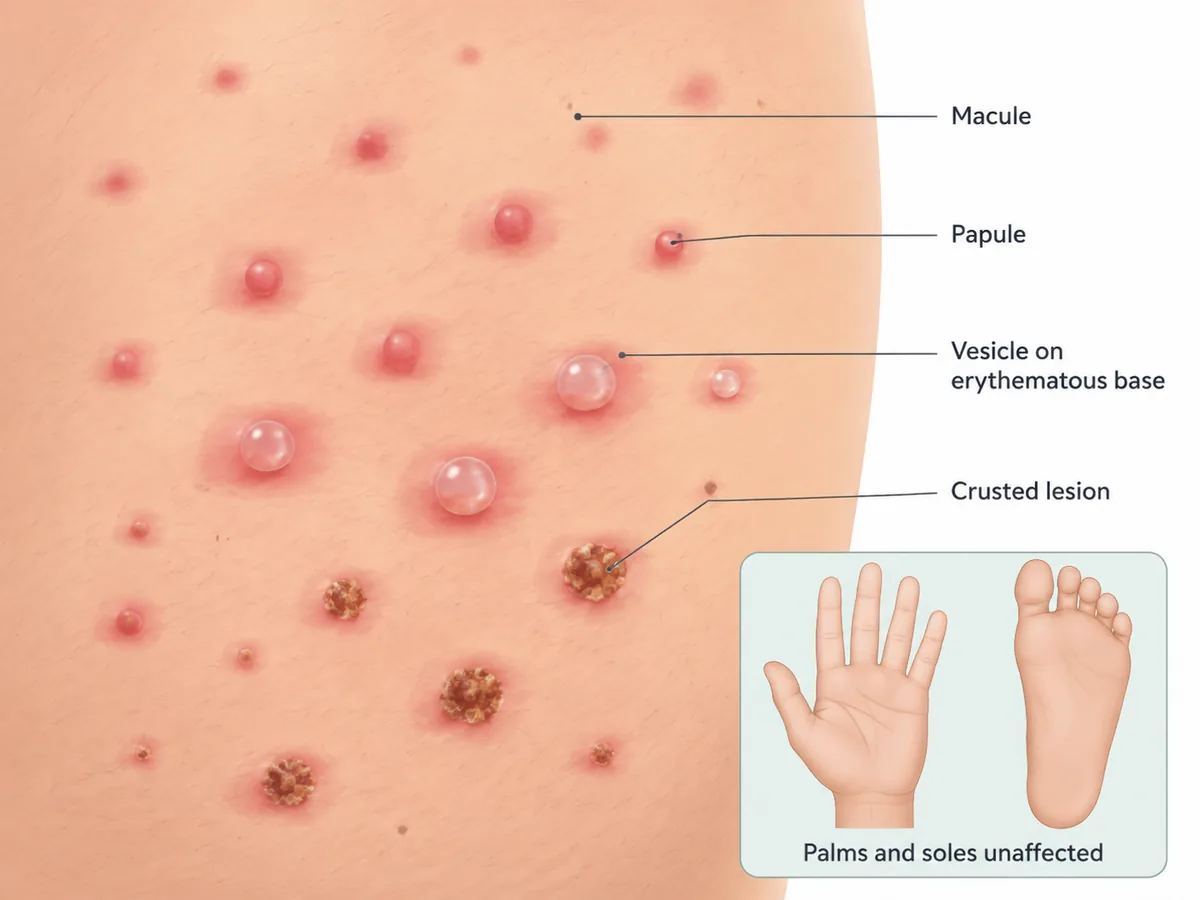
In a boys' hostel, several students develop fever followed by an itchy rash in which macules, papules, vesicles and crusts are all present together, sparing the palms and soles. For how long must a case be isolated?
- A. For 21 days from the onset of rash
- B. Isolation is unnecessary once the fever settles
- C. Until 48 hours of aciclovir have been completed
- correctD. Until all the lesions have crusted over
Explanation
Key fact
Chickenpox is infectious until every lesion has crusted. Crusting, not a fixed number of days, ends isolation.
Until all lesions have crusted over. In practice this is about 5 to 7 days after the rash starts, but the skin decides, not the calendar.
Why
The pleomorphic rash - all stages at once - is diagnostic of varicella.
Infectivity begins 1 to 2 days before the rash appears.
Virus is shed from the vesicle fluid and the respiratory tract.
Once a lesion crusts it no longer contains infectious virus.
Sparing of palms and soles helps separate it from smallpox and hand-foot-and-mouth.
The pleomorphic rash of chickenpox
Why not the others
- A. For 21 days from the onset of rash — confuses isolation with the incubation period, which is 14 to 21 days and governs quarantine of contacts.
- B. Isolation is unnecessary once the fever settles — is unsafe. Vesicles continue to shed virus long after the temperature has normalised.
- C. Until 48 hours of aciclovir have been completed — is a rule for other infections. Aciclovir shortens illness but does not define infectivity here.
Remember
Crusted means finished. Count lesions, not days.
Go deeper
Susceptible contacts at high risk - neonates, pregnant women, the immunosuppressed - should receive varicella-zoster immunoglobulin, ideally within 96 hours of exposure.
Post-exposure vaccination within 3 to 5 days protects immunocompetent susceptible contacts and is preferred where it is available.
The virus then lies dormant in dorsal root ganglia; reactivation gives shingles, whose vesicle fluid can give chickenpox to a non-immune contact.
Park K. Park's Textbook of Preventive and Social Medicine, 28th ed. (Bhanot, 2025); Jawetz, Melnick & Adelberg's Medical Microbiology, 29th ed. (McGraw Hill, 2025).