
Recallab › Question bank › Medicine › Immunology & Rheumatology › #50350
Mononeuritis multiplex in vasculitis
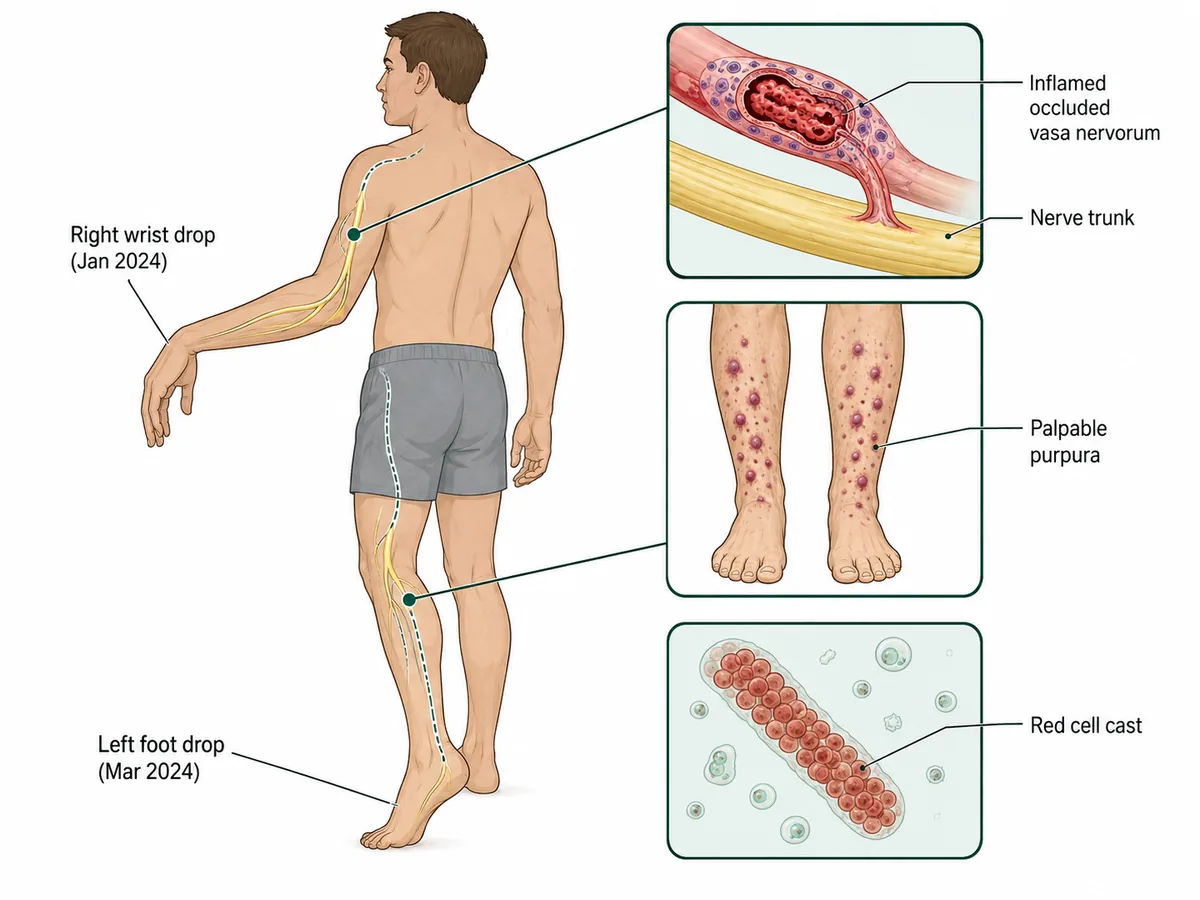
A 58-year-old man has palpable purpura on the legs, a wrist drop that appeared over days followed a week later by a foot drop on the other side, haematuria with red cell casts, and a raised creatinine. Which investigation is most likely to give the diagnosis?
- A. Rheumatoid factor
- B. Anti-glomerular basement membrane antibodies
- C. Hepatitis B surface antigen
- correctD. Anti-neutrophil cytoplasmic antibodies
Explanation
Key fact
Skin, nerve and kidney together mean a small-vessel vasculitis. Stepwise asymmetric nerve palsies are mononeuritis multiplex.
Anti-neutrophil cytoplasmic antibodies. They are positive in most cases of microscopic polyangiitis and granulomatosis with polyangiitis.
Why
Individual named nerves fail one after another, not symmetrically.
That pattern means the vasa nervorum are being occluded.
Palpable purpura is small-vessel vasculitis in the skin.
Red cell casts localise the same process to the glomerulus.
One disease affecting three organs by one mechanism is a systemic vasculitis.
Mononeuritis multiplex: named nerves failing one after another
Why not the others
- A. Rheumatoid factor — may be positive in cryoglobulinaemia and in rheumatoid vasculitis, but it is not specific and there is no arthritis described here.
- B. Anti-glomerular basement membrane antibodies — cause Goodpasture disease, which affects kidney and lung only. It does not cause purpura or neuropathy.
- C. Hepatitis B surface antigen — is worth testing, since it underlies classical polyarteritis nodosa - but that spares the glomerulus and does not give red cell casts.
Remember
Purpura plus a dropped foot plus casts: think vasculitis, test for ANCA.
Go deeper
Eosinophilia with asthma and sinus disease points to eosinophilic granulomatosis with polyangiitis, in which neuropathy is especially common.
The two antibody patterns matter: proteinase-3 tends to accompany granulomatosis with polyangiitis, myeloperoxidase to accompany microscopic polyangiitis.
Treatment is induction with steroids plus rituximab or cyclophosphamide, then maintenance - delay costs irreversible renal function.
Harrison's Principles of Internal Medicine, 22nd ed. (McGraw Hill, 2025).