
Recallab › Question bank › Medicine › Neurology › #50355
Tuberculous meningitis
A man has three weeks of headache, low-grade fever and increasing drowsiness, with a sixth nerve palsy. Cerebrospinal fluid shows 180 cells, 85 per cent lymphocytes, protein 2.4 g/L and glucose 1.8 mmol/L against a blood glucose of 6.0. Which diagnosis?
- correctA. Tuberculous meningitis
- B. Guillain-Barre syndrome
- C. Pyogenic bacterial meningitis
- D. Viral meningitis
Explanation
Key fact
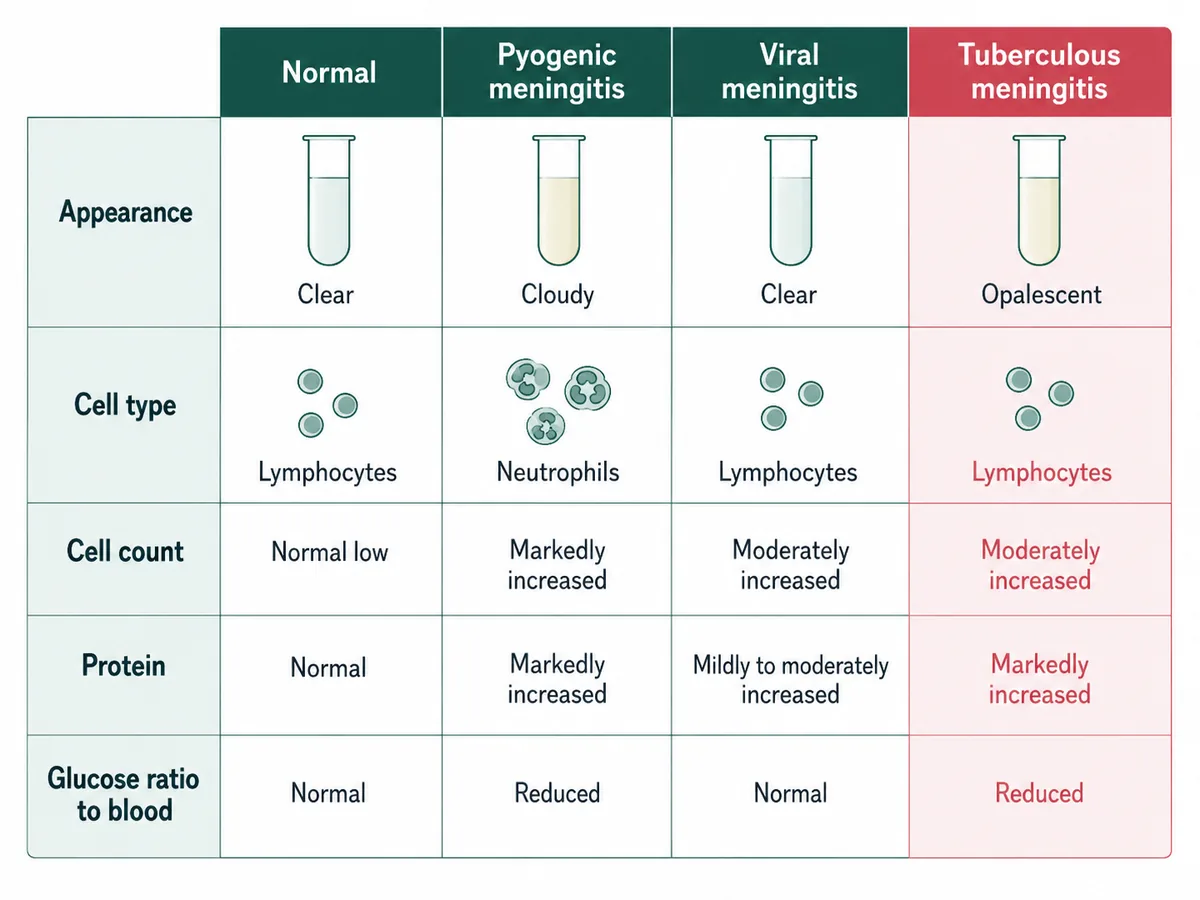
Lymphocytes with a LOW glucose is the combination that matters. Viral meningitis has lymphocytes with a normal glucose.
Tuberculous meningitis. A subacute course, cranial nerve palsy and that cerebrospinal fluid profile fit nothing else as well.
Why
The course is subacute, over weeks, not hours.
The cells are predominantly lymphocytes, so it is not pyogenic.
Protein is markedly raised, often higher than in any other meningitis.
Glucose is less than half the blood value, which viral meningitis does not do.
Basal exudate traps cranial nerves, so a sixth nerve palsy is common.
Cerebrospinal fluid profiles compared
Why not the others
- B. Guillain-Barre syndrome — shows albuminocytological dissociation - high protein with few cells - and causes ascending weakness, not meningism.
- C. Pyogenic bacterial meningitis — gives thousands of neutrophils with a very low glucose, over hours rather than weeks.
- D. Viral meningitis — also gives a lymphocytic picture but with a normal glucose and only modestly raised protein, and it evolves over days.
Remember
Lymphocytes plus low glucose: think tuberculosis. Viral spares the glucose.
Go deeper
Treatment is started on clinical suspicion; waiting for culture costs weeks, and delay is the strongest determinant of death and disability.
Adjunctive corticosteroids reduce mortality in tuberculous meningitis and are given from the outset.
Basal exudate also causes communicating hydrocephalus and vasculitic infarction, which is why imaging is needed as well as fluid analysis.
Harrison's Principles of Internal Medicine, 22nd ed. (McGraw Hill, 2025).