
Recallab › Question bank › Psychiatry › #50362
Opioid substitution with buprenorphine
A 28-year-old man with a five-year history of injecting heroin wants to stop. He is stable, has no intoxication, and last used 18 hours ago with early withdrawal signs. Which drug is appropriate for long-term maintenance, and why is the timing important?
- A. Naltrexone, started immediately, because it blocks the euphoria of any relapse
- correctB. Buprenorphine, started only once withdrawal has begun, or it will precipitate withdrawal
- C. Naloxone, given repeatedly, because it reverses opioid effects
- D. Diazepam, tapered over two weeks, because it treats the withdrawal symptoms
Explanation
Key fact
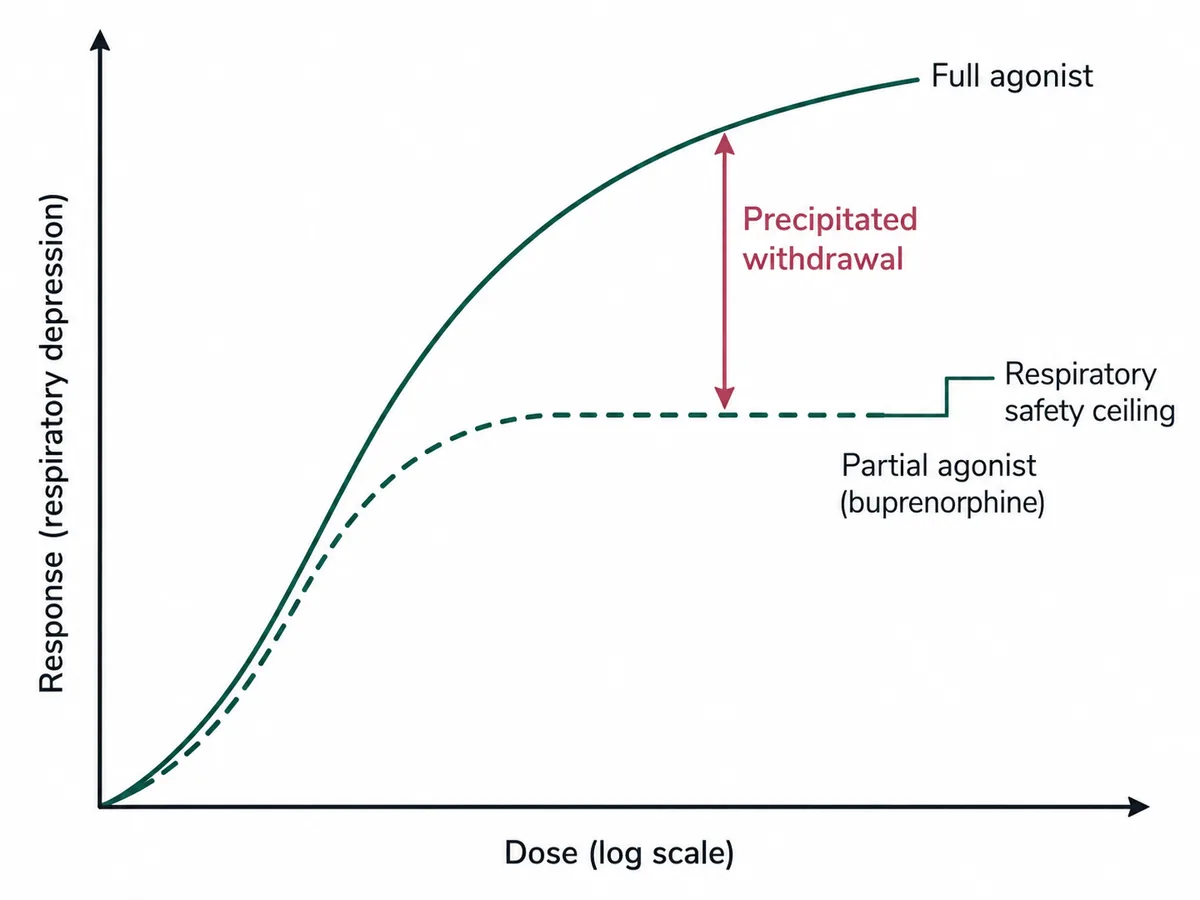
Buprenorphine is a partial agonist with very high receptor affinity. Given too early it displaces the full agonist and precipitates withdrawal.
Buprenorphine, started once withdrawal has begun. Waiting for early withdrawal is what makes induction safe.
Why
It binds the mu receptor more tightly than heroin or methadone.
If receptors are still occupied, it displaces the fuller agonist.
Its own weaker activity then leaves a sudden drop, and withdrawal follows.
Waiting for objective early withdrawal means receptors are already vacating.
The partial agonism gives a ceiling on respiratory depression, so overdose risk is lower than with methadone.
Partial agonism: the ceiling and the displacement problem
Why not the others
- A. Naltrexone, started immediately, because it blocks the euphoria of any relapse — is an antagonist. Given now it would precipitate severe withdrawal; it needs 7 to 10 opioid-free days.
- C. Naloxone, given repeatedly, because it reverses opioid effects — is for acute overdose. Its half-life is short and it has no maintenance role.
- D. Diazepam, tapered over two weeks, because it treats the withdrawal symptoms — substitutes one dependence for another and does not address opioid craving.
Remember
Wait for withdrawal before buprenorphine; wait ten days before naltrexone.
Go deeper
Buprenorphine is combined with naloxone in a fixed ratio: taken sublingually the naloxone is barely absorbed, but injected it precipitates withdrawal and deters misuse.
Substitution treatment reduces mortality, injecting and blood-borne virus transmission far more than detoxification alone, which has a very high relapse rate.
Clonidine relieves the autonomic features of withdrawal but does nothing for craving, so it is an adjunct rather than a maintenance option.
Kaplan & Sadock's Synopsis of Psychiatry, 12th ed. (Wolters Kluwer, 2022); Tripathi KD. Essentials of Medical Pharmacology, 9th ed. (Jaypee, 2024).