
Recallab › Question bank › Surgery › #50366
Infantile hypertrophic pyloric stenosis
A 5-week-old firstborn boy has three days of forceful non-bilious vomiting immediately after feeds and is now losing weight. He remains hungry. When is the olive-shaped pyloric mass most reliably felt, and what electrolyte picture is expected?
- A. While the infant cries; hypochloraemic hypokalaemic metabolic alkalosis
- correctB. During a test feed; hypochloraemic hypokalaemic metabolic alkalosis
- C. On deep palpation in the right iliac fossa; hyponatraemic metabolic acidosis
- D. During a test feed; hyperchloraemic metabolic acidosis
Explanation
Key fact
Feed the baby to feel the olive. Sucking relaxes the abdominal wall, and vomiting gastric acid produces an alkalosis, not an acidosis.
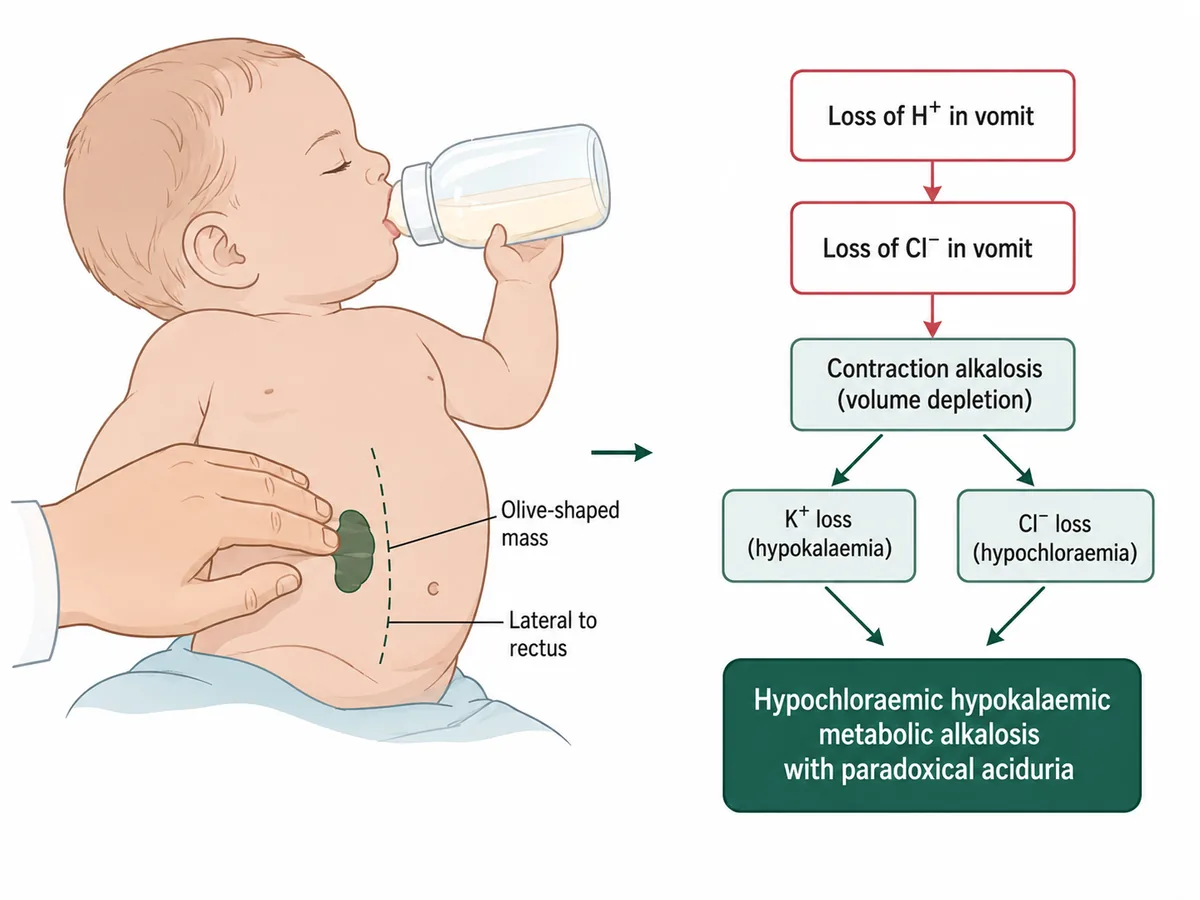
During a test feed, with hypochloraemic hypokalaemic metabolic alkalosis. Both halves follow from the mechanism.
Why
A crying infant tenses the abdominal wall and hides the mass.
Sucking on a feed relaxes it, and the pylorus can be rolled under the fingers.
The vomit is gastric content, so hydrogen and chloride are lost.
The kidney then retains sodium in exchange for potassium and hydrogen.
That paradoxically acid urine with alkalotic blood is characteristic.
The test feed and the metabolic consequence
Why not the others
- A. While the infant cries; hypochloraemic hypokalaemic metabolic alkalosis — has the right biochemistry but the wrong moment. Crying guards the abdomen.
- C. On deep palpation in the right iliac fossa; hyponatraemic metabolic acidosis — puts the mass in the wrong place. The pylorus lies in the right upper quadrant.
- D. During a test feed; hyperchloraemic metabolic acidosis — has the right examination but the wrong biochemistry. Chloride is lost, so it falls.
Remember
Feed to feel it; alkalosis, not acidosis.
Go deeper
This is a medical emergency before it is a surgical one: the alkalosis and dehydration must be corrected before anaesthesia, or apnoea may follow.
Ultrasound has largely replaced the test feed, with a muscle thickness above about 3 to 4 mm and a channel length above 15 to 17 mm being diagnostic.
The operation is a Ramstedt pyloromyotomy, splitting the muscle without opening the mucosa; feeding usually restarts within hours.
Bailey & Love's Short Practice of Surgery, 28th ed. (CRC Press, 2023); Ghai Essential Pediatrics, 10th ed. (CBS Publishers, 2025).