
Recallab › Question bank › Obstetrics › #50377
Pregnancy of unknown location
A woman with six weeks of amenorrhoea has mild lower abdominal pain and light vaginal bleeding. She is haemodynamically stable. Serum beta-hCG is 1400 mIU/mL, and transvaginal ultrasound shows no intrauterine sac and no adnexal mass. What is the next step?
- A. Give methotrexate now
- correctB. Repeat the beta-hCG in 48 hours
- C. Perform uterine evacuation and send tissue for histology
- D. Proceed to diagnostic laparoscopy
Explanation
Key fact
A stable woman below the discriminatory zone with no visible pregnancy needs a second hCG, not an operation. The trend is the test.
Repeat the beta-hCG in 48 hours. A single value below the discriminatory zone cannot distinguish the possibilities.
Why
The discriminatory zone is about 1500 to 2000 mIU/mL on transvaginal scanning.
Below it, an intrauterine pregnancy may simply be too early to see.
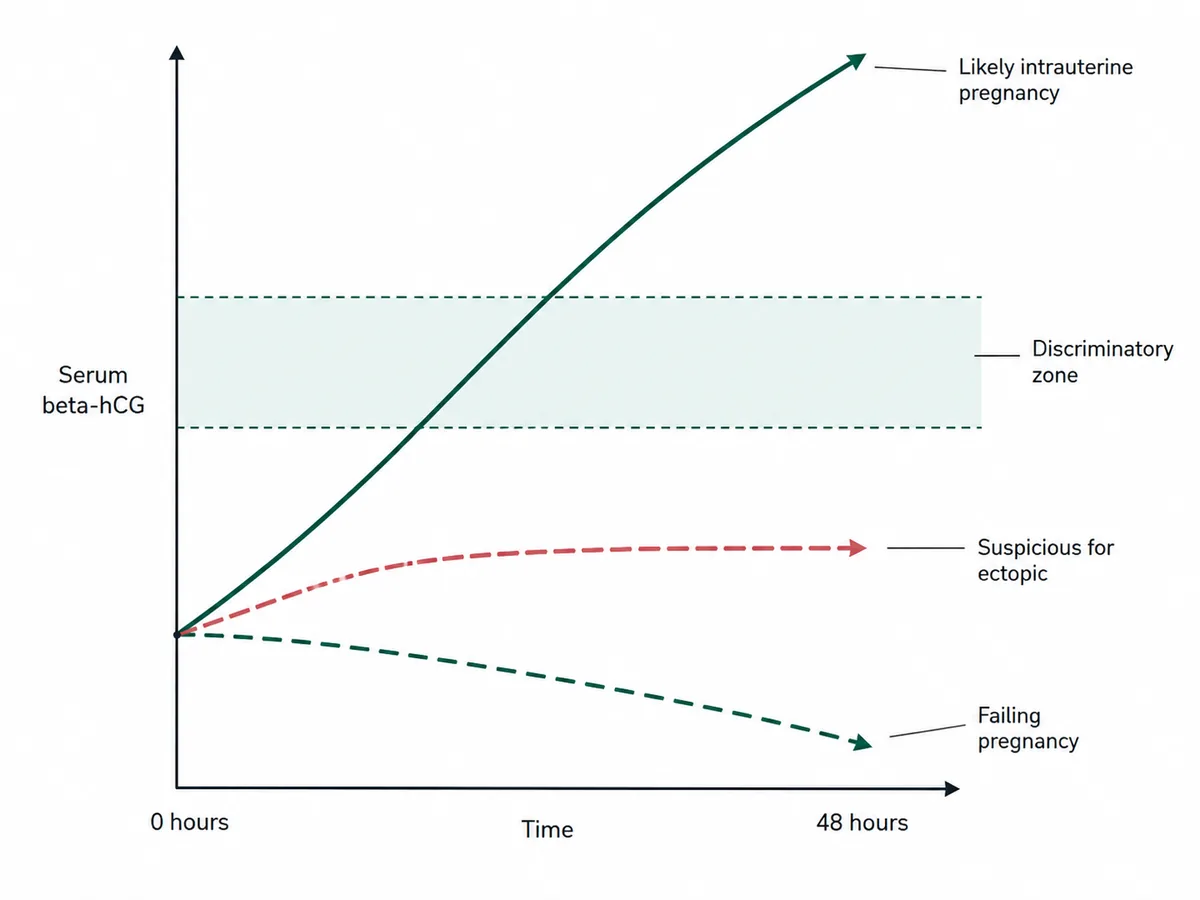
A rise of at least 49 to 66 per cent in 48 hours suggests a viable pregnancy.
A plateau or a shallow rise suggests an ectopic.
A steep fall suggests a failing pregnancy.
Reading the 48-hour beta-hCG trend
Why not the others
- A. Give methotrexate now — would destroy a viable intrauterine pregnancy that has not yet become visible. The diagnosis is not established.
- C. Perform uterine evacuation and send tissue for histology — has the same danger, and is used only once a viable intrauterine pregnancy has been excluded.
- D. Proceed to diagnostic laparoscopy — is invasive and often non-diagnostic this early. It is reserved for instability or a confirmed ectopic.
Remember
Below the zone, watch the trend. One number proves nothing.
Go deeper
Any instability, or free fluid with a suggestive adnexal mass, overrides all of this and calls for immediate surgery.
Methotrexate needs a stable patient, an unruptured ectopic below a size and hCG threshold, no fetal cardiac activity, and reliable follow-up.
Heterotopic pregnancy is rare naturally but far commoner after assisted conception, so an intrauterine sac does not fully exclude a coexisting ectopic in that group.
Williams Obstetrics, 26th ed. (McGraw Hill, 2022); DC Dutta's Textbook of Obstetrics, 11th ed. (Jaypee, 2026).