
Recallab › Question bank › Gynaecology › Disorders In Menstruation › #50385
Premature ovarian insufficiency
A 34-year-old has had no periods for eight months with hot flushes and vaginal dryness. Two follicle-stimulating hormone levels four weeks apart are 48 and 52 IU/L, and oestradiol is low. Pregnancy test is negative. What is the diagnosis, and what is the main reason to offer hormone therapy?
- correctA. Premature ovarian insufficiency; to protect bone and cardiovascular health until the usual age of menopause
- B. Hypothalamic amenorrhoea; to restore gonadotrophin secretion
- C. Polycystic ovary syndrome; to regulate the cycle and protect the endometrium
- D. Asherman syndrome; to prevent further intrauterine adhesions
Explanation
Key fact
A high follicle-stimulating hormone before 40 means the ovary has failed. Replacement here is not symptom relief but long-term protection.
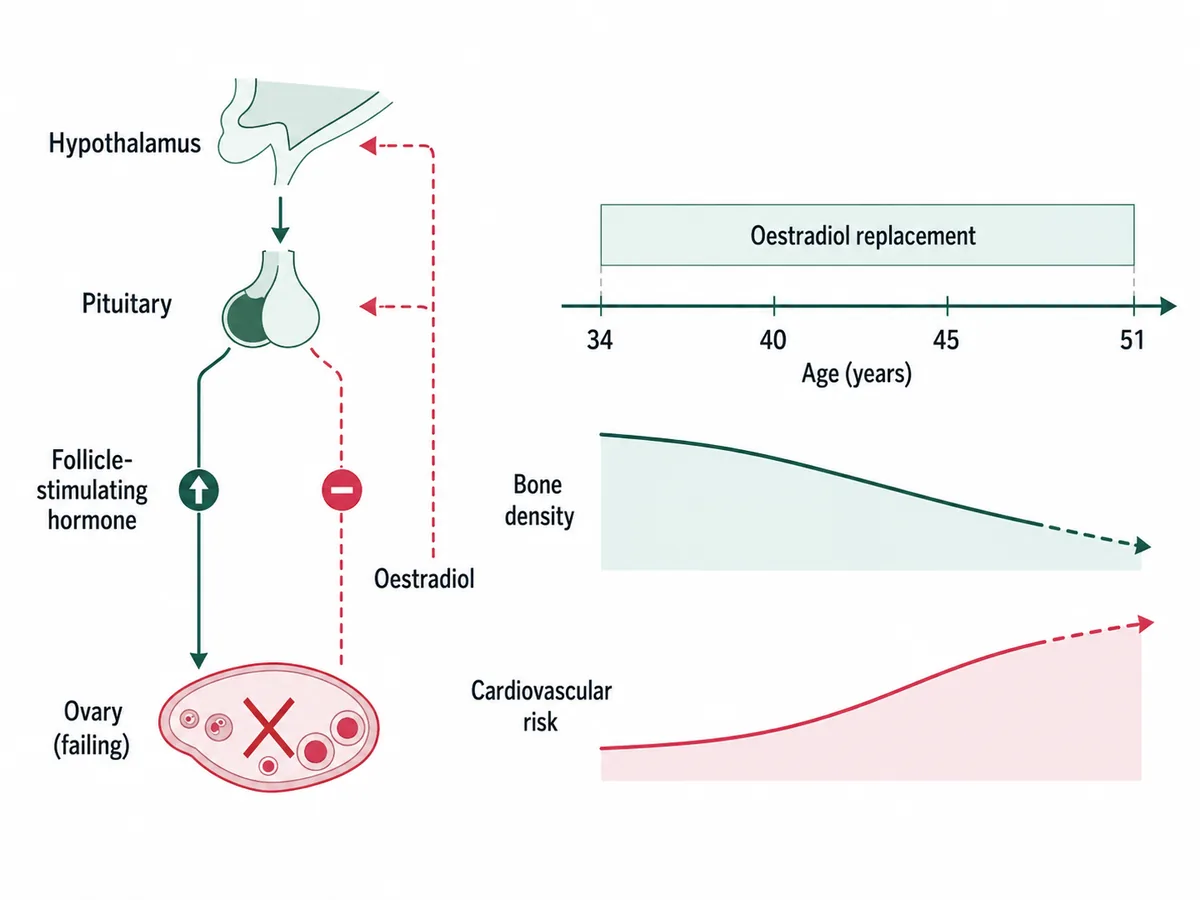
Premature ovarian insufficiency, and hormone therapy protects bone and cardiovascular health. It is continued to about age 51.
Why
Amenorrhoea before 40 with a raised follicle-stimulating hormone is ovarian failure.
Two raised values at least four weeks apart are needed to confirm it.
Low oestradiol confirms the ovary is not responding to that drive.
Decades of oestrogen deficiency cause osteoporosis and raise cardiovascular risk.
Replacement is therefore given until the usual age of menopause, not stopped early.
Where the failure lies, and why replacement continues to 51
Why not the others
- B. Hypothalamic amenorrhoea; to restore gonadotrophin secretion — gives a low follicle-stimulating hormone, because the problem is above the ovary.
- C. Polycystic ovary syndrome; to regulate the cycle and protect the endometrium — would show a normal or low follicle-stimulating hormone with normal oestrogen, and hot flushes would be unusual.
- D. Asherman syndrome; to prevent further intrauterine adhesions — gives amenorrhoea with entirely normal hormones, because the ovary is working.
Remember
High follicle-stimulating hormone under 40: the ovary has failed, so replace until 51.
Go deeper
Karyotype and fragile X premutation testing are indicated, since Turner mosaicism and FMR1 premutation are recognised causes, as is autoimmune ovarian failure.
Spontaneous ovulation still occurs in a minority, so contraception is needed if pregnancy is not wanted - hormone therapy alone is not contraceptive.
Donor oocyte in vitro fertilisation offers the realistic route to pregnancy, and the diagnosis should be given with that discussion, not without it.
Williams Gynecology, 4th ed. (McGraw Hill, 2020); DC Dutta's Textbook of Gynecology, 9th ed. (Jaypee, 2023).