
Recallab › Question bank › Paediatrics › Infection › #50392
Parvovirus B19
Which of the following is NOT caused by parvovirus B19?
- A. Erythema infectiosum
- B. Hydrops fetalis
- C. Transient aplastic crisis in sickle cell disease
- correctD. Roseola infantum
Explanation
Key fact
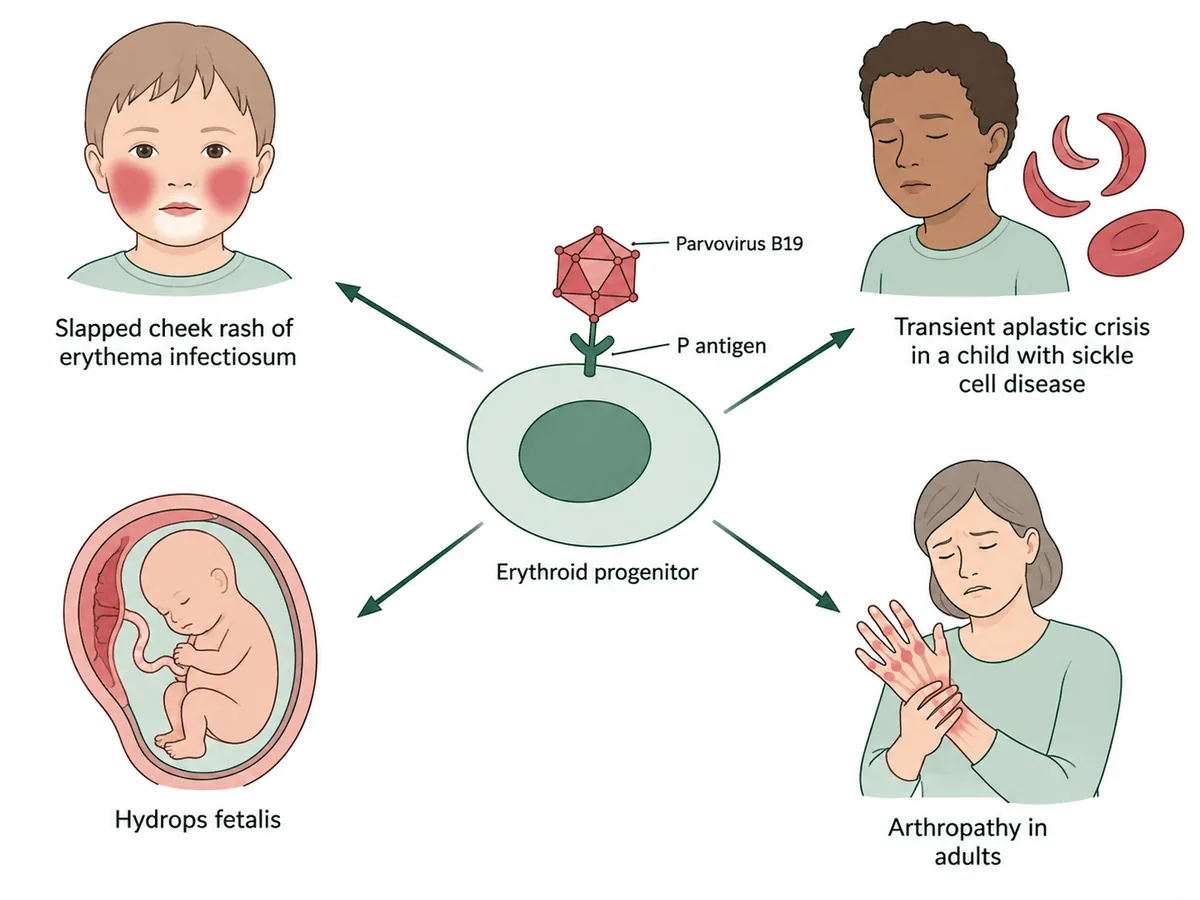
Parvovirus B19 attacks the erythroid progenitor. Every disease it causes follows from that, or from the immune response to it.
Roseola infantum. That is caused by human herpesvirus 6, not parvovirus B19.
Why
The virus binds the P antigen on erythroid precursors and halts their division.
In a healthy child red cell lifespan is long enough to absorb a brief pause.
In sickle cell disease, with a short red cell lifespan, an aplastic crisis follows.
In the fetus it causes severe anaemia, cardiac failure and hydrops.
Erythema infectiosum, the slapped cheek rash, is the immune-mediated phase.
One virus, one target cell, four presentations
Why not the others
- A. Erythema infectiosum — is the classical fifth disease of childhood, with the slapped cheek appearance followed by a lacy reticular rash on the limbs.
- B. Hydrops fetalis — occurs with maternal infection, particularly in the first half of pregnancy, from severe fetal anaemia and high-output failure.
- C. Transient aplastic crisis in sickle cell disease — is a genuine and dangerous complication, because these children cannot tolerate any pause in production.
Remember
B19 stops red cells being made. Everything else follows from that.
Go deeper
By the time the rash appears the child is no longer infectious, so exclusion from school at that point serves no purpose.
The reverse holds in aplastic crisis: those children are highly infectious and need isolation from pregnant staff and other haematology patients.
In adults, particularly women, a symmetrical small joint arthropathy is common and can be mistaken for early rheumatoid arthritis.
Nelson Textbook of Pediatrics, 22nd ed. (Elsevier, 2024); Jawetz, Melnick & Adelberg's Medical Microbiology, 29th ed. (McGraw Hill, 2025).