
Recallab › Question bank › Anatomy › Upper Limb › #50506
Musculocutaneous nerve
After a humeral fracture a boy cannot flex his elbow well and supination is weak, and sensation is lost over the lateral aspect of the forearm. The wrist and fingers move normally. Which nerve, and why is elbow flexion still partly possible?
- A. Radial nerve; biceps still flexes the elbow
- correctB. Musculocutaneous nerve; brachioradialis, supplied by the radial nerve, still flexes the elbow
- C. Median nerve; pronator teres still flexes the elbow
- D. Musculocutaneous nerve; no other muscle can flex the elbow, so flexion should be absent
Explanation
Key fact
Elbow flexion has three muscles and two nerves. Losing the musculocutaneous nerve weakens flexion but does not abolish it.
Musculocutaneous nerve, with brachioradialis preserving some flexion. Brachioradialis is radial-supplied.
Why
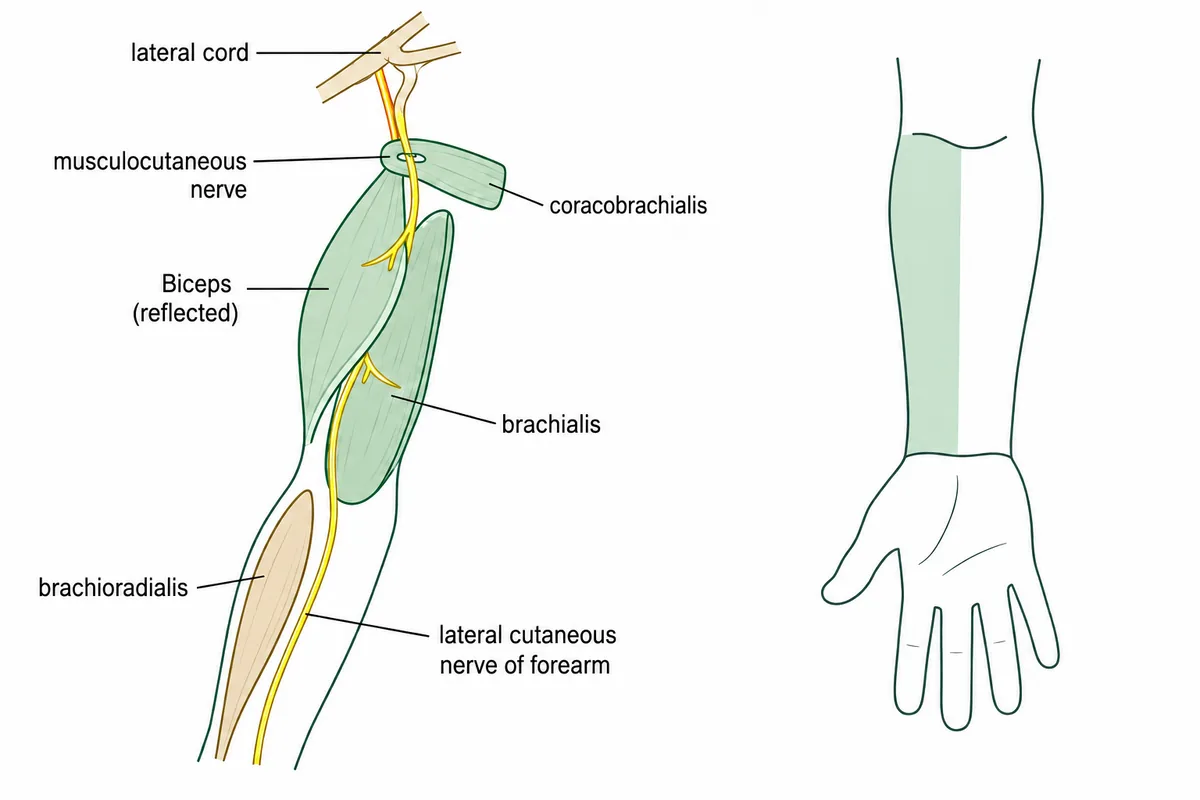
The musculocutaneous nerve supplies biceps, brachialis and coracobrachialis.
Biceps is also the main supinator, hence the weak supination.
Its terminal branch is the lateral cutaneous nerve of the forearm.
That explains the sensory loss over the lateral forearm.
Brachioradialis is radial-supplied and still flexes the elbow, especially in mid-pronation.
The musculocutaneous nerve and its territory
Why not the others
- A. Radial nerve; biceps still flexes the elbow — reverses the supply. Biceps is musculocutaneous, and a radial lesion would cause wrist drop.
- C. Median nerve; pronator teres still flexes the elbow — would weaken forearm pronation and the long flexors, and would not cause lateral forearm sensory loss.
- D. Musculocutaneous nerve; no other muscle can flex the elbow, so flexion should be absent — names the right nerve but is factually wrong. Brachioradialis and the forearm flexors contribute.
Remember
Biceps, brachialis, coracobrachialis, and the skin of the lateral forearm.
Go deeper
Isolated musculocutaneous injury is uncommon; it is usually part of an upper trunk or lateral cord injury, so the median territory should always be tested too.
The nerve pierces coracobrachialis, which is a recognised site of entrapment in weightlifters.
The biceps jerk tests C5 and C6 through this nerve, and its loss is an early sign in an upper trunk lesion.
Gray's Anatomy for Students, 5th ed. (Elsevier, 2023); Snell's Clinical Anatomy by Regions, 11th ed. (Wolters Kluwer, 2024).