
Recallab › Question bank › Biochemistry › Metabolism › #50511
Tetrahydrobiopterin
An infant has a phenylalanine of 40 mg/dL but normal phenylalanine hydroxylase activity. Dietary phenylalanine restriction alone does not prevent neurological deterioration. Which cofactor is deficient, and which other two hydroxylases share it?
- A. Pyridoxal phosphate; homogentisate oxidase and tyrosinase
- correctB. Tetrahydrobiopterin; tyrosine hydroxylase and tryptophan hydroxylase
- C. Ascorbate; prolyl hydroxylase and lysyl hydroxylase
- D. Tetrahydrofolate; tyrosine hydroxylase and tryptophan hydroxylase
Explanation
Key fact
Three aromatic amino acid hydroxylases share one cofactor. That is why diet alone cannot rescue a cofactor defect.
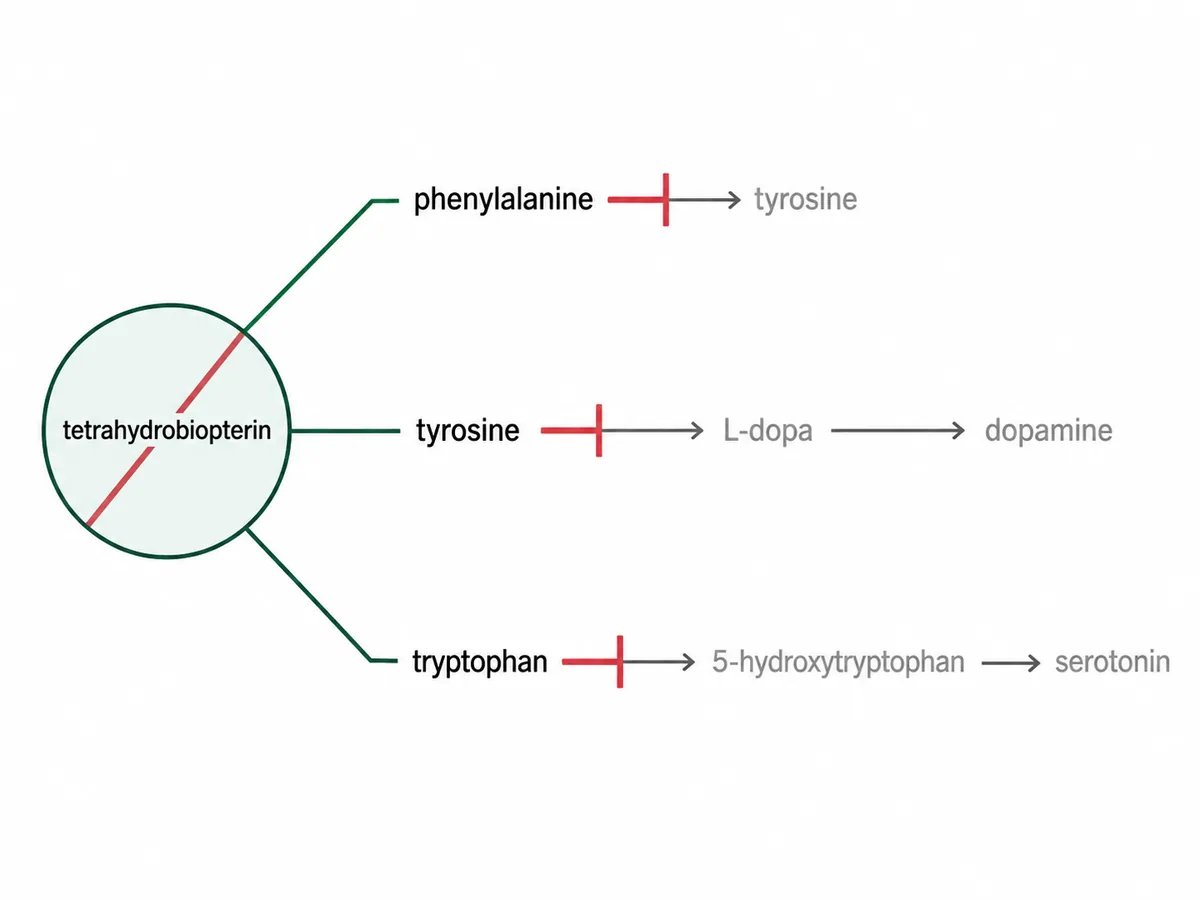
Tetrahydrobiopterin, shared with tyrosine and tryptophan hydroxylase. Losing it also stops dopamine and serotonin synthesis.
Why
Phenylalanine hydroxylase needs tetrahydrobiopterin as its cofactor.
So does tyrosine hydroxylase, the rate-limiting step for dopamine.
So does tryptophan hydroxylase, the rate-limiting step for serotonin.
Restricting phenylalanine lowers the level but does not restore the neurotransmitters.
Treatment therefore adds the cofactor plus levodopa and 5-hydroxytryptophan.
One cofactor, three hydroxylases
Why not the others
- A. Pyridoxal phosphate; homogentisate oxidase and tyrosinase — is the cofactor for transaminases and decarboxylases, not for these hydroxylases.
- C. Ascorbate; prolyl hydroxylase and lysyl hydroxylase — is a real cofactor pair - for collagen hydroxylation - but has nothing to do with phenylalanine.
- D. Tetrahydrofolate; tyrosine hydroxylase and tryptophan hydroxylase — names the right enzymes but the wrong cofactor. Tetrahydrofolate carries one-carbon units.
Remember
Same cofactor, three amines. Diet fixes the level, not the neurotransmitters.
Go deeper
Newborn screening detects the raised phenylalanine, but a cofactor defect must then be excluded, because the treatment is quite different.
Dihydropteridine reductase regenerates the cofactor after each reaction; its deficiency causes the same picture.
Sapropterin, a synthetic form of the cofactor, also lowers phenylalanine in some patients with ordinary phenylketonuria who retain residual enzyme.
Lippincott Illustrated Reviews: Biochemistry, 9th ed. (Wolters Kluwer, 2025); Harper's Illustrated Biochemistry, 33rd ed. (McGraw Hill, 2025).