
Recallab › Question bank › Pathology › #50520
Ewing sarcoma
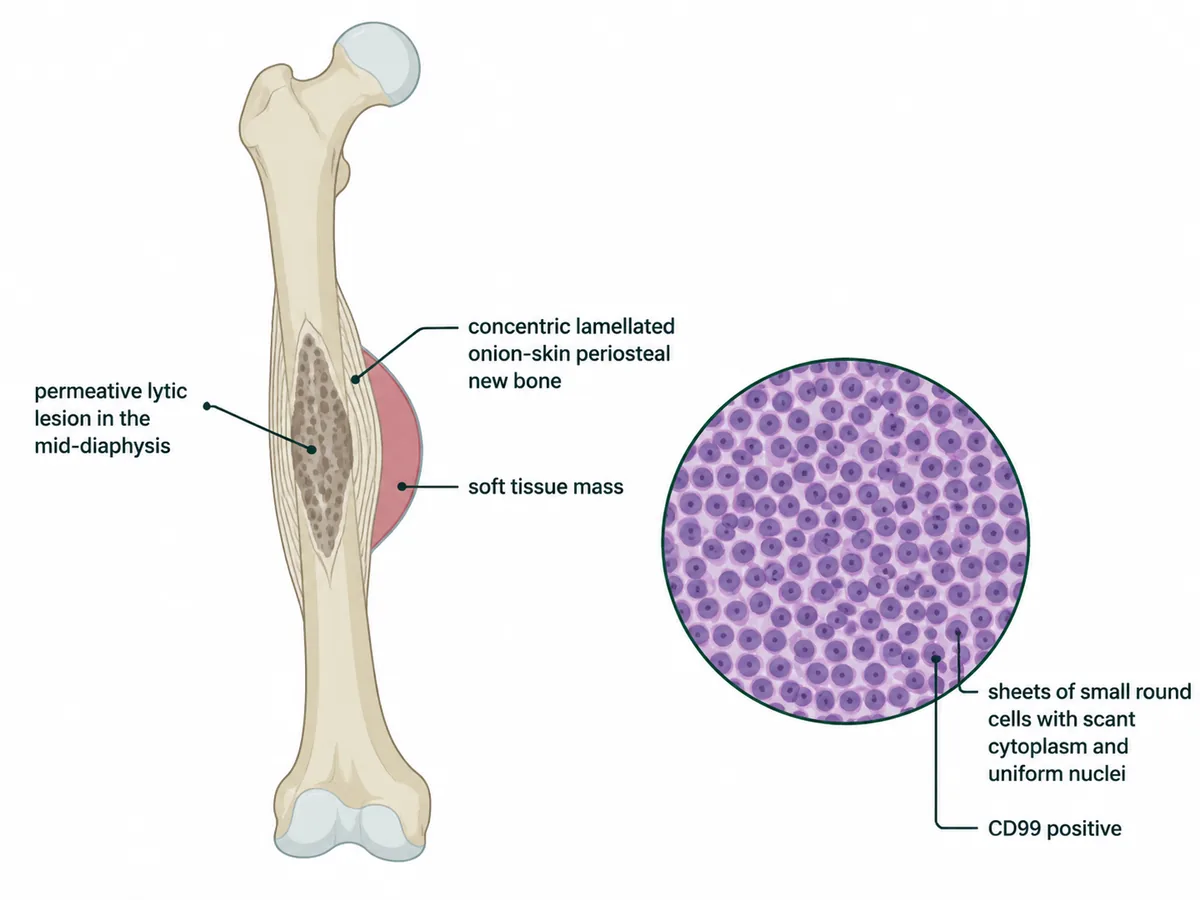
A 13-year-old has pain and swelling of the mid-femur with fever and a raised erythrocyte sedimentation rate. Radiographs show a permeative diaphyseal lesion with lamellated periosteal reaction. Biopsy shows small round blue cells that are CD99 positive. Which translocation confirms it?
- A. t(9;22)
- B. t(X;18)
- C. t(15;17)
- correctD. t(11;22)
Explanation
Key fact
Diaphyseal, permeative, onion-skin, small round blue cells, CD99: Ewing sarcoma. The translocation is t(11;22).
t(11;22). It fuses EWSR1 to FLI1 and is present in the large majority of cases.
Why
Ewing sarcoma arises in the diaphysis, unlike osteosarcoma's metaphysis.
The periosteal reaction is lamellated - the onion-skin appearance.
Fever and a raised sedimentation rate make it mimic osteomyelitis.
Histology is a small round blue cell tumour, membranous CD99 positive.
The fusion gene is the diagnostic confirmation.
Ewing sarcoma: site, periosteal reaction and histology
Why not the others
- A. t(9;22) — is chronic myeloid leukaemia, and also occurs in some acute lymphoblastic leukaemias.
- B. t(X;18) — is synovial sarcoma, which is a soft tissue tumour of young adults arising near but not within joints.
- C. t(15;17) — is acute promyelocytic leukaemia, fusing PML to RARA.
Remember
Diaphysis, onion skin, CD99, eleven-twenty-two.
Go deeper
Osteosarcoma is the main differential: it arises in the metaphysis, produces osteoid, and gives a sunburst reaction with a Codman triangle.
The fever, raised inflammatory markers and lytic bone lesion mean osteomyelitis must be excluded, and biopsy material should always be sent for culture as well.
Treatment is neoadjuvant chemotherapy followed by local control, and it is one of the chemosensitive paediatric solid tumours.
Robbins, Cotran & Kumar Pathologic Basis of Disease, 11th ed. (Elsevier, 2025); Apley & Solomon's System of Orthopaedics and Trauma, 10th ed. (CRC Press, 2018).