
Recallab › Question bank › Microbiology › Bacteriology › #50530
Campylobacter jejuni
Three weeks after an episode of bloody diarrhoea following unpasteurised milk, a man develops ascending symmetrical weakness with areflexia. Which organism, and what links the two illnesses?
- A. Vibrio cholerae; profound hypokalaemia causing flaccid paralysis
- correctB. Campylobacter jejuni; molecular mimicry between its lipo-oligosaccharide and peripheral nerve gangliosides
- C. Salmonella typhi; endotoxin-mediated demyelination
- D. Shigella dysenteriae; direct neurotoxin damage to peripheral nerves
Explanation
Key fact
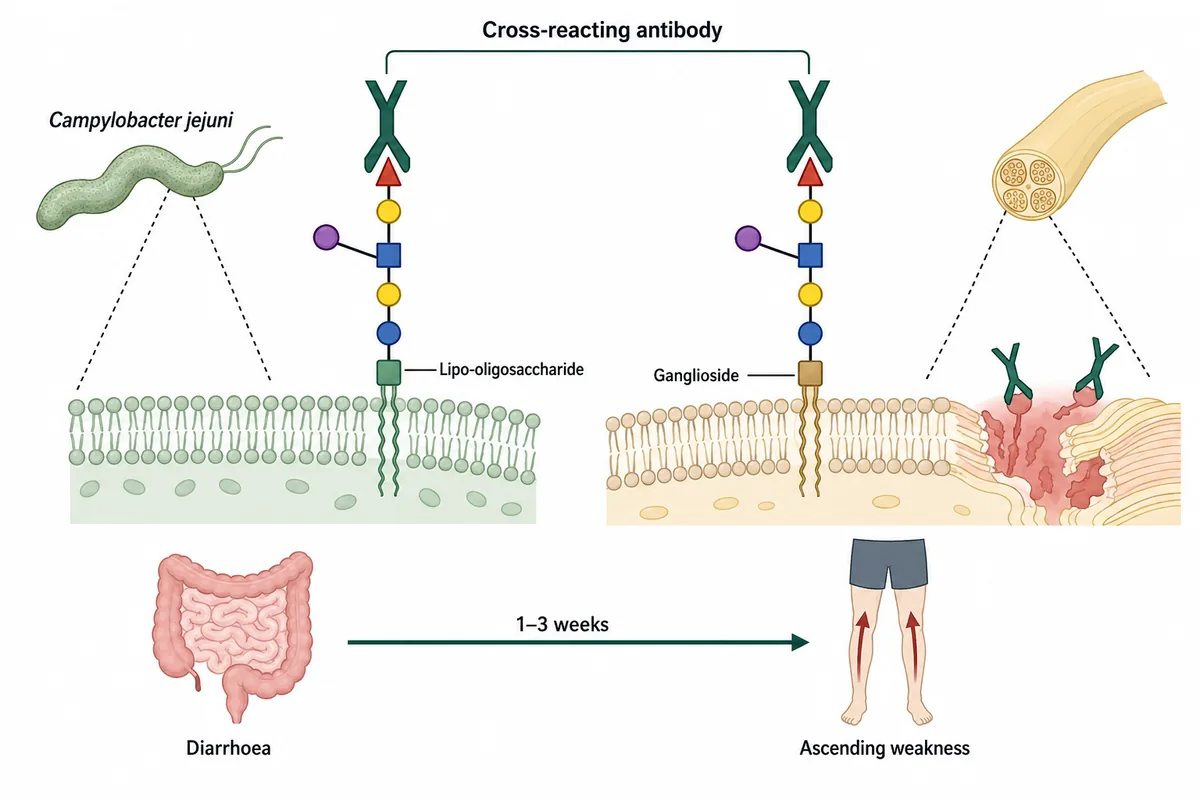
Campylobacter is the commonest identified trigger of Guillain-Barre syndrome. Its surface sugars resemble nerve gangliosides.
Campylobacter jejuni, through molecular mimicry with peripheral nerve gangliosides. The antibody made against the gut organism attacks nerve.
Why
Campylobacter causes a watery diarrhoea that becomes bloody.
It is a curved Gram-negative bacillus growing best at 42 degrees, microaerophilic.
Its lipo-oligosaccharide resembles the GM1 ganglioside of peripheral nerve.
Antibodies raised against it cross-react with the nerve.
Weakness follows one to three weeks later - ascending, symmetrical and areflexic.
Molecular mimicry after Campylobacter infection
Why not the others
- A. Vibrio cholerae; profound hypokalaemia causing flaccid paralysis — does cause weakness through potassium loss, but the stool is watery and painless, and there is no areflexia three weeks later.
- C. Salmonella typhi; endotoxin-mediated demyelination — is not a recognised trigger, and typhoid causes a systemic febrile illness rather than bloody diarrhoea early.
- D. Shigella dysenteriae; direct neurotoxin damage to peripheral nerves — produces Shiga toxin, which causes haemolytic uraemic syndrome, not a peripheral neuropathy.
Remember
Bloody diarrhoea, then weakness three weeks later: Campylobacter.
Go deeper
Campylobacter-associated cases more often take the axonal form, which tends to recover more slowly than the demyelinating form.
Treating the diarrhoea with antibiotics does not prevent the neuropathy, because the immune response is already under way.
Cerebrospinal fluid shows albuminocytological dissociation - high protein with few cells - typically after the first week.
Jawetz, Melnick & Adelberg's Medical Microbiology, 29th ed. (McGraw Hill, 2025); Harrison's Principles of Internal Medicine, 22nd ed. (McGraw Hill, 2025).