
Recallab › Question bank › Social & Preventive Medicine › #50544
The anganwadi worker
Under the Integrated Child Development Services scheme, what population does one anganwadi centre normally cover, and which six services does it deliver?
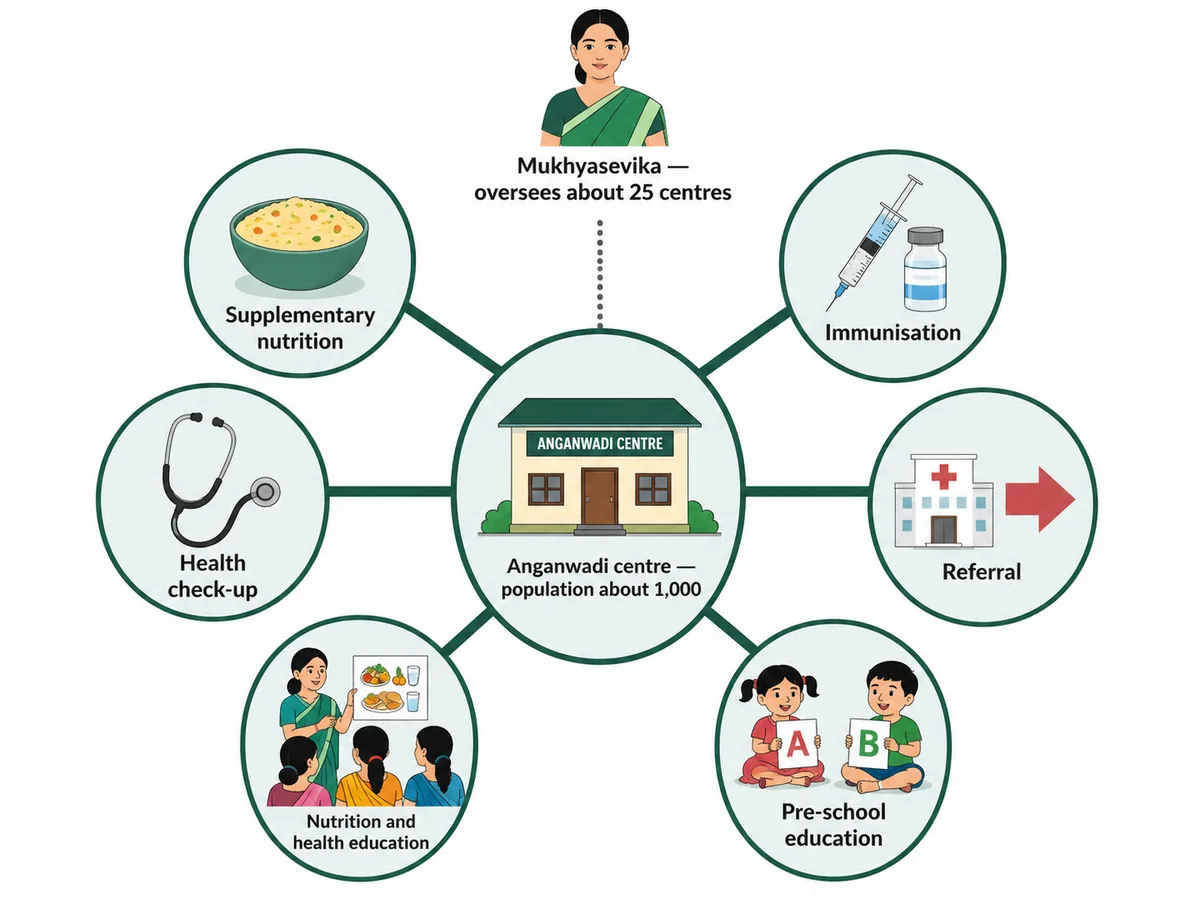
- correctA. About 1000 people; supplementary nutrition, immunisation, health check-up, referral, nutrition and health education, and pre-school education
- B. About 1000 people; immunisation and pre-school education only
- C. About 5000 people; curative care, surgery, immunisation, referral, family planning and health education
- D. About 30,000 people; the same six services delivered by a medical officer
Explanation
Key fact
One anganwadi, about a thousand people, six services. It is the delivery point of the Integrated Child Development Services scheme.
About 1000 people, with the six standard services. In tribal and hilly areas the norm is lower, around 700.
Why
The anganwadi centre is the community-level unit of the scheme.
The worker is a local woman, honorary rather than salaried, with short training.
The six services are supplementary nutrition, immunisation and health check-up.
Plus referral services, nutrition and health education, and pre-school education.
A mukhyasevika supervises about 25 anganwadi workers.
The anganwadi centre and its six services
Why not the others
- B. About 1000 people; immunisation and pre-school education only — has the right population but drops four of the six services.
- C. About 5000 people; curative care, surgery, immunisation, referral, family planning and health education — describes a sub-centre population and adds services the scheme does not provide.
- D. About 30,000 people; the same six services delivered by a medical officer — is the population of a primary health centre, and the anganwadi worker is not a medical officer.
Remember
One thousand people, six services, one local woman.
Go deeper
Three of the six services - immunisation, health check-up and referral - are delivered with the health system, which is what makes the scheme intersectoral.
The beneficiaries are children under six, pregnant and lactating women, and adolescent girls.
It is among the largest community programmes in the world, and its weakness is uneven quality rather than coverage.
Park K. Park's Textbook of Preventive and Social Medicine, 28th ed. (Bhanot, 2025).