
Recallab › Question bank › Medicine › Neurology › #50549
Triptans and their contraindications
A woman with migraine asks for a triptan. Which feature of her history would make a triptan contraindicated, and what is the mechanism behind that contraindication?
- A. Peptic ulcer disease, because triptans inhibit cyclo-oxygenase
- B. Asthma, because triptans cause bronchoconstriction through 5-HT2 receptors
- C. Epilepsy, because triptans lower the seizure threshold
- correctD. Ischaemic heart disease, because triptans are 5-HT1B agonists and constrict coronary arteries
Explanation
Key fact
Triptans constrict blood vessels, and not only cranial ones. That is why vascular disease bars them.
Ischaemic heart disease, because 5-HT1B agonism constricts coronary arteries. The same action that helps the headache threatens the heart.
Why
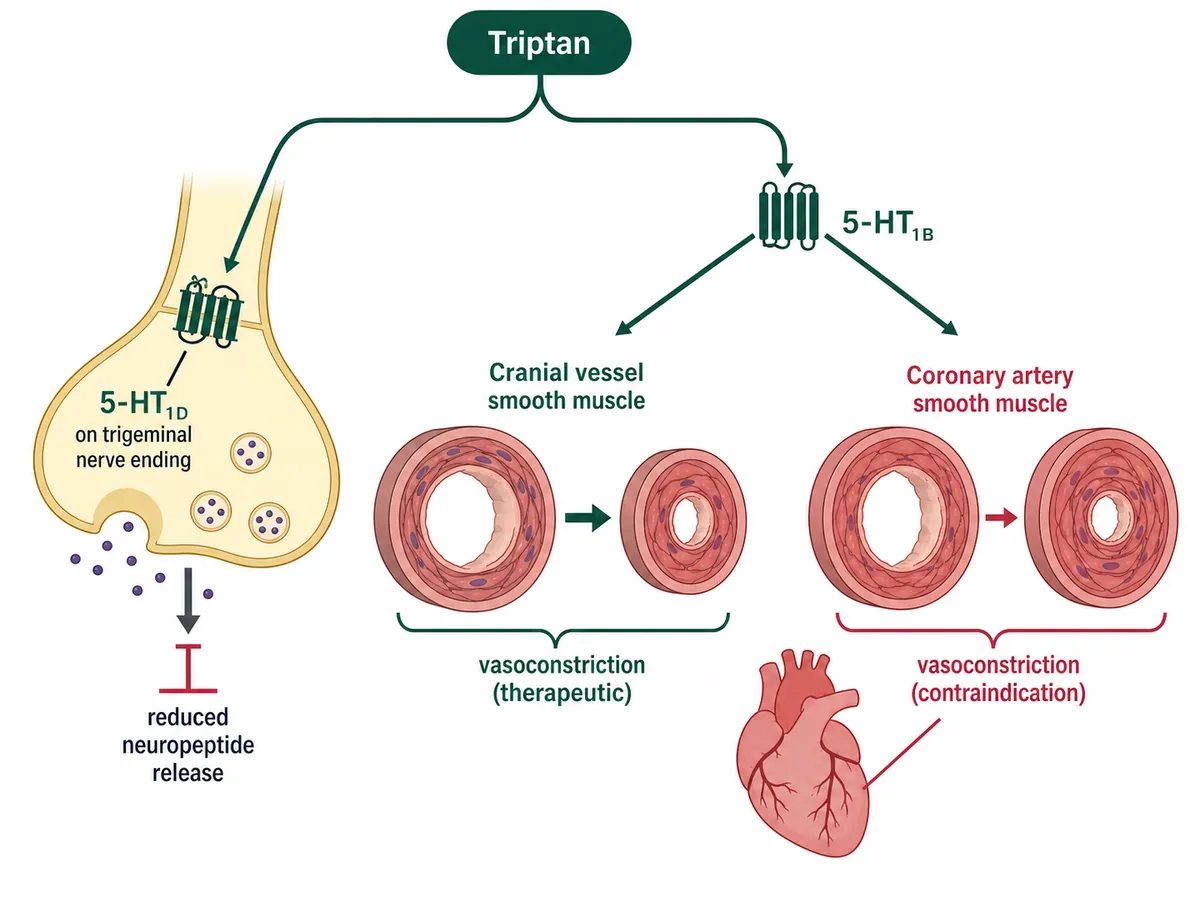
Triptans are agonists at 5-HT1B and 5-HT1D receptors.
5-HT1D on trigeminal endings reduces release of vasoactive neuropeptides.
5-HT1B on smooth muscle constricts cranial vessels - and coronary ones.
So ischaemic heart disease, uncontrolled hypertension and prior stroke bar their use.
Hemiplegic and basilar migraine are also contraindications.
Where a triptan acts, and why the heart is at risk
Why not the others
- A. Peptic ulcer disease, because triptans inhibit cyclo-oxygenase — confuses them with non-steroidal drugs, which do have that problem.
- B. Asthma, because triptans cause bronchoconstriction through 5-HT2 receptors — is not a recognised effect. Triptans are not contraindicated in asthma.
- C. Epilepsy, because triptans lower the seizure threshold — is not established, and epilepsy is not a contraindication.
Remember
A triptan constricts arteries. Ask about the heart before you prescribe one.
Go deeper
Ergotamine shares the vasoconstrictor problem and is more dangerous; the two must never be combined or given within 24 hours of each other.
Medication overuse headache develops with frequent use, and is the reason for limiting triptan days per month.
The CGRP antagonists - the gepants and monoclonal antibodies - act on the same pathway without vasoconstriction, which is why they are used when triptans are contraindicated.
Harrison's Principles of Internal Medicine, 22nd ed. (McGraw Hill, 2025); Tripathi KD. Essentials of Medical Pharmacology, 9th ed. (Jaypee, 2024).