
Recallab › Question bank › Medicine › Immunology & Rheumatology › #50554
Calcium pyrophosphate deposition
An 80-year-old has an acutely hot, swollen knee. Radiographs show a thin line of calcium within the joint cartilage. Synovial fluid shows short rhomboid crystals that appear blue when aligned parallel to the compensator. What is the diagnosis?
- A. Gout
- B. Septic arthritis
- C. Rheumatoid arthritis
- correctD. Calcium pyrophosphate deposition disease
Explanation
Key fact
Chondrocalcinosis plus positively birefringent rhomboid crystals is pyrophosphate, not urate. The colour when parallel separates them.
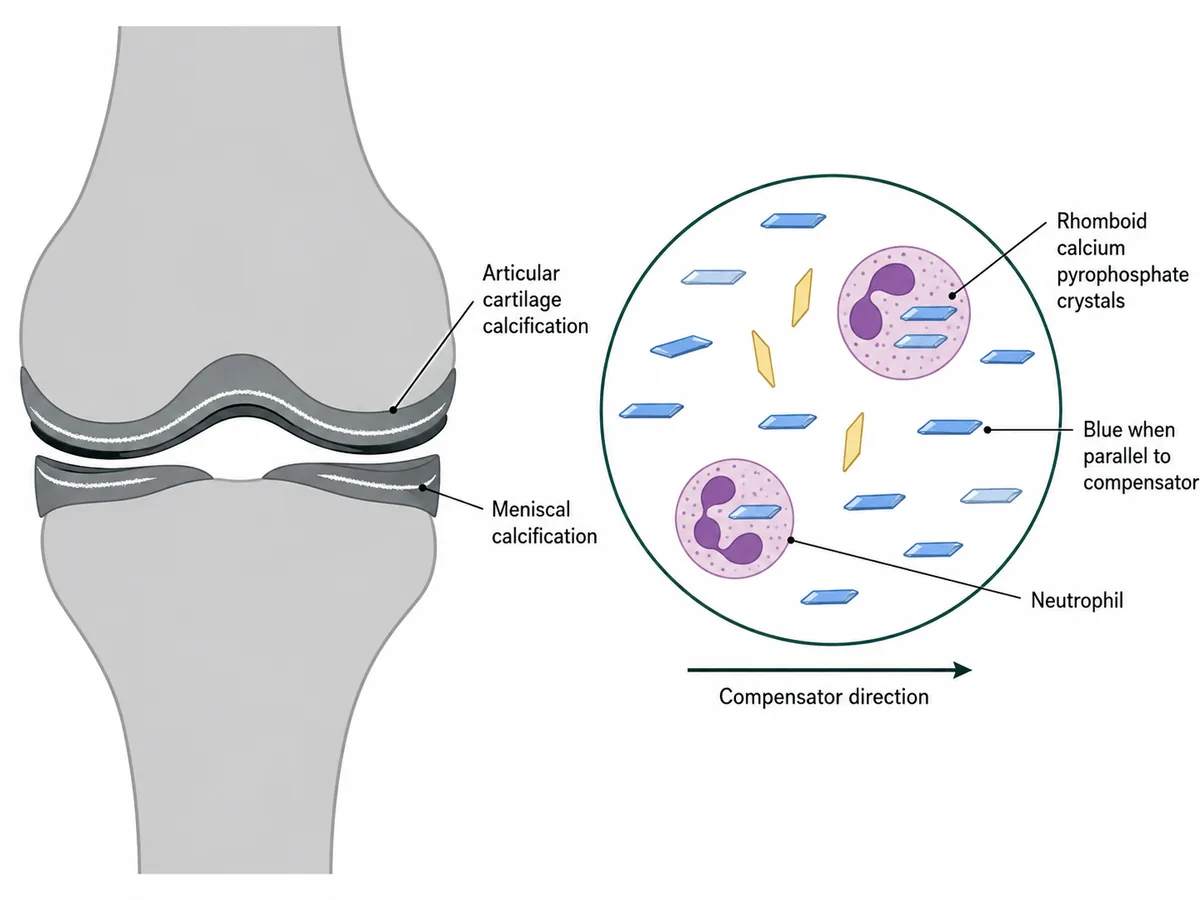
Calcium pyrophosphate deposition disease. The radiological calcification in cartilage is chondrocalcinosis.
Why
Crystals are short and rhomboid, unlike the needles of urate.
They are positively birefringent, appearing blue when parallel to the compensator.
Urate is negatively birefringent, appearing yellow in the same orientation.
Chondrocalcinosis is calcification of hyaline or fibrocartilage on radiography.
The knee and the wrist are the commonest joints affected.
Chondrocalcinosis and the crystal
Why not the others
- A. Gout — shows needle-shaped, negatively birefringent crystals appearing yellow when parallel, and typically affects the first metatarsophalangeal joint.
- B. Septic arthritis — must always be excluded and can coexist, but it shows organisms on Gram stain or culture and no crystals.
- C. Rheumatoid arthritis — is a symmetrical small joint synovitis with morning stiffness, not an acute monoarthritis with crystals.
Remember
Rhomboid and blue when parallel: pyrophosphate. Needle and yellow: urate.
Go deeper
Underlying causes should be sought in a younger patient: haemochromatosis, hyperparathyroidism, hypophosphatasia and hypomagnesaemia.
Treatment is symptomatic - non-steroidal drugs, colchicine or intra-articular steroid - since there is no way to dissolve the crystals.
Chondrocalcinosis on a radiograph does not by itself prove that an acute attack is pyrophosphate-related; the joint must still be aspirated to exclude infection.
Harrison's Principles of Internal Medicine, 22nd ed. (McGraw Hill, 2025).