
Recallab › Question bank › Surgery › #50564
Vesicoureteric reflux
A 6-year-old has had three febrile urinary tract infections. A micturating cystourethrogram shows contrast refluxing up both ureters into dilated calyces with blunted fornices. What grade is this, and what is the main long-term concern?
- A. Posterior urethral valves; bladder outlet obstruction
- B. Low-grade reflux; no long-term consequence, so no follow-up is needed
- C. Neurogenic bladder; urinary retention and overflow
- correctD. High-grade reflux; renal scarring leading to hypertension and chronic kidney disease
Explanation
Key fact
Reflux matters because of what infection does to the kidney, not because of the reflux itself. Scarring is the outcome to prevent.
High-grade reflux, with renal scarring, hypertension and chronic kidney disease as the long-term concern. Blunted calyces put it at grade IV or above.
Why
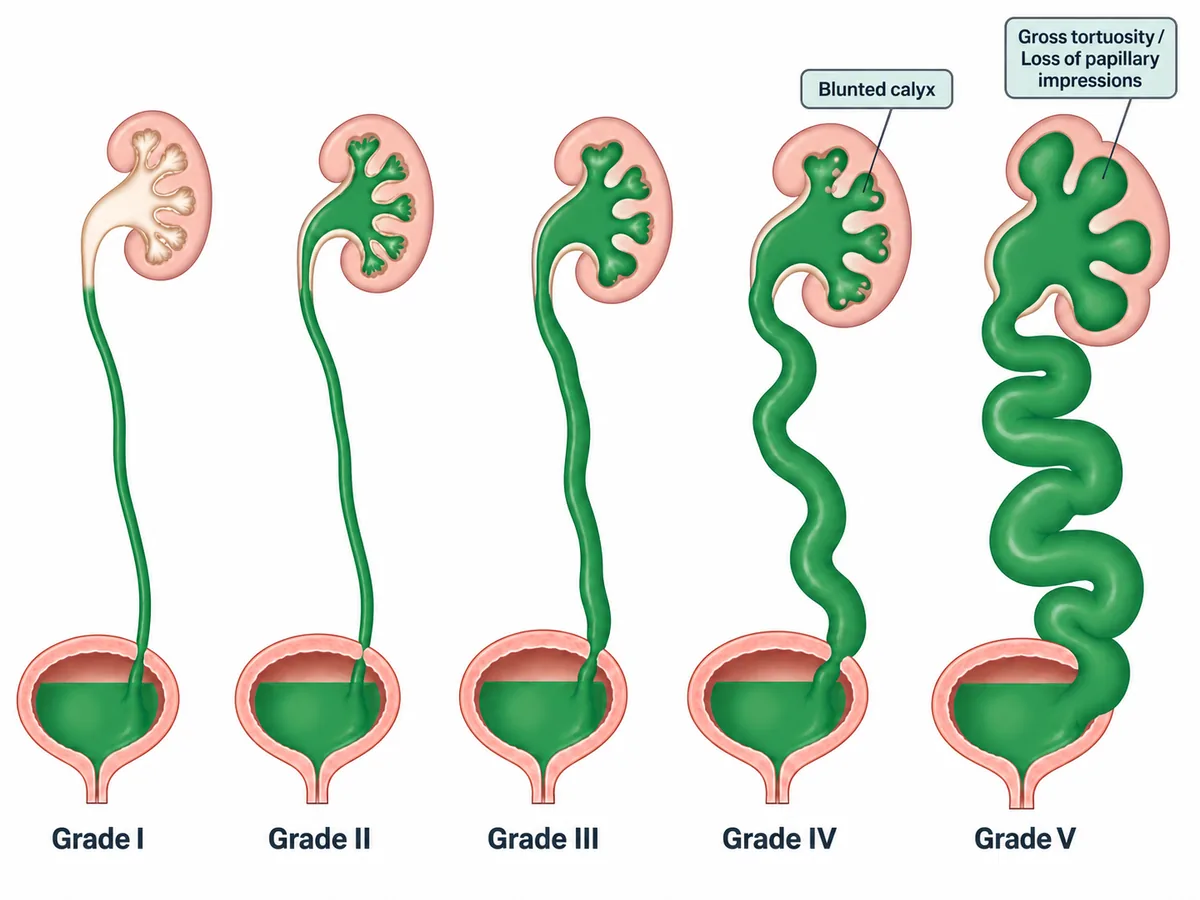
The micturating cystourethrogram grades reflux from I to V.
Grade I reaches the ureter only; grade II reaches the pelvis without dilatation.
Grade III adds mild dilatation; grade IV blunts the fornices.
Grade V is gross dilatation with a tortuous ureter and loss of papillary impressions.
Infected refluxing urine scars the kidney - reflux nephropathy.
Grading vesicoureteric reflux
Why not the others
- A. Posterior urethral valves; bladder outlet obstruction — occurs in boys and shows a dilated posterior urethra with a thick-walled trabeculated bladder.
- B. Low-grade reflux; no long-term consequence, so no follow-up is needed — misgrades the study and dismisses the risk. Blunted calyces are not low grade.
- C. Neurogenic bladder; urinary retention and overflow — would show a trabeculated bladder with a large residual volume and usually a neurological cause.
Remember
Reflux plus infection scars kidneys. Grade it, and protect it.
Go deeper
Low-grade reflux resolves spontaneously in most children as the intramural ureteric tunnel lengthens with growth.
DMSA scanning shows established scars; the micturating study shows the reflux itself, so the two answer different questions.
Antibiotic prophylaxis, endoscopic injection or ureteric reimplantation are the options, chosen by grade, age and the pattern of breakthrough infections.
Bailey & Love's Short Practice of Surgery, 28th ed. (CRC Press, 2023); Nelson Textbook of Pediatrics, 22nd ed. (Elsevier, 2024).